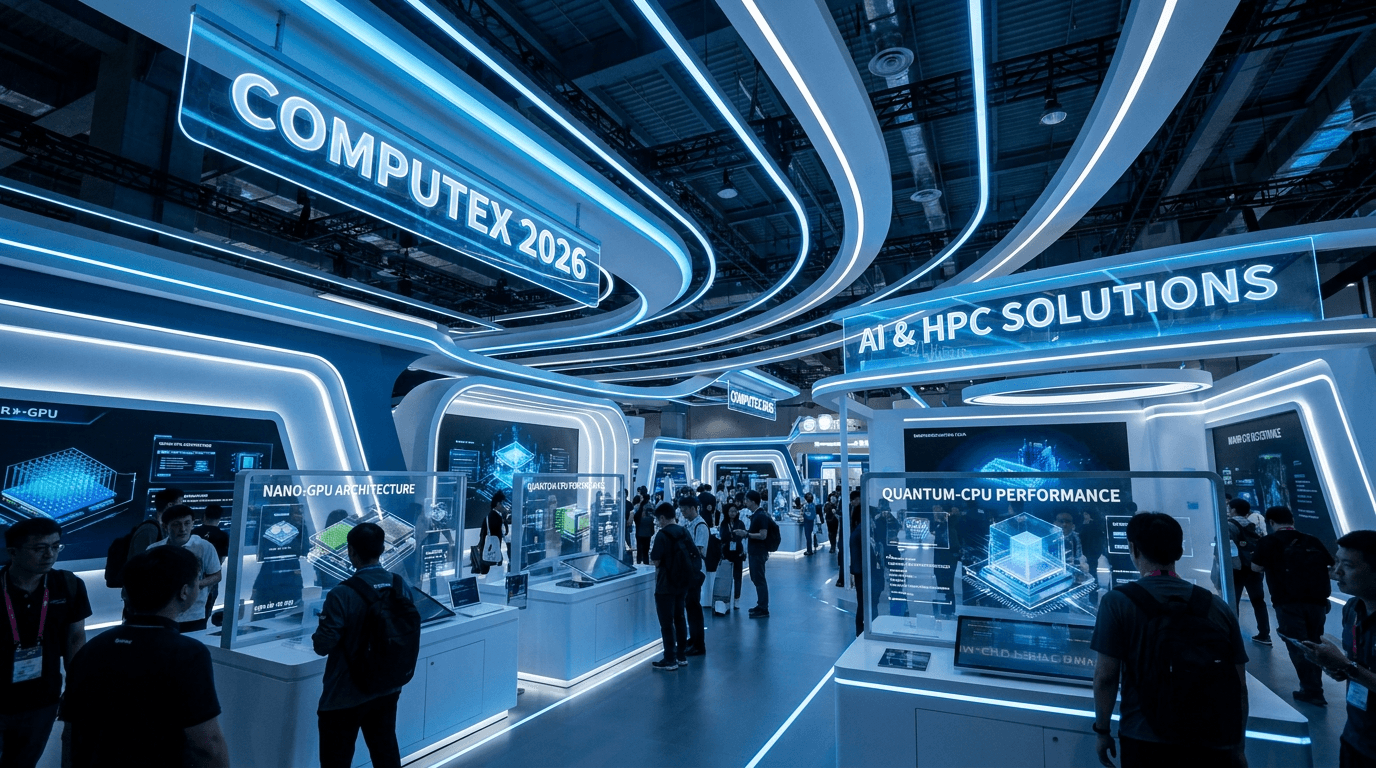
Computex just wrapped up in Taipei, and my feed has been flooded with press releases, benchmark slides, and breathless headlines about “revolutionary” hardware. I watched every major keynote, read through the spec sheets, and cross-referenced what Reddit’s tech communities actually cared about. Here’s the honest filter — the 10 announcements from Computex 2026 that will genuinely affect what you buy in the next 12 months.
On this page
- 1. AMD Zen 6 Desktop CPUs: The Architecture Leap We’ve Been Waiting For
- 2. NVIDIA RTX 6060: Finally, a Reasonable Mid-Range GPU
- 3. Intel’s Panther Lake Mobile Chips: Laptop Battery Life Gets Serious
- 4. DDR6 RAM: Overkill Today, Standard Tomorrow
- 5. USB4 Version 2.0 Hubs and Docks: 120Gbps Becomes Real
- 6. ASUS ROG Ally 2: The Steam Deck Competitor Gets Serious
- 7. Wi-Fi 7 Mesh Systems Under $200
- 8. Samsung’s 2TB microSD Card
- 9. Framework Laptop 16 (2nd Gen): Modular Gets Mainstream
- 10. On-Device AI Processing: Every Chip Maker Goes Local
- The Honest Summary
1. AMD Zen 6 Desktop CPUs: The Architecture Leap We’ve Been Waiting For
AMD’s Zen 6 (codenamed “Medusa”) is the biggest CPU architecture change since Zen 3. The move to TSMC’s 2nm process delivers a claimed 30% IPC improvement and 40% better power efficiency compared to Zen 5. That’s not marketing fluff — the on-stage demos showed a Zen 6 engineering sample matching Intel’s Arrow Lake i9 in multi-threaded workloads while consuming 65W less power.
What this means for you: if you’re currently on anything older than Zen 4 (Ryzen 7000 series), the Zen 6 launch in Q4 2026 will be worth waiting for. If you’re shopping for a programming laptop right now, current-gen hardware is still excellent — but desktop builders should hold off.
“The Zen 6 IPC numbers look real. AMD sandbagging on stage is actually a good sign — when they understate performance at Computex, the actual benchmarks usually exceed expectations.” — r/hardware
2. NVIDIA RTX 6060: Finally, a Reasonable Mid-Range GPU
After two generations of “mid-range” GPUs that cost $400+, NVIDIA announced the RTX 6060 at $299. It features 12GB of GDDR7 memory, full ray tracing support, and DLSS 5 with frame generation. The on-stage demo showed it running Cyberpunk 2077 at 1440p with ray tracing at 80+ FPS.
For anyone building a budget gaming setup, this is the card to wait for. The September 2026 launch date means current RTX 4060 prices should start dropping by August as retailers clear inventory.
3. Intel’s Panther Lake Mobile Chips: Laptop Battery Life Gets Serious
Intel’s Panther Lake mobile processors promise 25+ hours of real-world battery life in thin-and-light laptops. That sounds like marketing, but the architectural changes support it — the new hybrid core design uses dedicated ultra-low-power cores for background tasks while keeping the performance cores fully asleep. Intel showed a reference laptop streaming video for 28 hours continuously.
This matters because current budget laptops typically deliver 8-12 hours. If Panther Lake delivers even 70% of Intel’s claims in real products, we’re looking at laptops that genuinely last a full work day plus evening use on a single charge.
4. DDR6 RAM: Overkill Today, Standard Tomorrow
SK Hynix and Samsung both showed DDR6 modules running at 12,800 MT/s — roughly double the speed of current DDR5-6400. For most users, this won’t matter until DDR6 platforms launch in late 2027. But for content creators working with large video files and developers running local AI models, the bandwidth improvement is meaningful.
The practical takeaway: DDR5 is the smart buy right now and will remain so through 2027. Don’t let DDR6 hype prevent you from building a system today.
5. USB4 Version 2.0 Hubs and Docks: 120Gbps Becomes Real
The first USB4v2 docking stations were shown running at 120Gbps — enough to drive two 4K 144Hz monitors, a 10Gbps Ethernet connection, and charge your laptop at 240W simultaneously through a single cable. ASUS, CalDigit, and Anker all had working prototypes.
If you’re currently using a USB-C docking station and hitting bandwidth limits (dropped frames on external monitors, slow file transfers while docked), these USB4v2 docks arriving in Q1 2027 will solve that completely. Current Thunderbolt 4 docks remain the best option until then.
6. ASUS ROG Ally 2: The Steam Deck Competitor Gets Serious
The ROG Ally 2 features a Zen 6 APU with RDNA 4 integrated graphics, a 7-inch 1080p OLED display at 120Hz, and 24GB of LPDDR5X RAM. ASUS claims 3 hours of AAA gaming at native resolution — up from the original Ally’s painful 90-minute average.
The $399 price point (launching August 2026) puts it directly against the Steam Deck OLED at $399. Competition is good — expect Valve to respond with either a price cut or a hardware refresh by year’s end.
7. Wi-Fi 7 Mesh Systems Under $200
TP-Link, ASUS, and Netgear all showed Wi-Fi 7 mesh systems at the $150-200 price point. Last year, Wi-Fi 7 routers started at $300+ for a single unit. This price drop makes the mesh Wi-Fi upgrade genuinely accessible.
For most homes, Wi-Fi 6E routers are still perfectly adequate. But if you’re building new or have 50+ connected devices, the Wi-Fi 7 mesh systems at this price point are worth considering when they hit shelves in September.
8. Samsung’s 2TB microSD Card
Samsung showed a working 2TB microSD Express card. For perspective, that’s enough to store roughly 400 hours of 4K video or 500,000 RAW photos. The price wasn’t announced, but based on Samsung’s pricing history, expect $200-250 at launch.
This is immediately relevant for smartphone photographers, drone operators, and Nintendo Switch users who are tired of juggling storage. The microSD Express interface delivers read speeds up to 800MB/s — fast enough for direct 4K video recording.
9. Framework Laptop 16 (2nd Gen): Modular Gets Mainstream
Framework announced the second-generation Laptop 16 with Zen 6 options, a new GPU module based on RDNA 4, and a redesigned expansion bay that’s backwards-compatible with existing modules. The starting price drops to $1,199 — $200 less than the first generation.
For anyone who read our Framework Laptop Reddit review, this is the update the community was asking for. The original Laptop 16 was a proof of concept; this generation feels like a genuine product.
10. On-Device AI Processing: Every Chip Maker Goes Local
The most consistent theme across every Computex keynote was on-device AI processing. AMD, Intel, NVIDIA, Qualcomm, and MediaTek all showed demos of large language models running locally without internet. The pitch is privacy (your data stays on your device) and speed (no API latency).
Whether this matters to you depends on how you feel about AI-powered gadgets. The honest assessment: local AI is useful for specific tasks (photo editing, code completion, voice transcription) but won’t replace cloud-based AI for complex reasoning tasks anytime soon. Don’t buy hardware specifically for “AI features” — buy it for the traditional specs and consider AI capabilities a bonus.
The Honest Summary
Computex 2026 was heavy on AI marketing and light on genuinely new product categories. The real wins are incremental but meaningful: cheaper GPUs, longer laptop battery life, faster storage, and the slow march toward USB4v2. If you’re not in a rush, Q4 2026 through Q1 2027 is shaping up to be an excellent time to upgrade. If you need something now, current-gen hardware remains excellent — nothing announced at Computex makes today’s products obsolete.