
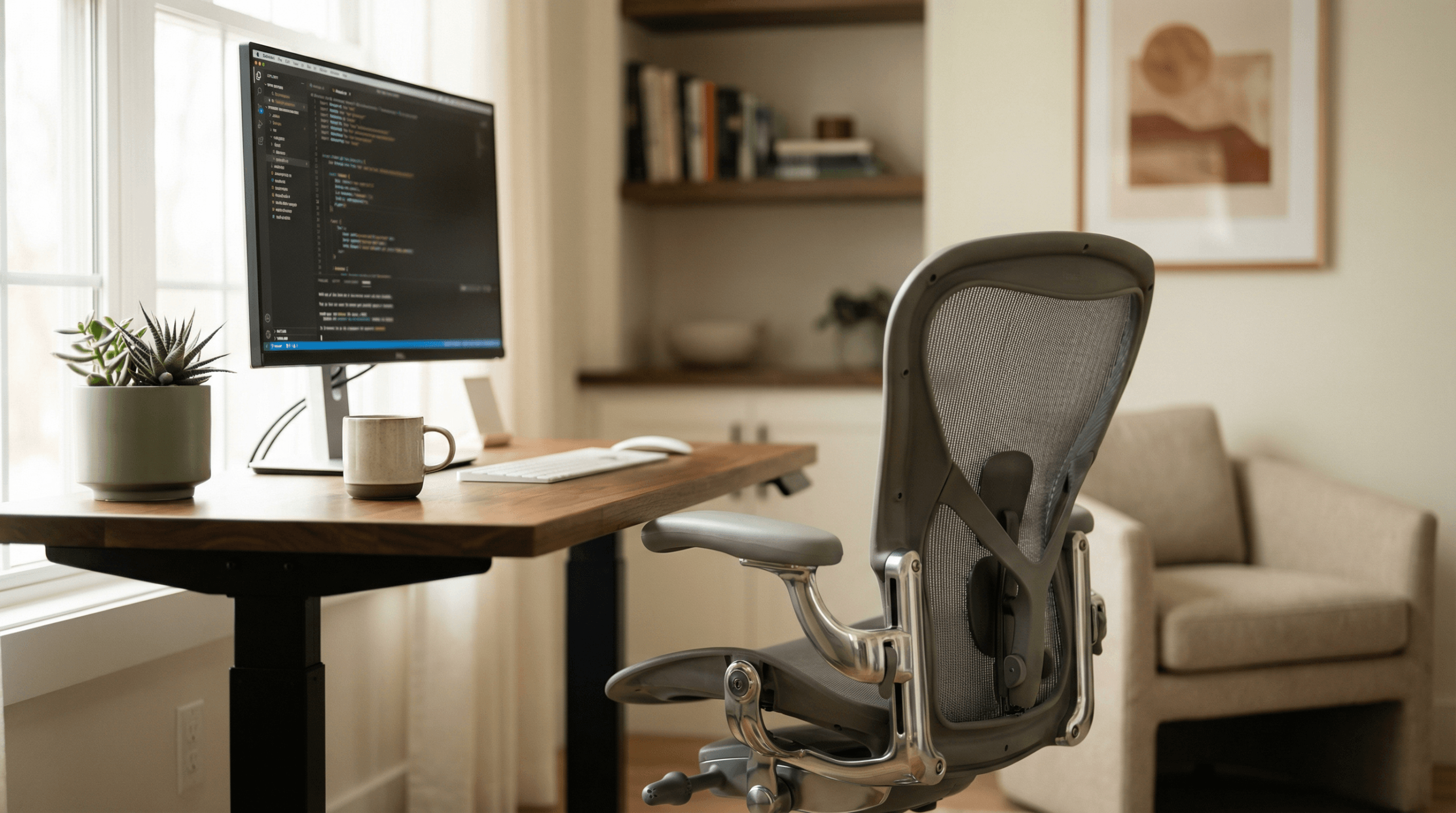
Let me tell you about the worst $89 I ever spent.
It was 2021. I’d just gone full-time remote, and I figured the dining chair situation was “temporary.” Three weeks later, my lower back felt like someone had taken a baseball bat to it. I was coding in 20-minute bursts, standing up, pacing around my apartment like a caged animal, then sitting back down to repeat the cycle. My chiropractor — who I was suddenly seeing twice a week — looked at me with genuine pity when I described my setup.
So I did what any reasonable person does: I bought a cheap “ergonomic” chair off Amazon. You know the type. Mesh back, questionable lumbar pillow held on by a single elastic strap, armrests that wobbled like a loose tooth. It lasted about four months before the hydraulic cylinder gave out and I found myself slowly sinking to floor level during a Zoom standup. My team lead thought I was doing a bit.
That chair radicalized me. Since then, I’ve spent an embarrassing amount of money and time testing office chairs — not because I’m some kind of seating enthusiast, but because when you spend 8 to 12 hours a day in a chair writing code, the chair is the most important piece of equipment you own. More important than your monitor. More important than your keyboard. I’ll die on this hill.
Over the past six months, I’ve been rotating through six chairs that represent the full spectrum of what’s available in 2026, from a $229 IKEA staple to the $1,395 Herman Miller that half of Reddit treats like a religious artifact. Here’s what I actually found.
On this page
- The Reddit Chair Wars: What 3 Years of Threads Taught Me
- Quick Verdict: All 6 Chairs Ranked
- Herman Miller Aeron Remastered (~$1,395) — The Gold Standard
- Steelcase Leap V2 (~$1,049) — The Programmer’s Secret Weapon
- Secretlab Titan Evo 2026 (~$549) — The Gaming-Office Hybrid
- Branch Ergonomic Chair (~$349) — Best Mid-Range Value
- HON Ignition 2.0 (~$299) — The Budget Sleeper Pick
- IKEA Markus (~$229) — The “Good Enough” Starter
- What Reddit Gets Wrong About Chairs
- My Setup and Final Recommendation
- FAQ
The Reddit Chair Wars: What 3 Years of Threads Taught Me
If you’ve spent any time on r/programming, r/homeoffice, r/ergonomics, or r/battlestations, you already know that chair discussions generate more heat than tabs-vs-spaces debates. And they follow predictable patterns.
Camp one: the Herman Miller devotees. These folks will tell you the Aeron pays for itself in avoided medical bills, that the 12-year warranty makes it cheaper per year than anything else, and that buying a used one is the ultimate life hack. They’re not entirely wrong.
Camp two: the Secretlab defenders. Usually younger devs or people who also game. They’ll post battlestation photos with RGB everything and swear the Titan is just as good as chairs costing twice as much. They get downvoted a lot in r/ergonomics but hold strong in r/battlestations.
Camp three: the contrarians. “Just buy a used Steelcase Leap for $300 on Facebook Marketplace.” This is genuinely solid advice, but it assumes you live somewhere with a robust used office furniture market, which not everyone does.
Camp four: the budget warriors. “The IKEA Markus is 90% as good as a Herman Miller.” This is… a stretch. But I understand the impulse.
I’ve read hundreds of these threads over the years, and the biggest problem is that most people have only ever owned one or two chairs. They’re comparing their current chair to their previous terrible chair, and of course the upgrade feels life-changing. That doesn’t make it the best option. So I figured I’d just test all the popular picks head-to-head. For science. And for my spine.
Quick Verdict: All 6 Chairs Ranked
| Rank | Chair | Price | Best For | My Rating |
|---|---|---|---|---|
| 1 | Steelcase Leap V2 | ~$1,049 | All-day coding sessions | 9.3/10 |
| 2 | Herman Miller Aeron Remastered | ~$1,395 | Hot environments, lean sitters | 9.0/10 |
| 3 | Secretlab Titan Evo 2026 | ~$549 | Devs who also game | 8.1/10 |
| 4 | Branch Ergonomic Chair | ~$349 | Mid-budget remote workers | 7.8/10 |
| 5 | HON Ignition 2.0 | ~$299 | Budget-conscious buyers | 7.5/10 |
| 6 | IKEA Markus | ~$229 | Starter chair, light use | 6.9/10 |
Now let me explain why.
Herman Miller Aeron Remastered (~$1,395) — The Gold Standard
What Reddit says:
“Bought a used Aeron for $400. Best purchase of my life. My back pain is completely gone.” — r/homeoffice
“Overpriced. You’re paying for the brand name at this point.” — r/programming
My actual experience:
The Aeron is a genuinely excellent chair, and I completely understand why it dominates these conversations. The mesh is still best-in-class — it breathes beautifully, distributes weight evenly, and after six months of testing still shows zero signs of sagging. The PostureFit SL lumbar system is the real star here. It supports both your lumbar and sacral regions independently, and once you dial it in, you kind of forget you’re sitting in a chair at all. That’s the highest compliment I can pay.
The build quality is absurd. Everything feels machined, precise, deliberate. The tilt mechanism is smooth. The armrests adjust in every direction you’d want.
Who it’s best for: People who run warm (the mesh is unbeatable for airflow), lean-to-average body types who fit the size B, and anyone who views this as a decade-long investment.
One honest complaint: You have to pick a size (A, B, or C), and if you’re between sizes, you’re out of luck. I’m right on the border of B and C, and the size B felt slightly narrow after long sessions. Also — and this is personal — I just don’t love sitting on mesh. It’s supportive, but it doesn’t feel comfortable in the way a cushioned seat does. There’s a difference, and after testing all six, I landed on the side that prefers cushion.
Steelcase Leap V2 (~$1,049) — The Programmer’s Secret Weapon
What Reddit says:
“The Leap is what ergonomists actually recommend. The Aeron is what designers recommend.” — r/ergonomics
“I switched from an Aeron to a Leap and I’m never going back. The flexible backrest is on another level.” — r/programming
My actual experience:
This is my number one pick, and it isn’t particularly close. The Leap’s LiveBack technology — where the backrest flexes and adjusts to mimic the movement of your spine — is something you have to experience to appreciate. I’ve caught myself unconsciously shifting positions throughout the day, and the chair just follows. With the Aeron, I felt like I needed to sit “correctly” for the chair to work. With the Leap, the chair adapts to however I’m sitting.
The seat cushion is dense foam that’s held up perfectly over months of testing. The armrests are the best of any chair I’ve tested — 4D adjustment with a sliding mechanism that actually stays put. The upper back force control is a feature I didn’t think I’d care about, and now I consider it essential.
I paired this with the standing desk from my productivity desk setup guide and the combination is genuinely transformative for long coding days.
Who it’s best for: Programmers who shift positions frequently, anyone in the average-to-large build range, and people who prioritize function over aesthetics. The Leap is not a pretty chair. It looks like it belongs in an accounting firm. I don’t care even a little.
One honest complaint: The base model fabric attracts lint and pet hair like a magnet. If you have a cat, budget an extra $50-80 for the upgraded fabric. Also, at $1,049, this isn’t cheap — though it’s $350 less than the Aeron, which counts for something.
Secretlab Titan Evo 2026 (~$549) — The Gaming-Office Hybrid
What Reddit says:
“People trash Secretlab because it’s a ‘gaming brand’ but the Titan Evo is legitimately a good office chair.” — r/battlestations
“It’s fine for 4-5 hours. For 8+ hour days, get a real ergonomic chair.” — r/homeoffice
My actual experience:
I went into this test expecting to confirm my biases against gaming chairs. I didn’t, entirely. The 2026 Titan Evo is a meaningful step up from earlier models. The integrated lumbar system with the magnetic memory foam headrest pillow is clever and works well. The 4D armrests are solid — not Steelcase solid, but solid. The cold-cure foam seat is comfortable for the first several hours.
Here’s where it gets complicated: past the six-hour mark, I started feeling it. The seat pan is relatively flat and firm, and my sit bones were not happy by end of day. The lumbar support, while adjustable, doesn’t have the dynamic flexibility of the Leap or Aeron — it pushes, but it doesn’t move with you. For a mixed-use chair where you’re coding for four hours and gaming for three, it’s genuinely great. For marathon debugging sessions, I wanted more.
Who it’s best for: Developers who also game, people who care about aesthetics (it comes in roughly 900 color options), and anyone who wants solid ergonomics without crossing the $600 threshold.
One honest complaint: The recline function is smooth, but the chair doesn’t lock well in intermediate tilt positions. It’s either upright or fully reclined. For the way most programmers sit — slightly reclined, maybe 100-110 degrees — this is a real limitation.
Branch Ergonomic Chair (~$349) — Best Mid-Range Value
What Reddit says:
“Branch is the DTC brand that actually delivers. Solid chair for the price.” — r/homeoffice
“It’s not going to blow your mind but there’s nothing wrong with it either.” — r/programming
My actual experience:
Branch has been quietly building a solid reputation, and the Ergonomic Chair is their flagship for good reason. At $349, you get adjustable lumbar depth, seat depth adjustment, and 2D armrests — features that some chairs at twice the price skip. The mesh back is breathable and reasonably supportive. The overall build quality feels like a $500 chair that someone decided to sell for less.
It’s not going to compete with the Steelcase or Herman Miller in terms of all-day comfort — by hour seven or eight, I was reaching for the lumbar adjustment more often than I’d like. But for the vast majority of people who work six-to-seven-hour days with breaks, this chair does everything you need.
If you’re building out your remote work tech setup on a reasonable budget, this is where I’d allocate the chair portion of the spend.
Who it’s best for: Remote workers spending $300-$400, people who want genuine ergonomic adjustability without the premium price, and anyone upgrading from a terrible chair who doesn’t want to go all-in yet.
One honest complaint: The armrests are the weak link. They only adjust up/down and in/out — no forward/back or pivot. For a chair that gets everything else right at this price, the armrests feel like where they cut the budget.
HON Ignition 2.0 (~$299) — The Budget Sleeper Pick
What Reddit says:
“Nobody talks about HON but their stuff is built like tanks. Office furniture companies have been buying these for decades.” — r/homeoffice
My actual experience:
HON is the brand your office manager buys in bulk, and there’s a reason for that. The Ignition 2.0 isn’t exciting — it won’t show up in anyone’s battlestation photo. But it’s well-built, reasonably comfortable, and comes with a limited lifetime warranty that actually means something because HON is a commercial furniture company that’s been around since 1944.
The seat cushion is surprisingly good for the price. The lumbar support is fixed but positioned well for average builds. The synchro-tilt mechanism is smooth. It’s just… competent. Relentlessly, boringly competent.
I used this for a full three-week stretch, and while I missed the adjustability of the pricier chairs, I never had a day where my back was angry at me. That’s more than I can say for the Markus.
Who it’s best for: Budget buyers who want something that will last 5-plus years without fuss, people who don’t want to tinker with 15 adjustment knobs, and anyone furnishing a home office on a real-world budget.
One honest complaint: It looks like an office chair from 2014. If aesthetics matter to you — and when your chair appears in the background of every video call, maybe they should — this is a tough sell.
IKEA Markus (~$229) — The “Good Enough” Starter
What Reddit says:
“The Markus is the best chair under $300, period. I’ve had mine for 5 years.” — r/battlestations
“It’s fine until you sit in an Aeron. Then you can never go back.” — r/ergonomics
My actual experience:
The Markus has a cult following that I think is about 60% deserved. It’s tall-back, so it supports your upper back and head — something the Branch and HON don’t do. The leather-look version is surprisingly decent looking. At $229, it’s accessible to almost everyone.
But here’s the thing: the lumbar support is essentially non-existent. There’s a slight curve in the backrest, and that’s it. No adjustment. After my testing period, the Markus was consistently the chair where I’d stand up feeling the stiffest. The seat cushion also compressed noticeably over just a couple months of heavy use.
If you’re a student or early-career dev and this is what you can afford, it’s fine. It’s way better than a dining chair. But the gap between this and the HON Ignition 2.0 at just $70 more is significant, and the gap between this and the Branch at $120 more is enormous.
Who it’s best for: Students, people furnishing their first home office, anyone who needs a chair right now for under $250.
One honest complaint: The fixed armrests are too wide for most people when typing. I ended up resting my forearms on them for reading but had to move my arms inside them for typing. It’s an ergonomic compromise that bothers me more than it should.
What Reddit Gets Wrong About Chairs
After reading thousands of comments and testing these chairs myself, here are the takes I think the hive mind gets wrong:
“Buy used, always.” Buying a used Aeron or Leap is great advice if you can inspect it in person, verify the manufacture date, and confirm all the adjustments still work. But I’ve seen people on r/programming recommend buying used from random Craigslist sellers like it’s risk-free. Hydraulic cylinders wear out. Mesh stretches. Foam compresses. A 10-year-old “gently used” Aeron might be worse than a new Branch. Know what you’re getting.
“Expensive chairs are always worth it.” The Steelcase Leap is a $1,049 chair, and I think it’s worth every penny. But I’ve also tested $1,500-plus chairs that were no better than the Branch at $349. Price and quality correlate, but it’s not a straight line.
“Gaming chairs are garbage.” This was true five years ago. The 2026 Titan Evo is a legitimate ergonomic option. Not the best, but not garbage. The internet moves slower than products do.
“You don’t need a headrest.” If you ever recline — to read documentation, watch a tech talk, or just think — a headrest matters. The lack of one on the Leap is actually my single biggest gripe with my top pick. I ended up adding an aftermarket headrest, and it made a real difference.
My Setup and Final Recommendation
My daily driver is the Steelcase Leap V2, paired with the sit-stand desk and ultrawide monitor from my coding monitor guide. The chair sits at my desk roughly 10 hours a day, and after six months, I have zero complaints about comfort and zero signs of wear.
But here’s my honest framework for deciding:
- Over $1,000 budget and you run hot? Get the Aeron. You won’t regret it.
- Over $1,000 budget and you want the best all-around? Get the Leap. I’d bet my back on it. Literally.
- $500-$600 budget? The Titan Evo 2026 is a strong pick, especially if you game too.
- $300-$400 budget? The Branch Ergonomic Chair is the clear winner here.
- Under $300? The HON Ignition 2.0 over the Markus, every time.
Whatever you pick, the single most important thing is that you actually adjust it properly. Set the seat height so your feet are flat, adjust the lumbar to the natural curve of your lower back, and position the armrests so your shoulders stay relaxed while typing. A $1,400 Aeron set up wrong will hurt you more than a $300 HON set up right.
Your back is the one piece of hardware you can’t RMA. Take care of it.
FAQ
How long did you test each chair?
Each chair got a minimum of three weeks as my daily driver. The Steelcase Leap and Herman Miller Aeron each got about two months because they were the obvious top contenders and I wanted to see how they held up over time.
Should I buy a used Herman Miller Aeron?
If you can get a certified refurbished model from an authorized dealer, absolutely — it’s one of the best value plays in office furniture. If you’re buying from a random person online, inspect it in person first. Check the mesh for sagging, test every adjustment, and make sure the tilt mechanism is smooth. Manufacture date is on a sticker under the seat.
Are gaming chairs bad for programming?
Not inherently, but most gaming chairs under $400 prioritize looks over ergonomics. The Secretlab Titan Evo 2026 is the exception I’d recommend. Avoid anything with “racing style” in the description and a bucket seat design — that shape makes zero sense for someone sitting at a desk.
What about standing desks — do I still need a good chair?
Yes. Even dedicated standing desk users typically sit for 50-70% of their workday. Standing all day brings its own problems. The ideal setup is a sit-stand desk with a good chair, alternating throughout the day. I cover this in more detail in my desk setup guide.
Is it worth spending over $1,000 on a chair?
If you work from home full-time and spend 7-plus hours a day sitting, I genuinely believe yes. The difference between a $300 chair and a $1,000 chair after eight hours is not subtle — it’s the difference between feeling fine and feeling beaten up. That said, the Branch at $349 gets you 80% of the way there, so the value equation depends on your budget and how many hours you’re in the seat.