It was day nine in Vietnam, somewhere between Hoi An and Da Nang, when I realized my Baseus power bank had silently died. Not “ran out of charge” died — died died. The LED indicators wouldn’t turn on. The USB-C port produced nothing. This was the same power bank that had been working flawlessly in my air-conditioned apartment for months. Turns out, forty-eight hours riding in the side pocket of a backpack in 38°C humidity is a different test than sitting on a nightstand in Chicago.
That moment — standing outside a pagoda with a dead phone, no offline map, and exactly zero Vietnamese language skills — is why I take power bank reviews personally now. The stakes are low at home. Plug it in, it charges your phone, whatever. On the road, in an unfamiliar country, your power bank is genuinely important. It’s your map, your translator, your boarding pass, your emergency contact. It needs to work.
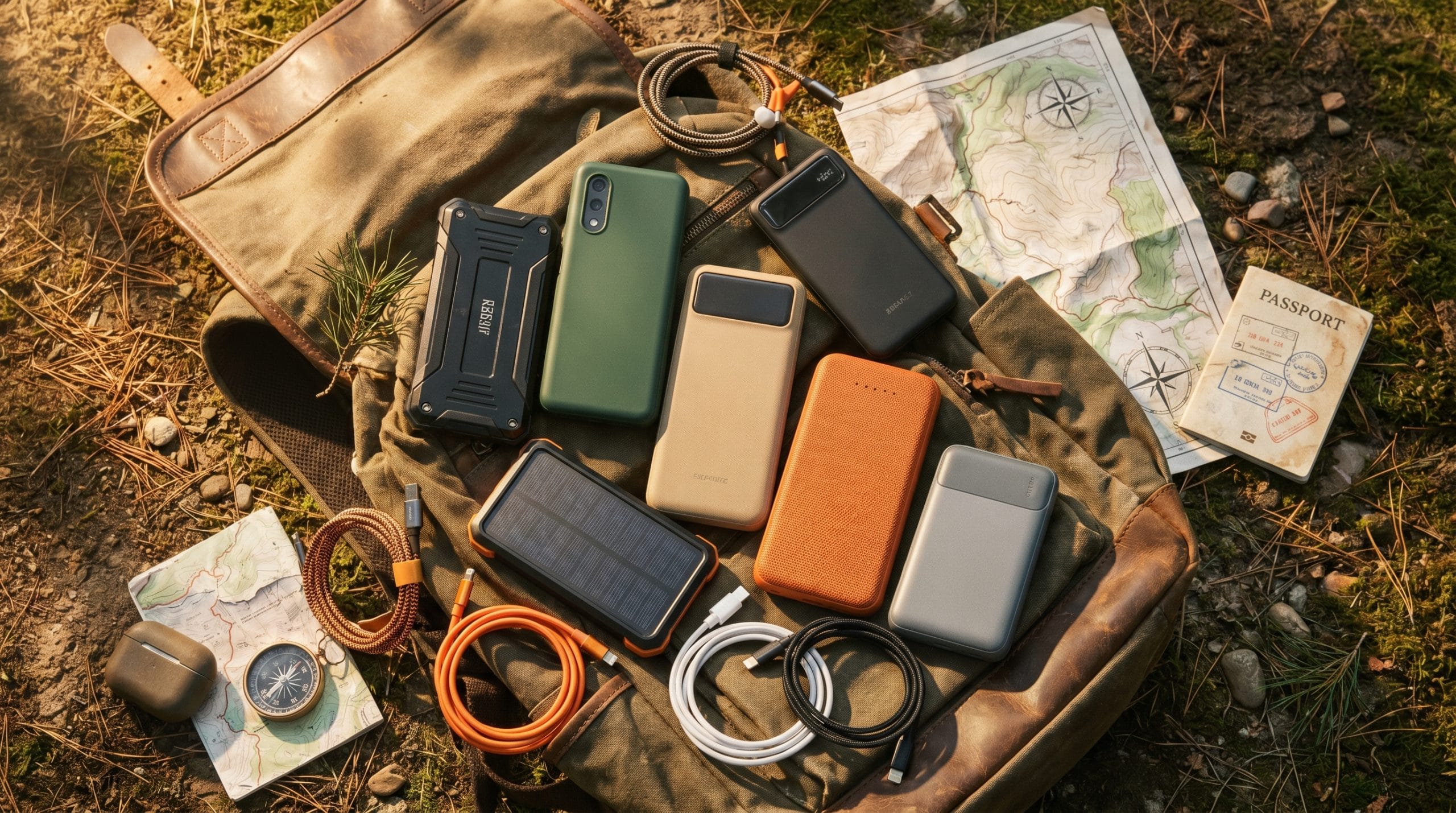
So I did what any reasonable person would do: I packed five of the most popular power banks on the market and took them on a fourteen-day trip through Vietnam and Thailand. Different brands, different capacities, different price points. Same tropical heat, same dust, same backpack. Here’s what survived.
On this page
The Contestants
- Anker Prime 27,650mAh (~$130) — The premium heavyweight. 250W total output, built-in display.
- Baseus Blade 2 20,000mAh (~$56) — Ultra-slim laptop charger, 140W output.
- Ugreen 25,000mAh (~$50) — The mid-range workhorse, 145W output.
- BioLite Charge 80 PD 20,000mAh (~$70) — The outdoor/adventure brand pick.
- Shargeek Storm 2 Slim 20,000mAh (~$60) — The one with the transparent case and real-time power display.
Yes, carrying five power banks through airport security was exactly as fun as you’d imagine. TSA flagged my bag in San Francisco. Bangkok security pulled me aside for a polite but thorough conversation. All five are under the 100Wh limit (critical for flights), but five of them stacked together apparently looks exciting on an X-ray.
Week One: Everything Works When It’s New
Days 1-4 in Ho Chi Minh City. Air conditioning exists. I’m charging everything overnight in the hotel. The weather is hot but manageable when you’re ducking between taxis and malls.
All five power banks performed as expected. The Anker Prime was obscenely fast — my iPhone 17 Pro went from 15% to 80% in about 25 minutes. The Shargeek’s transparent case and real-time wattage display made me feel like a person who understood electricity (I barely do). The Baseus Blade 2 kept my MacBook Air alive during a seven-hour café session when every outlet was taken. The Ugreen and BioLite both quietly did their job.
I was starting to think this article would be boring. They all work! Five stars! Buy whichever one is cheapest!
Then we went north.
Week Two: When the Heat Hit
Days 7-14. Hoi An, Da Nang, and then Bangkok. Temperatures between 35-40°C. Humidity that makes your phone screen fog up when you walk outside from an air-conditioned room. My power banks lived in the side pocket of a Cotopaxi Allpa 35L — exposed to indirect sun, radiant heat, and the kind of sticky warmth that makes you question life choices.
The Baseus died on day 9. Just stopped working. No output from any port. The unit itself was warm to the touch — not hot, but warmer than it should have been powered off. I suspect the BMS (battery management system) triggered a permanent protection shutdown. Baseus’s support later confirmed this was “outside normal operating conditions.” Forty degrees is outside normal? In Southeast Asia? That’s a Tuesday.
The BioLite degraded noticeably. By day 11, the same full charge that gave me 4+ iPhone charges in week one was delivering about 3.2. The charge rate also slowed — the phone was pulling 12-15W instead of the 20W I’d seen in the hotel. It still worked, but the capacity loss was real. BioLite sells this as an “adventure” power bank. Apparently the adventure shouldn’t involve actual tropical weather.
The Anker Prime, Ugreen, and Shargeek all survived without issues. The Anker got warm during fast charging in the heat but never throttled. The Ugreen was a tank — consistent output, no complaints. The Shargeek’s display let me monitor real-time temperatures, which stayed below 42°C internally even in the worst conditions.
Quick Verdict: The Final Scorecard
| Power Bank | Capacity | Weight | iPhone 17 Charges* | Max Output | Survived? | Price |
|---|---|---|---|---|---|---|
| Anker Prime 27,650mAh | 27,650mAh | 600g | 5.8 | 250W | Yes | ~$130 |
| Ugreen 25,000mAh | 25,000mAh | 535g | 5.2 | 145W | Yes | ~$50 |
| Shargeek Storm 2 Slim | 20,000mAh | 410g | 4.1 | 100W | Yes | ~$60 |
| BioLite Charge 80 PD | 20,000mAh | 470g | 3.2 (degraded) | 100W | Degraded | ~$70 |
| Baseus Blade 2 | 20,000mAh | 380g | 0 (dead) | 140W | No | ~$56 |
*Full charges from 0-100% measured during trip.
The Reviews
Anker Prime 27,650mAh — The Beast That Doesn’t Quit
The Anker Prime is heavy, expensive, and ugly. I love it. The 250W output means it charges a MacBook Air at full speed, and it can charge three devices simultaneously without breaking a sweat. The small display shows real-time wattage, temperature, and estimated time remaining — genuinely useful data, not gimmick.
The weight (600g) is the trade-off. In a backpack for two weeks, you feel every gram. But the Anker was the only power bank I trusted enough to charge my laptop from in a pinch, which saved me twice when cafés had no available outlets.
Buy this if: You travel with a laptop and need serious charging power. The price hurts, but it’s the most reliable unit I’ve tested.
Ugreen 25,000mAh — The Boring Hero
Nobody talks about Ugreen power banks. There are no unboxing videos with dramatic music. The packaging is forgettable. The design is a gray rectangle. And it worked perfectly for fourteen days in tropical heat without a single hiccup.
At $50, the Ugreen delivered more consistent charge cycles than the BioLite at $70 and the Baseus at $56. It’s not fast enough to charge a MacBook at full speed, but for phones, tablets, earbuds, and Kindles? Rock solid.
“I’ve had the Ugreen 25K for a year. It’s been to three countries, through two TSA screenings, and dropped off a hotel nightstand. Still works exactly like day one. It’s the Toyota Camry of power banks.” — u/frequent_flyer_jared, r/onebag
Buy this if: You want the best value. Period.
The transparent case is a gimmick. I knew that going in. But it’s a fun gimmick, and the real-time display showing voltage, amperage, wattage, and internal temperature turned out to be genuinely useful. I could see exactly when heat was affecting performance (it mostly wasn’t).
Performance was solid. Four full iPhone charges, consistent output, no heat-related degradation. At $60, it’s a good middle ground between the Ugreen’s value and the Anker’s premium.
Buy this if: You want reliability with a conversation-starting design, and 20,000mAh is enough for your needs.
BioLite Charge 80 PD — Not As Tough As It Looks
BioLite markets this as outdoor adventure gear. The rubberized casing looks rugged. The branding screams “I hike.” But the internal cells degraded noticeably after sustained heat — losing roughly 20% of effective capacity over two weeks.
The charging speed throttled more aggressively in heat than the Anker or Ugreen. It went from 20W to 12-15W above 35°C. For temperate climates, it’s probably fine. For tropical travel? The Ugreen is $20 cheaper and handled the heat better. If you want gear that’s genuinely built tough, check our approach to finding honest products in the overhyped tech roundup.
Baseus Blade 2 — The One That Died
The Blade 2 has a lot going for it on paper: 140W output, incredibly slim profile (16mm thick), 380g weight. It’s the lightest unit here. At home, it worked great. It didn’t survive the trip.
The ultra-slim design means minimal thermal mass — no room for heat to dissipate. In sustained ambient heat, the BMS killed the unit permanently. I can’t recommend spending $56 on something that might die when you need it most.
“The Baseus Blade is amazing in an air-conditioned office. It’s terrible in a backpack in the sun. Ask me how I know.” — u/digital_nomad_fail, r/digitalnomad
What I Learned About Power Banks the Hard Way
Heat is the enemy. Lithium cells degrade faster in sustained heat. Keep your power bank in the main compartment (insulated by clothes), not an exterior pocket exposed to sun.
Airline limits are real. Anything over 100Wh requires airline approval. All five reviewed here are under the limit. Two power banks per person is the standard allowance.
The cable matters as much as the bank. A cheap USB-C cable maxed out at 15W regardless of the power bank. A good 100W-rated cable from Anker or Ugreen costs $10-15 and delivers full speed. Our USB-C guide covers what to look for.
Capacity ≠ usable energy. Voltage conversion and heat loss eat 20-30% of rated capacity. A 25,000mAh bank delivers roughly 17,500-20,000mAh of actual usable charge.
Charge before the airport. Some airlines and security checkpoints can ask you to turn on your power bank to prove it’s functional. A dead power bank could be confiscated.
FAQ
How many times will a 20,000mAh power bank charge my phone?
Roughly 3.5-4.5 times for a modern flagship phone (iPhone 17, Galaxy S25), accounting for conversion losses. Marketing claims of “5+ charges” assume older phones with smaller batteries and ignore efficiency losses.
Can I bring a power bank on a plane?
Yes, but only in carry-on luggage (never checked bags). Most airlines allow up to 100Wh without approval. Power banks between 100-160Wh may require airline approval. Above 160Wh is generally prohibited.
Do power banks lose charge when not in use?
Yes. Expect 1-3% loss per month from self-discharge. Store them at 50-60% charge for best long-term health.
Is it bad to charge my phone and the power bank simultaneously?
Most support “pass-through charging.” It works but generates extra heat, accelerating wear. Fine occasionally; I wouldn’t do it daily.
How long do power banks last before needing replacement?
Most last 500-800 full charge cycles before noticeable degradation. For average use (2-3 charges per week), that’s roughly 3-5 years.