
CheckPet · cat litter
Best cat litter for multiple cats
The best multi-cat setup starts with enough boxes and fast scooping—not a stronger fragrance. Count your cats, calculate the boxes you can maintain, then choose clumping speed, scent, material, and bag weight.
On this page
What matters most in a multi-cat litter?
Choose a litter your cats accept that forms scoopable clumps before waste breaks apart. In a multi-cat home, box count and cleaning frequency usually matter more than a “multi-cat” label. Unscented litter is the safer starting point when cats have different scent preferences; fragrance can mask odor for people without making a dirty box more acceptable to cats.
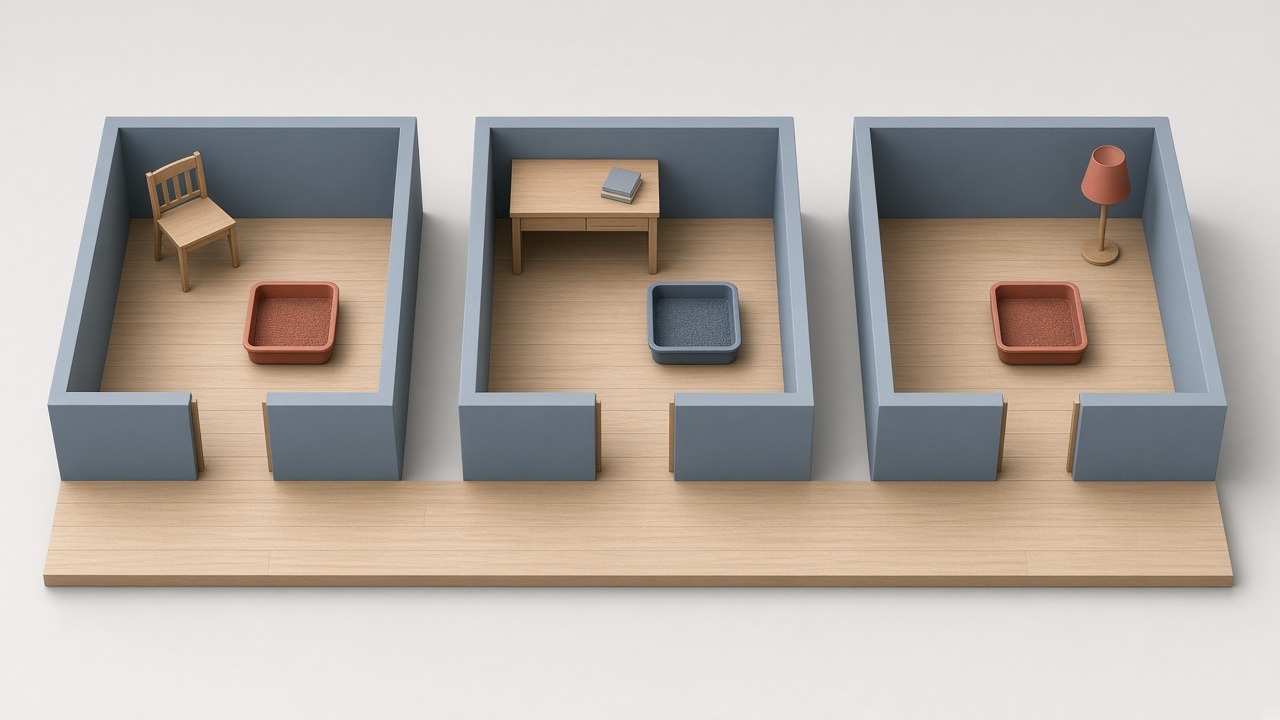
One giant box is not the same as several boxes. Cats need more than capacity: they need a route that cannot be guarded by another cat. Spread boxes across different rooms or levels where possible, rather than lining every box side by side.
Measure before you buy
| Box count | Start with the common n + 1 rule: 2 cats → 3 boxes; 3 cats → 4 boxes. Adjust for space, health, and individual preference. |
|---|---|
| Box placement | Use separate, quiet locations with more than one escape route. Side-by-side boxes can function like one resource to cats. |
| Usable box length | A practical starting point is about 1.5× the cat’s nose-to-tail-base length, excluding a high hood or unusable entry area. |
| Litter depth | Begin around 3–4 inches for clumping litter, then follow cat preference and the product or box instructions. |
| Scoop interval | Scoop every box at least daily; busy boxes may need twice-daily checks. Do not buy stronger scent to replace cleaning. |
| Bag handling | The verified options below run from 17.5 to 40 lb. Choose a package you can pour, seal, and store safely. |
| Automatic-box fit | Check permitted material and granule size in the box manual. “Clumping” and “multi-cat” do not guarantee compatibility. |
Multi-cat litter comparison
These are real Amazon product pages checked on October 9, 2026. We compare format and household fit; CheckPet did not independently lab-test odor duration, dust, or tracking, and we do not repeat star ratings or volatile prices.
| Option | Best fit | Check before buying | Amazon |
|---|---|---|---|
| Dr. Elsey’s Ultra 40 lb, unscented clumping clay | Unscented baseline for homes that prioritize firm clumps | Heavy package; confirm every cat accepts clay | View on Amazon |
| Fresh Step Advanced Heavy Duty Multi Cat 17.5 lb, clumping clay | Smaller package for shoppers prioritizing a multi-cat odor-control formula | Verify scent and exact variant; fragrance preference differs by cat | View on Amazon |
| Purina Tidy Cats 24/7 Performance 38 lb box, clumping clay | Large-box comparison for a frequently scooped multi-cat routine | Confirm package format and scent before checkout | View on Amazon |
| World’s Best Multiple Cat Unscented 32 lb, plant-based clumping litter | Unscented non-clay comparison for cats that accept the texture | Transition gradually; verify automatic-box compatibility | View on Amazon |
Best when / skip if
- Every cat already accepts the selected texture
- You can provide several accessible boxes
- You will scoop at least daily
- You can lift and store the chosen bag safely
- You are trying to solve conflict with one shared box
- A cat avoids fragrance, clay, or the current box style
- Your automatic box forbids the material
- Straining, blood, or sudden elimination changes are present
Set up litter for more than one cat
- Map the resources. Count cats and boxes, then mark whether another cat can guard each entrance.
- Add capacity before fragrance. Add a box in a separate useful location before switching to a stronger scent.
- Keep one familiar box. When changing litter, test the new material in one box while leaving another familiar option available.
- Scoop on a fixed schedule. Check at least daily and note which boxes fill fastest; that reveals location preference.
- Compare one variable at a time. Change litter, depth, or placement separately so you can identify what helped.
- Deep-clean without perfume. Follow the box maker’s instructions and avoid leaving a strong cleaner residue.
Common failures
- One oversized box for several cats. It adds volume but does not provide a second safe location.
- All boxes in one row. One cat can control the entire resource area.
- Using fragrance as maintenance. Scent does not remove waste or make a dirty box more acceptable.
- Choosing by bag price alone. A 40 lb package is poor value if it is unsafe to lift or impossible to store dry.
- Replacing every box at once. A sudden texture change can create avoidance and makes the cause hard to identify.
Frequently asked questions
How many litter boxes do two cats need?
A common starting point is three boxes—one per cat plus one extra—placed in separate useful locations. Individual cats, home layout, mobility, and conflict can change what works.
Is scented litter better for multiple cats?
Not automatically. Fragrance can be unpleasant to some cats and does not replace scooping. Start with cat acceptance, clumping, box count, and cleaning routine; choose scent only if every cat tolerates it.
Can all boxes use the same litter?
They can if every cat accepts it. During a transition, keep at least one familiar box and test the new litter separately. Cats with different preferences may need different substrates.
Will multi-cat litter stop tracking?
No. “Multi-cat” usually describes odor or clumping positioning, not a tracking guarantee. For granule size, mats, and exit-path setup, use our low-tracking litter guide.
Related guides
Editorial standards · Affiliate disclosure · Not veterinary advice.