
CheckPet · automatic litter-box decision guide
Best self-cleaning litter boxes: choose by fit, not features
A machine can cost hundreds of dollars and still be wrong for your cat. Start with entrance and interior space, then check floor clearance, litter compatibility, return terms, and the work required to deep-clean it. App features come last.
On this page
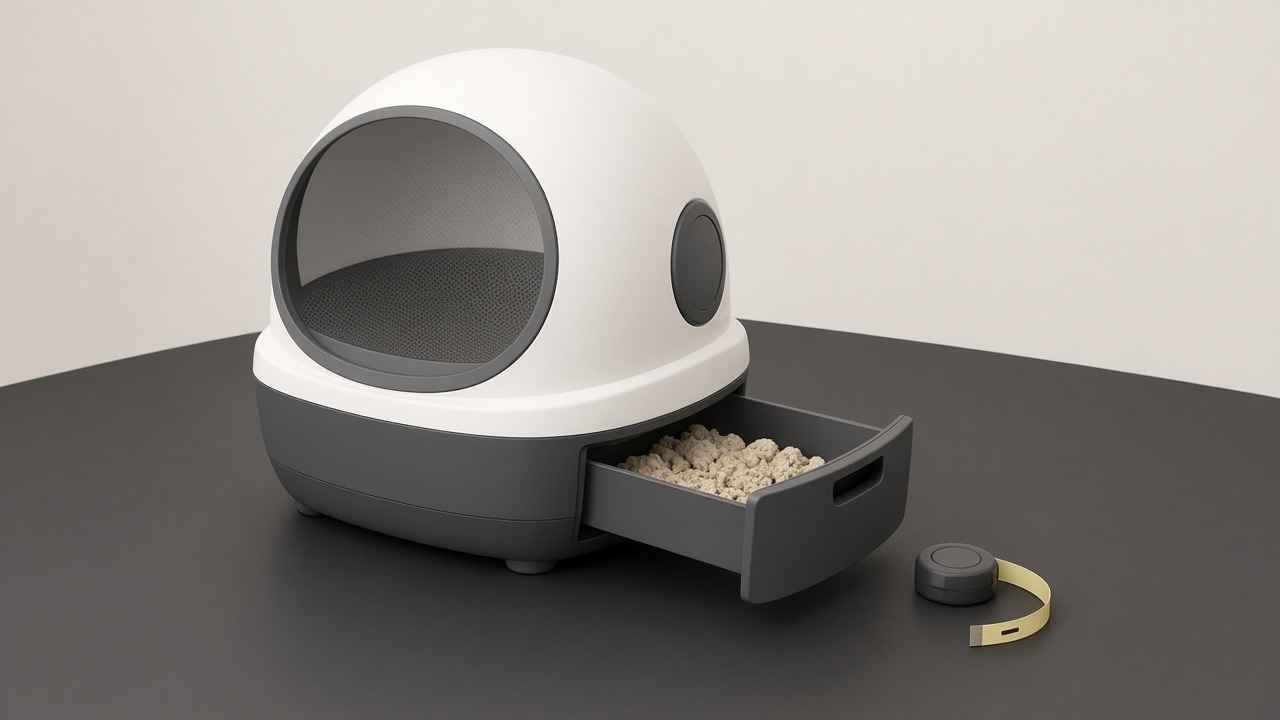
Five reasons to reject a machine before comparing apps
- Your cat is below the automatic-mode threshold. Litter-Robot lists 3 lb; PETKIT lists 3.3 lb and instructs owners to disable automatic cleaning in Kitten Protection Mode for smaller cats; Neakasa provides a kitten mode. Follow the current manual for the exact model.
- The usable litter area is too small. Exterior liters and supported weight do not prove that a cat can turn comfortably. Wirecutter notes that automatic boxes generally provide less litter area than the commonly recommended target of roughly 1.5 times a cat’s nose-to-tail-base length.
- The unit cannot sit as instructed. Weight-sensing machines need the specified clearance and flooring. PETKIT requires a hard, level surface and at least 1.97 inches from walls; its troubleshooting document also tells owners not to place the machine on a mat or carpet.
- You cannot return it reasonably. Check the seller’s current trial period, return freight, original-packaging rules, and route through doorways before assembly. A generous manufacturer trial may not apply when buying from another retailer.
- You expect it to replace observation. Automated visit records can flag a change, but they do not diagnose urinary or digestive problems. Waste and machine operation still need daily inspection.
Choose the failure mode you can live with
Begin with an open-top design. Neakasa’s official page lists a 13.86-inch entry, an approximate 2.2–33 lb range, and a 22.81 lb machine. The trade-off is a taller open body and potentially more exposed litter scatter.
PETKIT PuraMax 2 is 21.96 inches high on its selected Amazon listing, compared with 29.5 inches for the Litter-Robot 4 machine. Its 7.87-inch entrance and enclosed globe still need to suit the individual cat.
Meowant’s official MW-SC01 page lists a 4.8-inch entrance. That does not automatically make its enclosed 57.6L toileting space appropriate for a large or enclosure-averse cat.
Litter-Robot 4 is the only model here selected overall by both Wirecutter and CNN Underscored in the current search set. It is also the most expensive starting point in this comparison and requires meaningful vertical and drawer clearance.
Best when / Skip if
- Your cat already accepts a similar entrance and litter texture
- The exact model’s automatic-mode limits include your cat
- You can preserve a conventional fallback box
- You will still inspect waste and machine operation every day
- The cat cannot turn comfortably in the usable litter area
- The unit cannot sit on its required surface with full service clearance
- Return freight or repacking would make refusal unaffordable
- You expect the machine to replace veterinary attention or daily observation
Four models compared by purchase-stopping detail
This is an evidence synthesis, not a CheckPet laboratory test. Official specifications describe intended use; the independent testing sources below provide performance context. Amazon links identify the exact US listing or bundle checked on November 12, 2026. Prices and stock change, so we do not reproduce them as permanent facts.
| Model | Why it stays on the shortlist | Reason to skip | Checked US listing |
|---|---|---|---|
| Litter-Robot 4 with step & fence Whisker lists 22 × 27 × 29.5 in for the machine; 15.75 × 15.75-in entry; 3–25 lb automatic-mode range | Overall pick at Wirecutter and CNN; wide entry, repairable modular design, sealed carbon-filtered drawer, 90-day manufacturer trial | Highest starting cost here; large vertical footprint; return shipping may be the buyer’s responsibility; Amazon’s selected step bundle lists different overall dimensions than the bare machine | View black step-and-fence bundle |
| Neakasa M1 Plus Official page lists 13.86-in entry, 22.81 lb machine, 11.23L waste bin and approximate 2.2–33 lb range | Open-top route for large or enclosure-averse cats; manufacturer lists kitten mode, 2-year warranty and pull-and-wrap drawer | Needs open clearance above; official claims about up-to-14-day capacity depend on use; Amazon listing uses a more conservative 3.3 lb lower bound | View M1 Plus on Amazon |
| PETKIT PuraMax 2 basic bundle Selected Amazon listing: 24.21 × 21.96 × 21.96 in; 22 lb machine; 7.87-in entrance; 3.3–22 lb range | Shorter enclosed option; CNN’s current small-space pick; official troubleshooting PDF lists a 7L drawer and clay, tofu or mixed clumping litter within its stated granule limits | Enclosed turning space; proprietary odor consumable; PETKIT’s document contains different wall-clearance figures in separate answers, so use the stricter current setup instructions | View basic bundle on Amazon |
| Meowant MW-SC01 Official page lists 20.87 × 21.85 × 20.4 in, 28.7 lb machine, 4.8-in entrance and 57.6L toileting space | Lowest listed entrance here; enclosed comparison at a lower checkout tier than the premium models when checked | Official page conflicts with itself on cat upper weight and waste-bin capacity; we use the conservative 3–18 lb range reflected in the specification block and Amazon listing | View MW-SC01 on Amazon |
Measure before you buy: run a room-and-cat fit check
| Cat fit | Measure nose to tail base, shoulder width and comfortable step height. Compare those measurements with the usable entry and litter area—not the exterior capacity claim. |
|---|---|
| Operating envelope | Tape the machine footprint on the floor. Add the current manual’s wall clearance, the full drawer-pull path, space to lift or remove the globe, and an unobstructed approach for the cat. |
| Floor and power | Confirm a nearby outlet and the required hard, level surface. Do not assume that a mat or thick carpet will preserve accurate weight sensing. |
| Litter | Check clumping requirement and maximum granule dimensions. Plant pellets, loose-clumping litter and some crystals may not sift or may interfere with level sensing. |
| Fallback | Keep a conventional box for transition, deep-cleaning, outages and refusal. A multi-cat household should not depend on one machine as its only toilet. |
Estimate 12-month ownership cost before checkout
Do not compare machine price alone. Open the live product, consumables, warranty and returns pages, then calculate:
Use the same household assumptions for every model. If one machine promises “up to 15 days” and another “up to 8 days,” do not convert those claims directly into savings: cat count, waste volume, climate and how full you allow the drawer to become change the interval. Record your actual replacement rate during the return window.
- Litter-Robot 4: standard liners and carbon filter; optional OdorTrap, ramp, carpet tray, LitterHopper and Whisker+.
- PETKIT PuraMax 2: waste bags and N50 odor eliminator; bundle contents vary, so match the exact selected bundle.
- Neakasa M1 Plus: refill bags and optional step, fence or AirStep bundles.
- Meowant MW-SC01: liners and optional odor gel; verify whether the chosen bundle includes them.
Use a refusal-safe transition
- Set the machine beside the familiar box, powered off, with compatible familiar litter.
- Let the cat enter and use it reliably before enabling automatic cycles. Do not force the cat inside.
- Run early cycles manually only when the cat is away. Follow the model’s kitten mode and minimum-weight rules.
- Keep the old box available through the seller’s return window. A cat that avoids the machine has vetoed the purchase.
- Test the manufacturer-specified sensors, inspect the drawer and waste daily, and stop using a unit that cycles unexpectedly, pinches, leaks into electronics, or reports persistent errors.
Common failures after delivery
- Removing the old box before the cat reliably uses the machine
- Adding a new litter texture at the same time as the new box
- Placing a weight-sensing unit on a thick mat or uneven floor
- Trusting a drawer-capacity claim instead of checking waste daily
- Discovering too late that the globe or drawer cannot be removed in the chosen alcove
- Assuming an app alert proves that a health problem is absent
Questions buyers should settle before ordering
Is an open-top automatic litter box always safer?
No. An open entrance can remove one trapping concern, but the moving mechanism, sensor behavior, minimum weight and maintenance still matter. Evaluate the exact model rather than treating “open top” as a safety certification.
Can app data tell me whether my cat is sick?
No. It can provide visit or weight patterns that deserve attention. It cannot determine the cause. Straining, repeated unsuccessful visits, blood, inability to urinate or a sudden behavior change warrants prompt veterinary advice.
Which model is best for a large cat?
Neakasa M1 Plus provides the clearest open-top route in this shortlist; Litter-Robot 4 provides a wide entry and an official 3–25 lb range. Neither weight limit proves fit. Compare your cat’s length and turning behavior, then preserve the return option.
Editorial standards · Affiliate disclosure · Not veterinary advice.