
CheckPet · cat litter
Low-dust cat litter: compare claims, materials, and handling
“99% dust free” is a package claim, not a promise that pouring and scooping create zero airborne particles. Compare material, scent, clump strength, bag weight, tracking, and your cat’s current preference before changing the box.
On this page
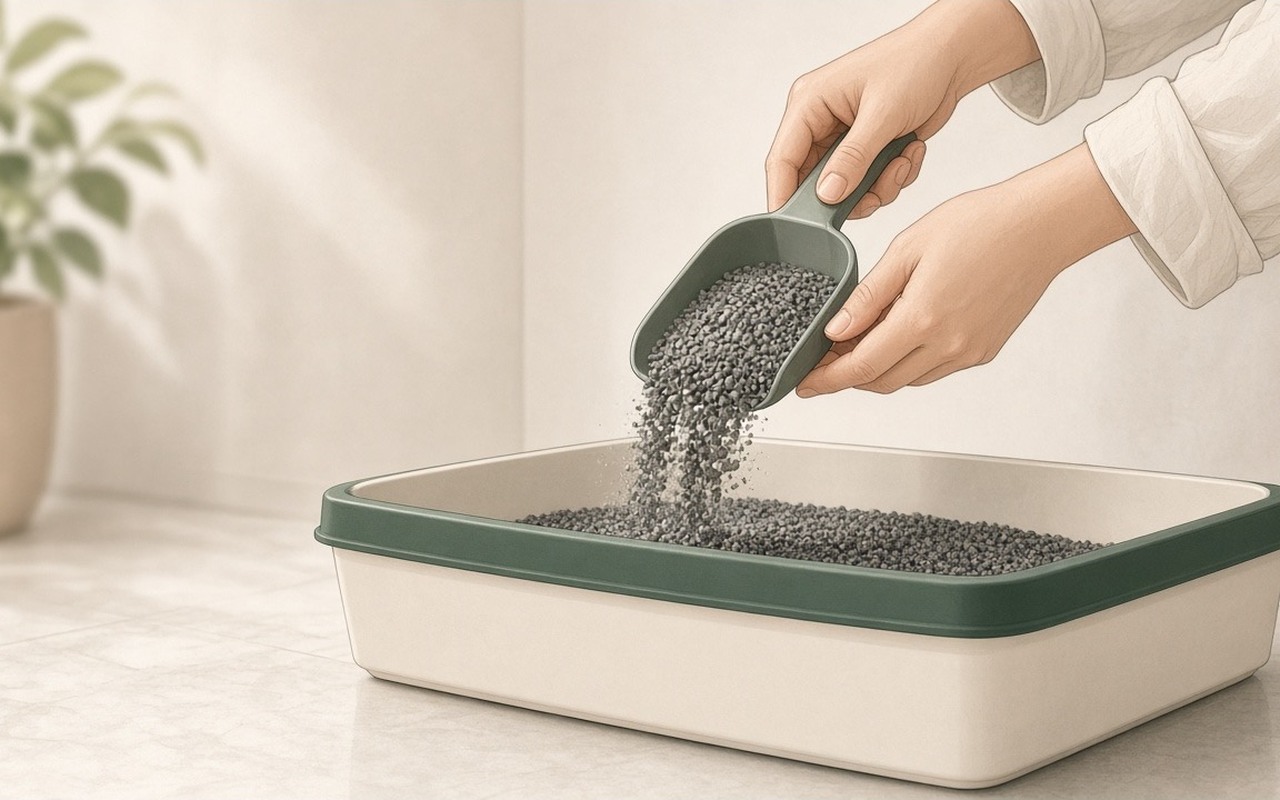
Measure the box routine before buying
| Current material | Record clay, grass, corn, crystal, tofu, or pellets. Changing material and scent together makes rejection harder to diagnose. |
|---|---|
| Dust observation | Follow the handling directions, keep the pour close to the box and avoid shaking the bag. A 24-hour surface observation is a household note, not an airborne-particle measurement. |
| Box depth | Follow the exact product directions or automatic-box fill line; do not select depth from a generic low-dust claim. |
| Cat count | More cats mean more scooping and pouring. See the multi-cat litter guide for box-count decisions. |
| Scent tolerance | Unscented avoids added fragrance; scented formulas may control perceived odor but can be a poor fit for fragrance-averse cats or people. |
| Listing fit | SmartCat currently lists grass seed, unscented clumping, lightweight handling, and a 99% dust-free claim. Verify current size and materials before checkout. |
Compare the test basis, not just the percentage
Before treating 99% and 99.9% as comparable, look for the test method, particle definition, handling conditions and sample basis. If these are not disclosed, we cannot infer a tenfold reduction in your exposure or rank two different materials from the percentages. Visible residue also does not measure invisible airborne particles or establish respiratory safety.
Percent claims are useful for narrowing products, but they do not describe your pouring technique, the age of the bag, broken granules in shipping, or how aggressively a cat digs. Treat the claim as a starting filter and observe the first week in your own box.
Material changes also affect weight and clumping. Grass litter is lighter to carry than dense clay, while clay may form the familiar firm clump a cat already accepts. The best choice is the lowest-dust option your cat reliably uses and you can scoop without breaking clumps apart.
Best when / skip if
- You want an unscented alternative to dense clay
- Bag lifting weight is part of the decision
- You can run a gradual side-by-side transition
- You will pair litter choice with a suitable box and mat
- Your automatic litter box restricts substrate type or granule size
- Your cat has previously rejected grass or fine sand-like textures
- You need zero airborne particles rather than a reduced-dust claim
- A veterinarian has advised a different litter during recovery or illness
A side-by-side transition that preserves box access
- Keep the established box available; do not remove the only accepted toilet.
- Place a second clean box nearby with the new litter at a similar depth.
- Pour slowly close to the box and avoid shaking the bag.
- Scoop both boxes at least once daily and record which one is used.
- Check nearby dark surfaces after 24 hours for visible dust and paw carryout.
- If the cat uses the new box consistently for 7 days, transition the remaining box gradually.
- If elimination moves outside the box, restore the accepted setup and seek veterinary advice if the change persists.
Quick comparison
| Option | Material and claim | Check before buying | Amazon |
|---|---|---|---|
| SmartCat All Natural Clumping Litter | Grass seed; unscented; current listing claims 99% dust free | Compare a non-clay texture only if your cat accepts it; verify bag size, carryout and machine compatibility. | View on Amazon |
| Scoop Away Advanced Multi-Cat | Clumping clay; Meadow Fresh scent; current listing claims 99.9% dust free | Consider only when scented clay is already accepted; verify fragrance, package weight, delivery condition and pack count. | View on Amazon |
Common failures
- Switching every box at once — the cat loses access to the familiar substrate and may avoid the box.
- Equating low dust with low tracking — fine light granules can still leave the box on paws.
- Pouring from shoulder height — even reduced-dust litter creates more plume when dropped farther.
- Ignoring fragrance — a low-dust scented clay may fail because the cat dislikes the odor.
- Overfilling the box — deep loose litter increases digging, scatter, and product use.
- Assuming “natural” means universal — grass texture, plant ingredients, and clumping behavior still require a gradual trial.
FAQ
Is any cat litter completely dust free?
No package claim can guarantee zero particles in every home. Shipping, pouring height, granule breakage, box depth, and digging affect visible dust. Compare the current claim, then observe the actual box area.
Is dust-free litter also low tracking?
Not necessarily. Dust measures fine airborne particles; tracking measures granules carried out of the box. Use the low-tracking litter guide when floor cleanup is the primary problem.
Should I choose scented or unscented litter?
Start from what the cat already accepts. Unscented avoids added fragrance, while a scented clay may appeal to owners but discourage a fragrance-sensitive cat.
Can low-dust litter go in an automatic box?
Only when the litter’s material and granule size meet that machine’s current instructions. “Clumping” alone does not prove compatibility.
Related guides
Editorial standards · Affiliate disclosure · CheckPet guides are not veterinary advice.