
CheckPet · litter selection
Unscented cat litter: clay, grass, paper, or crystal?
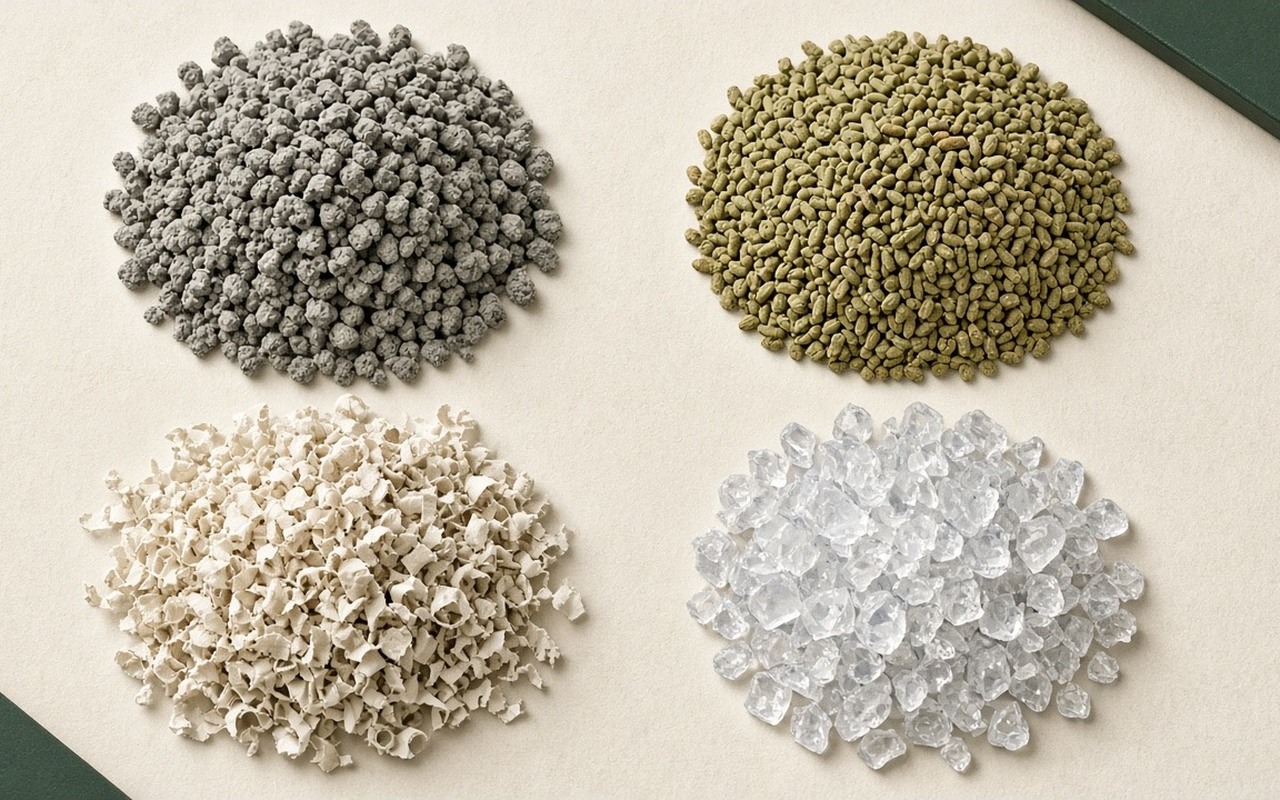
If your cat already uses clay reliably and you only want to remove fragrance, start by checking an unscented clay variant. Grass, paper, and crystal also change the texture or cleaning method. Below we compare those differences and identify one grass-litter listing to inspect—not a tested ranking of litter brands.
Read the label beyond “unscented”
| Fragrance wording | Confirm the exact unscented formula. “Fresh,” “odor control,” and a neutral package color are not adequate evidence. |
|---|---|
| Material | Record clay, grass, paper, crystal, or another substrate. Unscented options exist in different formats. |
| Clumping | Check whether liquid forms scoopable clumps or whether the system expects whole-tray changes. |
| Package weight | Compare what you can carry, not only the largest available pack. A 20 lb bag may be awkward even if economical. |
| Box requirements | For an automatic box, verify approved material, particle size, fill line, and clumping requirements. |
| Existing routine | Note cat count, box count, scoop frequency, and current texture. Keep a 7 day observation record during a change. |
Unscented, low dust, and low tracking describe different properties
Unscented means you are selecting against added fragrance; it does not mean the material has no natural smell. Dust describes fine particles disturbed during pouring, digging, or scooping. Tracking describes granules carried beyond the box. A fragrance-free product can still create dust or stick to paws.
If dust is your main concern, use our low-dust litter comparison. If floor cleanup is the problem, the low-tracking guide focuses on granules, exit paths, and mats. This guide prioritizes fragrance choice and the practical consequences of changing material.
Compare the material with your cleaning routine
| Unscented format | Reason to compare | Check first |
|---|---|---|
| Clumping clay | Familiar sand-like texture and separate urine clumps | Bag weight, dust, exact fragrance variant, and clump breakage |
| Clumping grass | Lighter handling and an alternative substrate | Cat acceptance, carryout, storage, and machine compatibility |
| Paper pellets | A different texture where that format is appropriate | Clumping status and how often the tray must be renewed |
| Crystal litter | An absorbent system with a different maintenance method | Stirring instructions, saturation, replacement interval, and texture acceptance |
No row is a universal winner. A cat accustomed to fine clay may avoid coarse pellets even though both bags say unscented. A lighter material may be easier on your back but require more floor cleanup. CheckPet has not performed a controlled odor or dust test on these formats; the comparison describes buying variables to verify.
Best when / Skip if
- You want to avoid added fragrance around the box.
- You can maintain daily scooping without relying on perfume.
- You can test one small package while keeping the accepted box accessible.
- Your chosen material is permitted by the box manufacturer.
- You expect fragrance removal alone to solve persistent house-soiling.
- Your cat is straining, passing little urine, or showing pain.
- A veterinarian has requested a particular substrate during recovery.
- The retailer’s selected variant is scented despite the search result title.
Run a transition that does not remove the accepted toilet
Use a second box for the trial and preserve the familiar one. Match location quality and box accessibility as closely as practical; a new litter in a noisy or cramped location is not a fair comparison. Begin with the depth specified by the product or machine instructions rather than adding an arbitrary extra layer.
For 7 days, note which box receives urine and stool, whether clumps survive scooping, and how much litter appears outside the entrance. Do not force a cat to use the new material by removing its only accepted box. Restore the established setup if avoidance appears, and seek veterinary advice for persistent changes or symptoms.
Compare the cost of a material change
A scent-free box still requires scooping and periodic cleaning. Added fragrance can change what people smell without correcting waste buildup. Compare the number and placement of boxes, not just the bag: our multi-cat guide explains the common one-box-per-cat-plus-one starting point and why useful locations matter.
Track how long the first bag actually lasts. Divide package price by days of acceptable use, including discarded material, to compare household cost. For example, a hypothetical $18 bag used for 20 days costs $0.90 per day. A $12 bag discarded after 10 days costs $1.20 per day. These are arithmetic examples, not current product prices or promised replacement intervals.
Common failures
- Buying a scented variant from an unscented search result.
- Replacing fragrance with another strong smell near the tray.
- Changing texture, box location, and depth simultaneously.
- Adding any clumping litter to an automatic machine without checking its instructions.
- Comparing price per pound when different materials have different density and waste.
- Treating urinary discomfort as a shopping problem.
Questions shoppers ask
Is unscented litter odor-free?
No. The substrate and waste can have smells. Reliable scooping, appropriate box access, and a workable cleaning schedule still matter.
Should I choose clay or grass?
Start from accepted texture and required cleaning method. Grass is an alternative to compare when handling weight matters; clay may preserve a familiar substrate. Buy a trial-size package before changing every box.
Can I use it in a self-cleaning box?
Only when the specific material meets the machine’s requirements. See our automatic litter-box guide for compatibility questions.