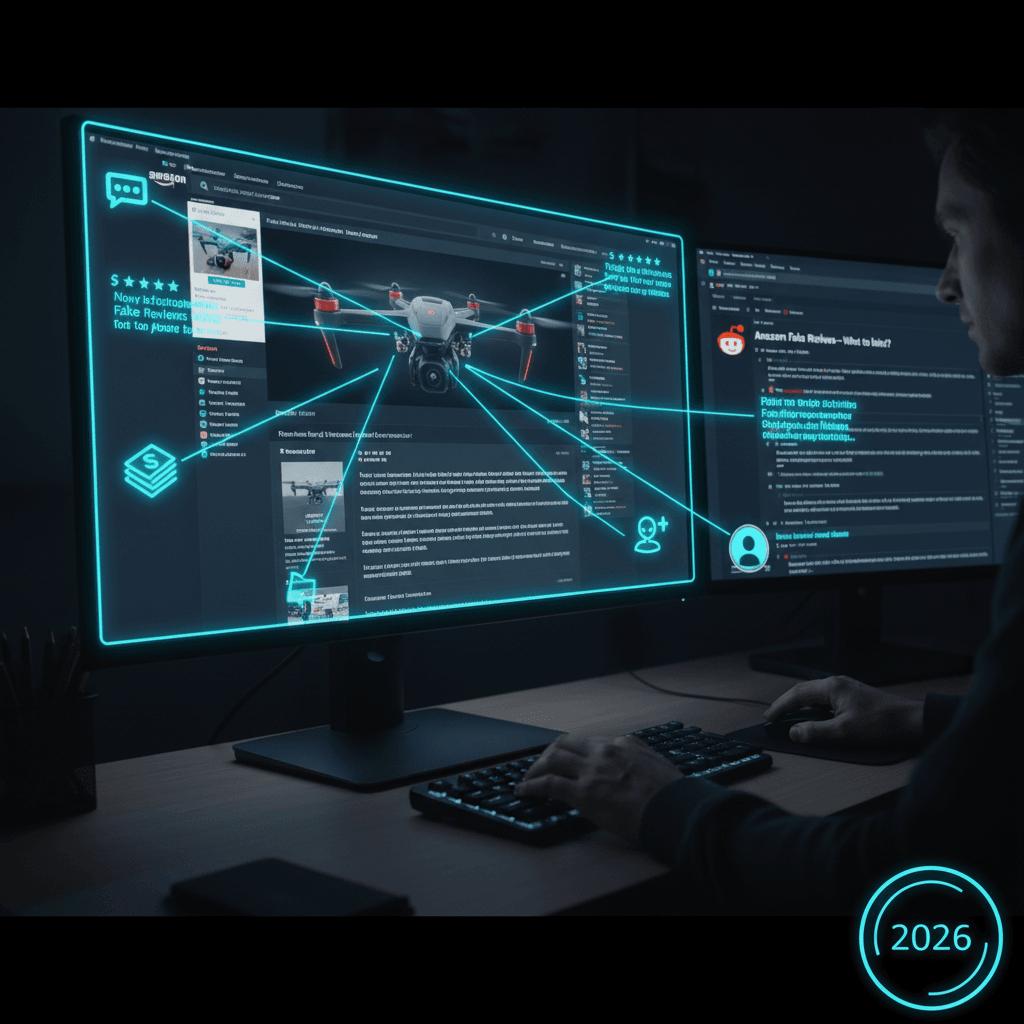
I almost bought a $45 USB-C hub last year that had 4,847 five-star reviews. The listing looked perfect — detailed specs, lifestyle photos, an “Amazon’s Choice” badge, and a review section full of people calling it “the best hub I’ve ever owned.” I was one click away from checkout when I did what I always do: I searched Reddit.
Within three minutes on r/UsbCHardware, I found a thread where someone had run the hub’s reviews through Fakespot and discovered that roughly 68% of the reviews were flagged as inauthentic. Another user posted teardown photos showing the hub used recycled components from a different brand. The “Amazon’s Choice” badge, it turns out, has nothing to do with quality and everything to do with search keyword optimization.
I didn’t buy the hub. I bought a different one I’d already vetted, and it’s been rock-solid for over a year now. That near-miss taught me something: the review system on Amazon isn’t broken — it’s been gamed, and if you don’t know the game, you’re playing at a disadvantage.
This article compiles everything I’ve learned from Reddit communities like r/AmazonSeller, r/BuyItForLife, r/TechDeals, and r/Scams about how fake reviews work in 2026 and how to see through them.
On this page
- Why Fake Reviews Are Worse Than Ever in 2026
- Red Flag #1: The Review-to-Rating Ratio Is Impossibly High
- Red Flag #2: The “Received This Product for Free” Disclosure Is Buried (or Missing)
- Red Flag #3: Reviewer Profiles Tell the Real Story
- Red Flag #4: The Product Title Is Stuffed with Keywords
- Red Flag #5: “Amazon’s Choice” Means Almost Nothing
- Red Flag #6: The Listing Was Recently “Reborn”
- Red Flag #7: The “Verified Purchase” Badge Is Not Verification
- Red Flag #8: No Negative Reviews Exist (Or They’re All About Shipping)
- Red Flag #9: The Brand Has No Presence Outside Amazon
- Tools That Actually Help
- The Reddit Method: How I Actually Evaluate Products
- FAQ
- The Bottom Line
Why Fake Reviews Are Worse Than Ever in 2026
First, some context on why this problem has escalated. In 2024, Amazon reported removing over 200 million suspected fake reviews. That sounds impressive until you realize that the fake review industry adapted. The old playbook — buying bulk 5-star reviews from click farms in Southeast Asia — still exists, but it’s been supplemented by more sophisticated tactics:
- AI-generated reviews — ChatGPT and similar tools can generate review text that reads naturally and varies in structure. The robotic “I love this product! It is very good quality!” reviews have been replaced by paragraph-long assessments with specific (fabricated) use cases.
- Review hijacking — Sellers merge review histories from discontinued products into new listings, so a brand-new product launches with thousands of “verified” reviews that were actually written about something else entirely.
- Vine abuse — Amazon’s Vine program gives free products to reviewers in exchange for feedback. Legitimate in theory, but some sellers use it to seed their listings with positive reviews from real accounts, making detection harder.
- Incentivized reviews laundered through social media — Sellers offer full refunds, gift cards, or PayPal payments through Facebook groups, WhatsApp, and Telegram channels. The review appears as a “verified purchase” because the reviewer technically bought the product.
One r/AmazonSeller commenter described the economics bluntly:
“A single fake review costs about $3-5 on the low end. A product with 500 fake reviews represents maybe a $2,000 investment. If that gets the product to page one of Amazon search results, it generates $50,000+ in sales. The math makes fraud extremely profitable.” — u/seller_insider_throwaway
Red Flag #1: The Review-to-Rating Ratio Is Impossibly High
Real products with genuine reviews almost never sustain a perfect 5.0 rating above a few hundred reviews. Human nature guarantees that someone will dock a star because shipping was slow, the box was dented, or the product was slightly different than expected. A legitimate product with 1,000+ reviews typically sits between 4.1 and 4.6.
If you see a product with 3,000 reviews and a 4.9 rating, be suspicious. Sort by “most recent” and look for the pattern — do the 5-star reviews all sound slightly different but say the same thing? That’s a sign.
Reddit users in r/BuyItForLife call this the “suspiciously perfect” indicator. A real 4.3-star product is usually better than a fake 4.9-star product.
Red Flag #2: The “Received This Product for Free” Disclosure Is Buried (or Missing)
Amazon requires reviewers to disclose if they received a product for free or at a discount. Vine reviewers have a green badge. But non-Vine incentivized reviewers are supposed to self-disclose — and many don’t. Look for reviews that are suspiciously detailed and positive on a brand-new product with few overall reviews. If 15 glowing, paragraph-long reviews appear within the first week of a product launch, someone bought that coverage.
Red Flag #3: Reviewer Profiles Tell the Real Story
Click on the reviewer’s profile. This is the single most effective fake review detection method, and almost nobody does it. Here’s what to look for:
- Review volume — Did this person write 47 reviews in the last month, all 5 stars, all for random products across unrelated categories? That’s a review farm account.
- Review dates — If all their reviews were posted within a 2-week window and then activity stopped, the account was created for a campaign and abandoned.
- Category consistency — Real people review products in related categories. Someone who reviews a laptop stand, a keyboard, and a monitor arm makes sense. Someone who reviews a laptop stand, dog food, women’s jewelry, and baby formula in the same week is reviewing for money.
- Photo patterns — Fake review photos often look like studio shots or have suspiciously consistent lighting and staging. Real user photos look like they were taken on a kitchen counter with mediocre lighting. Imperfection is authentic.
A r/Scams moderator shared this insight:
“The best fake reviews in 2025 come from real accounts that were hacked or purchased. The account has a real purchase history going back years, which makes the fake review look legitimate. Always check the most recent reviews, not just the overall profile.” — u/scam_patrol_mod
Red Flag #4: The Product Title Is Stuffed with Keywords
Legitimate brands name their products like products: “Anker PowerCore 10000” or “Logitech MX Master 3S.” Fake review farms optimize for Amazon’s algorithm, so their products have titles like “USB C Hub Adapter 7-in-1 HDMI Multiport Dongle 4K 60Hz Docking Station USB 3.0 SD TF Card Reader Laptop MacBook Pro Air 2026 Thunderbolt.”
That title isn’t written for humans. It’s written for Amazon’s A9 search algorithm. The brand name (if there even is one) is usually something you’ve never heard of — an arrangement of consonants that looks vaguely like a real word but isn’t. If you can’t pronounce the brand name, proceed with extreme caution.
Red Flag #5: “Amazon’s Choice” Means Almost Nothing
I need to say this clearly because it trips up smart people: the “Amazon’s Choice” badge is not a quality endorsement. It’s algorithmically assigned based on search relevance, pricing, availability, and shipping speed. A terrible product can have the badge. A great product can lack it.
Amazon doesn’t test the products, doesn’t evaluate the reviews, and doesn’t vouch for quality. The badge means “this product is popular and ships quickly.” That’s it. Reddit figured this out years ago — search any tech subreddit for “Amazon’s Choice” and you’ll find hundreds of threads debunking it.
Red Flag #6: The Listing Was Recently “Reborn”
Review hijacking works like this: a seller has an old listing for a phone case with 5,000 reviews. They change the product title, images, description, and price to a completely different product — say, a Bluetooth speaker. The new product inherits all 5,000 reviews from the phone case. If you see reviews mentioning a completely different product than what’s listed, that’s review hijacking.
Scroll past the first page of reviews. Look at reviews from 1-2 years ago. If those reviews describe a different product entirely, walk away.
Red Flag #7: The “Verified Purchase” Badge Is Not Verification
Many people treat “Verified Purchase” as proof that the review is genuine. It only proves that the reviewer bought the product through Amazon. It does not prove they paid full price, weren’t refunded after the review, or have any authentic relationship with the product. Incentivized review schemes specifically create verified purchases to exploit this trust signal.
In my overhyped tech products article, several items had overwhelmingly positive Amazon reviews that contradicted the lived experience of actual Reddit users. Verified purchase or not, volume and uniformity of praise should make you skeptical, not confident.
Red Flag #8: No Negative Reviews Exist (Or They’re All About Shipping)
Every real product has legitimate complaints. If a product has 2,000 reviews and the only negative ones are about shipping delays or damaged packaging — not about the actual product — that’s abnormal. Real products get criticized for real product issues: battery life, build quality, software bugs, comfort, noise levels. An absence of product-specific criticism means negative reviews are being suppressed — either through Amazon’s removal process or by sellers contacting negative reviewers directly to offer refunds in exchange for deletion.
Red Flag #9: The Brand Has No Presence Outside Amazon
Search the brand name. If the only results are Amazon listings and maybe a bare-bones website with no real about page, no support contacts, and product descriptions copied from the Amazon listing, that’s a white-label or fly-by-night brand. These brands exist solely to sell products on Amazon, have no reputation to protect, and will disappear the moment their review-pumped listing gets taken down.
That doesn’t mean every Amazon-only brand is bad — Anker started as an Amazon-first brand. But Anker built a real company, real support infrastructure, and real product reputation. The difference is obvious when you look.
Tools That Actually Help
Reddit recommends several tools for automated fake review detection. Here’s what I’ve found actually works:
- Fakespot (fakespot.com) — Analyzes review patterns and assigns a letter grade. Not perfect, but a useful first-pass filter. If Fakespot gives a product an F, don’t buy it.
- ReviewMeta (reviewmeta.com) — More detailed than Fakespot. It strips out suspected fake reviews and recalculates the “adjusted rating.” Often reveals a product’s real rating is 1-2 stars lower than what Amazon shows.
- The Reddit search itself — Before buying any tech product over $30, search “[product name] reddit” in your browser. Real user experiences on r/BuyItForLife, r/headphones, r/homelab, r/UsbCHardware, and category-specific subreddits are worth more than 10,000 Amazon reviews. I use this method for everything I review on WU120 — it’s how I sourced many of the picks in my mesh WiFi guide and Bluetooth speaker roundup.
- CamelCamelCamel — Price tracking tool that also shows review count over time. A sudden spike in reviews (e.g., going from 50 to 500 in a week) is a dead giveaway of a review campaign.
The Reddit Method: How I Actually Evaluate Products
Here’s my complete workflow before buying any tech product, distilled from years of r/BuyItForLife and tech subreddit lurking:
- Identify the product on Amazon, note the brand and model
- Run it through ReviewMeta for adjusted rating
- Search Reddit for “[product name] review” and “[product name] vs” to find comparison discussions
- Check the brand — does it exist outside Amazon? Does it have real support?
- Read the 3-star reviews on Amazon — these are the most honest. 5-star reviews are either paid or posted during honeymoon excitement. 1-star reviews are often user error or shipping complaints. 3-star reviews are people being genuinely thoughtful about trade-offs.
- Look for the “6 months later” updates — On Reddit, people sometimes return to their posts to update. These are gold. The product that seemed great on day one but failed at month four — only a genuine user shares that story.
This is the same approach I use for every product review on this site. When I recommended specific phones for photography or ergonomic chairs for programmers, I cross-referenced Amazon reviews against Reddit threads, professional reviews, and my own testing. The Amazon reviews alone would have led me to different (worse) conclusions.
FAQ
Can Amazon detect fake reviews with AI?
Amazon uses machine learning models to flag suspicious review activity, and they’ve gotten better at catching bulk-posted reviews from obvious bot accounts. But AI-generated reviews written by sophisticated tools are harder to detect because they mimic natural language patterns. Amazon’s detection is reactive, not preventive — many fake reviews stay up for weeks or months before being flagged.
Are Vine reviews trustworthy?
More trustworthy than random 5-star reviews, but not unbiased. Vine reviewers receive free products and know that positive reviews tend to earn them more invitations to the program. That said, Vine reviews are at least written by real people with real accounts and visible review histories. I weight Vine reviews higher than anonymous 5-star reviews, but lower than Reddit threads or professional reviews.
Should I avoid all Amazon-exclusive brands?
No. Some Amazon-native brands like Anker, Iniu, and Nitecore have built genuine reputations through consistent product quality. The difference between a legitimate Amazon brand and a disposable one is history — legitimate brands have years of consistent presence, dedicated support channels, and real community discussion. Check r/BuyItForLife for community-vetted Amazon brands.
What if a product has both fake and real reviews?
Most products with fake reviews also have some real reviews mixed in. Focus on the 3-star reviews and any reviews posted more than 3 months after purchase. Early reviews are more likely to be seeded; later reviews reflect actual ownership experience. ReviewMeta’s adjusted rating helps filter the noise.
Is this problem unique to Amazon?
No. Walmart, Best Buy, and Newegg all have fake review problems, though Amazon’s scale makes it the biggest target. Any platform that allows anonymous reviews and ties search ranking to review volume will attract manipulation. The same detection skills work everywhere.
The Bottom Line
The review system on Amazon is a trust architecture that’s been compromised by economic incentives. That doesn’t mean all reviews are fake or that Amazon is unusable — it means you need to be a more informed consumer. The nine red flags in this article aren’t theoretical; they’re distilled from thousands of Reddit discussions by people who got burned and shared what they learned so others wouldn’t.
The irony is that the best product review system in 2026 isn’t Amazon’s star ratings — it’s Reddit threads written by people with nothing to sell and everything to complain about. That’s the source I trust, and it’s why this site exists.
Read the 3-star reviews. Check the profiles. Search Reddit. Your wallet will thank you.
Ethan Caldwell writes for WU120 — independent, logic-driven tech analysis sourced from real communities, not marketing departments.