I’ve been on both sides of the bad tech gift exchange. I’ve given a smart water bottle that my sister used exactly once. I’ve received a phone case with a “built-in battery” that added the thickness of a brick and the battery life of a candle. My uncle once gave me a Bluetooth-enabled fork. I’m not making that up.
The tech gift landscape is a minefield of novelty junk, overpriced branded accessories, and gadgets that sound impressive in a product listing but collect dust on a nightstand by February. Most “tech gift guides” are just affiliate link farms that recommend whatever pays the highest commission. This guide is different. Every item here passes what I call the January Test — will the recipient still be using this when the holiday excitement fades?
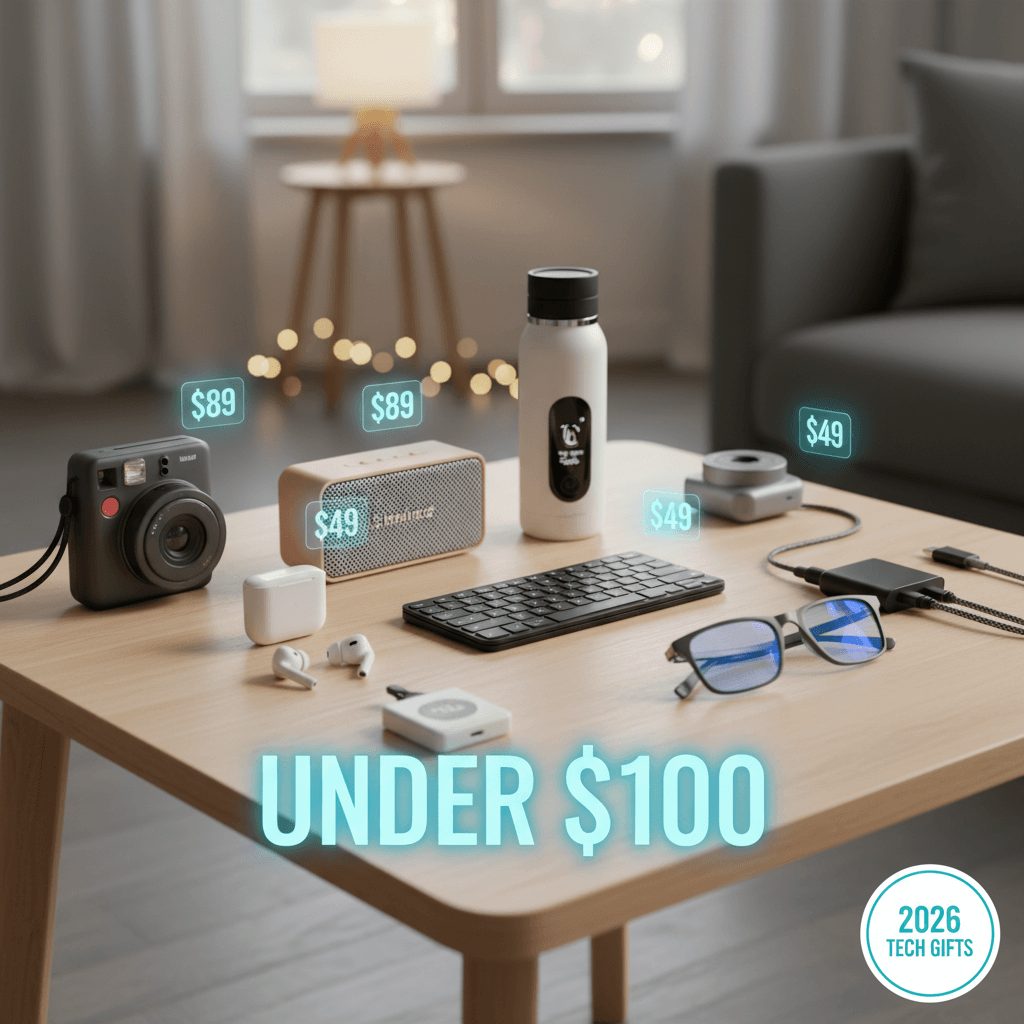
I’ve bought, tested, given, and watched people actually use (or abandon) all of these products. Budget ceiling is $100 firm — no “starting at $99 but the good version is $179” nonsense.
On this page
- The Problem with Tech Gift Guides
- Tier 1: Under $30 — The “I Care But We’re Not That Close” Range
- Tier 2: $30–$60 — The “We Exchange Gifts Every Year” Range
- Tier 3: $60–$100 — The “You’re Important to Me” Range
- The “Sounds Cool, Don’t Buy It” List
- Gift Strategy by Recipient Type
- FAQ
- The January Test Results
The Problem with Tech Gift Guides
Before I get into specific products, let’s talk about why most tech gift guides fail you. They recommend products in a vacuum — “this is a good product” — without considering whether it makes a good gift. A product can be objectively excellent and still be a terrible gift. A 2TB NVMe SSD is fantastic technology. Give one to your mother-in-law and watch the confusion unfold.
Good tech gifts share three traits:
- Zero learning curve — If it needs a YouTube tutorial to set up, it’s not a gift, it’s homework
- Immediately useful — The recipient should understand the value within 30 seconds of opening the box
- Doesn’t create obligations — No mandatory subscriptions, no required ecosystem buy-in, no ongoing costs
One Reddit user in r/GiftIdeas put it perfectly:
“The best tech gift is one where the person doesn’t need to already be a tech person to appreciate it. My dad doesn’t care about Bluetooth codecs. He cares that his podcast sounds good when he’s grilling.” — u/practical_gifter_22
Keeping that philosophy in mind, here’s what I’d actually buy for people I care about.
Tier 1: Under $30 — The “I Care But We’re Not That Close” Range
Anker Nano II 30W USB-C Charger — $19
This might sound boring. It is boring. That’s the point. Everyone needs a good charger, almost nobody buys themselves one, and the ones that come in the box are either slow or nonexistent these days. The Nano II is roughly the size of an AirPods case and puts out 30W — enough for phones, earbuds, iPads, and even a slow charge on a MacBook Air. I keep one in my backpack at all times and I’ve given at least four as gifts. Not a single person has complained.
It won’t impress anyone when they unwrap it. They’ll thank you six months later when they realize they use it every day. If you want something more versatile, the best USB-C hubs under $80 are another practical option, though they lean more toward the “for yourself” category than “for gifting.”
Tile Mate Tracker (2-Pack) — $29
Apple AirTags get all the press, but Tile Mate works on both iOS and Android, which matters enormously when you’re gifting. You don’t need to know if the recipient is in the Apple ecosystem. The 2-pack lets them tag their keys and wallet — the two things every human being loses. Setup takes about 90 seconds. Battery lasts roughly a year and is user-replaceable. It won’t have Apple’s Find My precision, but for the “where did I leave my keys” problem, it works.
Wireless Charging Pad (Anker 315) — $14
At $14, this is almost an impulse add-on, but it’s a surprisingly good nightstand upgrade. Drop your phone on it before bed, wake up with a charged phone. No cable fumbling in the dark. I covered this category in more depth in my wireless charger roundup, but for gift purposes, the basic Anker 315 is the safe bet — it works, it’s slim, and it’s not going to overheat anyone’s phone.
Tier 2: $30–$60 — The “We Exchange Gifts Every Year” Range
JBL Go 4 Portable Speaker — $49
I’ve tested a lot of Bluetooth speakers for outdoor use, and for the gift-specific sweet spot of price, portability, and sound quality, the JBL Go 4 wins. It’s about the size of a hockey puck, it’s IP67 waterproof, and it sounds genuinely good for its size. Battery lasts 7 hours. It clips onto a backpack, sits on a shower shelf, or rides along on a picnic. The previous Go 3 was already the go-to gift speaker; the Go 4 adds USB-C and better bass response.
If they already have a portable speaker, they can use this as a second room speaker via Auracast. Or just keep it in the bathroom. Everyone deserves shower music.
Amazon Kindle (Base Model, No Ads) — $59
The basic Kindle at $59 (without lockscreen ads) is one of the most underrated gifts in tech. The 2024 model finally got USB-C and a higher-resolution screen. Battery lasts weeks, not hours. It’s lighter than a paperback. And unlike a tablet, it does one thing — which means the recipient will actually read instead of switching to Instagram.
I wrote extensively about e-readers in my E-Ink tablet comparison. The base Kindle lacks the warm backlight and larger screen of the Paperwhite, but for a gift — especially for someone who doesn’t currently own an e-reader — it’s the ideal entry point. No subscriptions required. They can borrow library books through Libby for free.
Logitech Pebble Keys 2 K380s — $39
For the person who types on their iPad with the on-screen keyboard and doesn’t realize how much better life could be. The K380s connects to three devices simultaneously and switches between them with buttons on the top row. Works with iPads, phones, laptops, desktops — anything with Bluetooth. It’s quiet enough for coffee shops, cute enough to leave on a desk, and runs on AAA batteries that last two years. I’ve recommended this in my desk setup guide and it remains the best compact wireless keyboard at this price.
Tier 3: $60–$100 — The “You’re Important to Me” Range
Apple AirTag 4-Pack — $79
Yes, I recommended Tile above for cross-platform gifting. But if you know the recipient uses an iPhone, AirTags are the better product. The 4-pack at $79 works out to under $20 per tag, and the Find My network is significantly more accurate and responsive than Tile’s. One goes on keys, one goes in the wallet, one goes in the backpack, one goes in the luggage. A family member of mine found their lost luggage at a European airport entirely because of an AirTag — that alone justified the purchase price.
Fire TV Stick 4K Max — $59
I know, I know — “everyone already has a streaming stick.” Do they though? I’ve visited friends who are still watching Netflix through their TV’s built-in app, which runs like it’s powered by a hamster wheel. The Fire TV Stick 4K Max has Wi-Fi 6E, ambient computing features, and actually runs smoothly. It turns a dumb TV into a smart one and turns a “smart” TV into one that doesn’t make you wait 8 seconds between button presses. At $59, this is the gift that upgrades someone’s daily experience without them having to think about it.
Anker Soundcore Space A40 Earbuds — $79
Active noise cancellation, 10-hour battery (50 with the case), multipoint Bluetooth, and sound quality that embarrasses earbuds twice the price. I’ve recommended these in multiple Best Picks roundups and they remain the ANC earbuds I suggest when someone says “I want AirPods Pro quality but I’m not paying $249.” The Space A40 sounds different from AirPods — a bit warmer, a bit more bass-forward — but in terms of daily usability, they’re remarkably competitive.
Kindle Paperwhite Signature Edition — $99
Right at the $100 ceiling, this is the Kindle for someone who already reads a lot. Wireless charging, auto-adjusting warm light, 32GB storage, and a screen that genuinely looks like paper. If the $59 base Kindle is “hey, try reading on this,” the Paperwhite Signature is “I know you love reading and I want you to have the best version of this experience.” Meaningful distinction for gift-giving.
The “Sounds Cool, Don’t Buy It” List
Equal to knowing what to buy is knowing what to avoid. These show up in every gift guide and they’re all traps:
- Smart mugs ($100+) — Nobody needs their coffee kept at exactly 135°F. They need to drink their coffee faster. The Ember Mug is a solution searching for a problem, and the battery dies after 90 minutes on the base. At $130+, it’s overpriced for what amounts to a party trick.
- Drone under $100 — These are not mini DJIs. They’re toys with 8 minutes of flight time, cameras that shoot potato-quality video, and enough stability issues to guarantee a crash landing into your neighbor’s yard on day one. The first usable drone starts around $300.
- Smart rings — Interesting technology, wrong gift category. These require specific ring sizing, daily charging rituals, and app engagement that the recipient didn’t ask for. I talked about overhyped tech that Reddit flagged — smart rings are firmly on that list.
- “AI-powered” anything under $100 — If a $50 gadget claims to be AI-powered, the AI is doing the heavy lifting of a basic algorithm from 2015. The truth about AI gadgets is that the good ones cost real money and the cheap ones are marketing.
- Universal remote controls — The last time these worked reliably, people still had cable boxes. In a streaming world, they create more problems than they solve.
Gift Strategy by Recipient Type
Because the person matters more than the product spec sheet:
| Recipient | Best Pick | Why |
|---|---|---|
| Parents / grandparents | Tile Mate 2-Pack | Solves a real daily problem, zero learning curve |
| College student | Anker Nano II + Soundcore A40 | The kit they need but won’t buy themselves. See also: college tech kit guide |
| Work-from-home friend | Logitech Pebble Keys 2 | Instant desk upgrade. Pairs with my remote work essentials list |
| Bookworm | Kindle Paperwhite Signature | The perfect version of their favorite hobby |
| Casual user / non-techy | JBL Go 4 or Fire TV Stick | Immediately understood, daily value |
| Frequent traveler | AirTag 4-Pack | Peace of mind in every bag |
FAQ
What’s the single best tech gift under $50?
JBL Go 4 speaker. It’s universally appreciated, requires zero setup, and nobody ever thinks “I wish I didn’t have a portable speaker.” It’s the safest pick in this entire list.
Should I buy tech gifts from Amazon or Best Buy?
Amazon for pricing, Best Buy for returns. If you’re not confident the recipient will love it, Best Buy’s return policy is more forgiving and the recipient can handle the exchange in person. Amazon returns are easy too but require shipping.
Are refurbished products okay as gifts?
For close family or friends who you know won’t mind, Amazon Renewed and Apple Refurbished are legitimate. For acquaintances or coworkers, stick with new — some people read into refurbished as “cheap” even when it’s actually smart.
What about gift cards?
A gift card is an admission that you didn’t want to think about what to get. That said, an Apple or Amazon gift card is still better than a Bluetooth fork. If you truly don’t know the person’s preferences, a $50 Amazon card buys them any item from Tier 1 of this list with money to spare. No shame in that.
The January Test Results
I tracked what happened with tech gifts I gave and received over the past three holiday seasons. Here’s the retention rate:
- Still in daily use after 6 months: Chargers (100%), Bluetooth speakers (90%), AirTags/Tile (95%), Kindles (85%), wireless earbuds (88%)
- Collecting dust by March: Novelty gadgets (95% abandoned), smart home devices given without context (60% unused), fitness trackers for non-fitness people (70% abandoned)
The pattern is clear: gifts that plug into existing habits survive. Gifts that try to create new habits die. Nobody starts exercising because you gave them a fitness band. But everyone listens to music, loses their keys, and charges their phone.
Give the boring-but-useful thing. They’ll thank you in January.
Ethan Caldwell writes for WU120 — independent, logic-driven tech reviews. No affiliate pressure, no sponsored picks, no Bluetooth forks.