Last summer I traveled for six weeks across three countries with a carry-on bag and a tech kit that cost me under $200 total. Not per-trip — total purchase price for everything. This year I refined that kit based on what I actually used, what I never touched, and what I wished I had. Here’s the updated version.
Two ground rules: everything on this list must be available right now for under $200 combined, and everything must fit in a single packing cube. I’m not interested in theoretical “best travel tech” — I’m interested in what you’ll actually use every day while traveling.
On this page
- The Complete Kit
- The Charger: Why One Charger Changes Everything
- The Power Bank: Size vs Capacity Trade-off
- Noise-Canceling Earbuds: The Non-Negotiable Travel Item
- The Universal Travel Adapter: One Adapter, Every Country
- The USB-C Hub: Your Hotel Entertainment System
- Luggage Trackers: Peace of Mind for $22
- What I Stopped Carrying
- The Packing Strategy
- Budget Breakdown by Priority
- The One Thing No Tech Kit Replaces
The Complete Kit
| Item | Price | Why It’s Here |
|---|---|---|
| Anker Nano II 65W charger | $28 | Charges laptop, phone, tablet — one charger for everything |
| Anker 10,000mAh power bank | $26 | Full phone charge x2, compact enough for a pocket |
| USB-C to USB-C cable (2x 6ft) | $12 | Charging + data transfer |
| USB-C to Lightning cable (if needed) | $8 | For older Apple devices |
| Universal travel adapter (Epicka) | $14 | Works in 150+ countries, USB ports built in |
| AirPods Pro 2 / Galaxy Buds FE | $65-89 | Noise canceling for flights, calls, music |
| Anker USB-C hub (4-in-1) | $18 | HDMI for hotel TV, USB-A for old devices |
| Tile / AirTag (2-pack) | $22 | Luggage tracking, never lose your bag |
Total: $193-$217 depending on earbuds choice.
The Charger: Why One Charger Changes Everything
The single most important item in this kit is the 65W GaN charger. Before I switched to one universal charger, my travel bag had a laptop charger, a phone charger, a tablet charger, and sometimes a smartwatch charger. Four bricks, four cables, four things to forget in a hotel room.
The Anker Nano II 65W is the size of a standard phone charger but delivers enough power to charge a MacBook Air at full speed, an iPhone at full speed, or both simultaneously (at reduced wattage). I travel with one charger and two USB-C cables. That’s it. One wall outlet, two devices charging.
If you already own a portable power bank, the 65W charger also recharges it in about 90 minutes instead of the 3-4 hours a standard 5W charger takes. On a layover, that speed difference matters.
The Power Bank: Size vs Capacity Trade-off
I’ve tested power banks from 5,000mAh to 30,000mAh across multiple trips. The sweet spot for travel is 10,000mAh. Here’s why:
Too small (5,000mAh): One partial phone charge. Not enough for a full day of heavy navigation + photo use. You’ll find yourself rationing battery anxiety.
Too large (20,000mAh+): Heavy, bulky, and often flagged by airline security for additional screening. TSA regulations allow power banks up to 100Wh (roughly 27,000mAh at 3.7V) in carry-on bags, but anything over 20,000mAh attracts attention and takes up significant bag space.
Just right (10,000mAh): Two full phone charges, fits in a pants pocket, weighs 6-7oz, and passes through every airport security checkpoint without a second glance. For a day of tourist navigation, photography, and occasional video calls, 10,000mAh is enough with room to spare.
Noise-Canceling Earbuds: The Non-Negotiable Travel Item
If you only take one tech accessory on a trip, make it noise-canceling earbuds. Not a luxury — a practical necessity. They’re your defense against crying babies on flights, noisy hostels, hotel HVAC that sounds like a jet engine, and the general sensory overload of traveling in busy cities.
The AirPods Pro 2 ($89 at current street price) are my pick for iPhone users — the noise canceling is excellent, the transparency mode lets you hear announcements without removing them, and the case charges via USB-C or any Qi wireless charger. For Android users, the Samsung Galaxy Buds FE ($65) deliver 90% of the AirPods Pro experience at a lower price. We covered both in our wireless earbuds comparison.
Budget alternative: wired IEMs
If noise-canceling earbuds blow the $200 budget, a pair of Moondrop Chu II wired IEMs ($20) with foam tips provides passive noise isolation that blocks 80% of ambient noise. No battery to charge, no Bluetooth to pair, and audio quality that rivals $100 wireless earbuds. The tradeoff is a wire — which is honestly less annoying than dead earbuds on hour 8 of a long-haul flight.
The Universal Travel Adapter: One Adapter, Every Country
The Epicka universal adapter ($14) is the best value travel adapter I’ve found. It covers US, EU, UK, and AU plug types, includes two USB-A ports and one USB-C port, and has a built-in fuse for safety. I’ve used the same Epicka adapter across 12 countries over two years without issues.
One tip: the Epicka adapter is a plug adapter, not a voltage converter. Modern electronics (laptops, phones, chargers) all handle 100-240V input, so this doesn’t matter for tech. But if you’re traveling with a hair dryer or curling iron from the US, you need a voltage converter — or just buy one at your destination.
The USB-C Hub: Your Hotel Entertainment System
A small USB-C hub with HDMI output turns any hotel TV into a streaming display. Plug it into your laptop or phone, connect the HDMI to the hotel TV, and watch your own content instead of paying $15/night for the hotel’s terrible movie selection.
The Anker 4-in-1 hub ($18) adds HDMI 4K output, USB-A, USB-C passthrough charging, and an SD card reader. The SD card reader is useful if you’re shooting photos on a dedicated camera and want to back them up to your laptop each evening.
If you carry a more capable USB-C hub, you can leave the basic one at home. But for dedicated travel use, a small, cheap hub that you won’t cry about losing is the right choice.
Luggage Trackers: Peace of Mind for $22
After losing a checked bag on a domestic flight in 2024 (which took four days to recover), I now put an AirTag in every checked bag. The $22 investment has saved me hours of stress on multiple occasions — I can see exactly where my bag is, whether it made the connection, and where it ends up if it doesn’t.
AirTags work best for iPhone users (leveraging the massive Find My network). For Android users, Samsung Galaxy SmartTags or Tile trackers provide similar functionality using Google’s Find My Device network, which has expanded significantly in 2026.
What I Stopped Carrying
Equally important is what I removed from my travel tech kit after realizing I never used it:
Portable Bluetooth speaker. I carried one for three trips and used it twice. Hotel rooms and Airbnbs usually have decent enough speakers (or just use your phone). The weight and space aren’t worth it unless you’re specifically doing beach/camping trips.
Kindle/e-reader. Controversial take: my phone handles reading just fine. The Kindle is better for extended reading sessions, but on travel days I’m reading in 15-20 minute bursts — waiting at gates, on trains, before bed. A phone handles that without adding another device to charge and carry.
Laptop stand. I used to carry a Roost stand for working at hotel desks. In practice, I never used it because hotel desks are inconsistent sizes and I’d end up working from the bed or couch anyway. If you’re a digital nomad working from hotels regularly, a stand makes sense. For occasional trip-work, skip it.
Extra cables “just in case.” Two USB-C cables and one Lightning cable (if needed) cover everything. I used to pack five cables. Now I pack three. Nothing has ever required that fourth cable.
The Packing Strategy
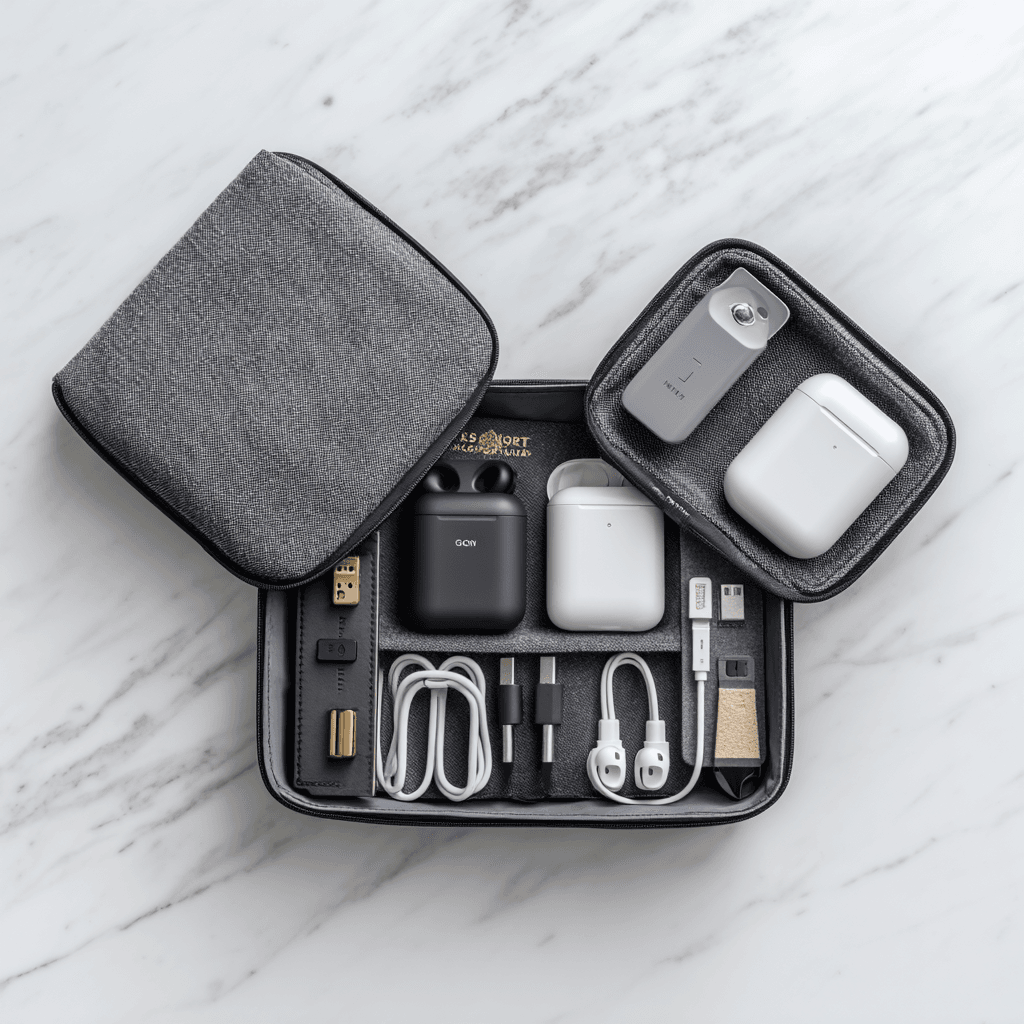
Everything fits in a small Gonex packing cube ($8, not counted in the $200 budget). The packing cube goes in the top of my laptop backpack for easy access during security screening and on the plane.
Layout: charger and cables in one side, power bank and hub in the other, earbuds case in the mesh pocket, adapter and AirTags loose. Total weight: about 1.2 pounds. Total volume: roughly the size of a paperback book.
Budget Breakdown by Priority
If $200 is too much right now, here’s the priority order:
$28 — GaN charger. The single biggest quality-of-life improvement. Stop carrying multiple chargers.
$26 — Power bank. Dead phone in a foreign city is a genuine safety issue, not just an inconvenience.
$12 — USB-C cables. You need two. Trust me.
$14 — Travel adapter. Essential for international travel. Skip if domestic only.
$65-89 — Earbuds. The biggest single expense but the most impactful for flight comfort and daily sanity.
The hub and luggage trackers are nice-to-haves. Buy them when budget allows, but you can travel perfectly well without them for now.
The One Thing No Tech Kit Replaces
Back up your phone to the cloud before you leave. Photos, contacts, documents — everything. All the tech gear in the world doesn’t help if you lose your phone and your memories go with it. Set up automatic iCloud or Google Photos backup, verify it’s working, and travel knowing that the worst case scenario is replacing a device, not losing irreplaceable content.
Travel light, charge smart, and spend your time experiencing the destination instead of managing your tech. That’s what a good travel kit enables — less thinking about gear, more living the trip.