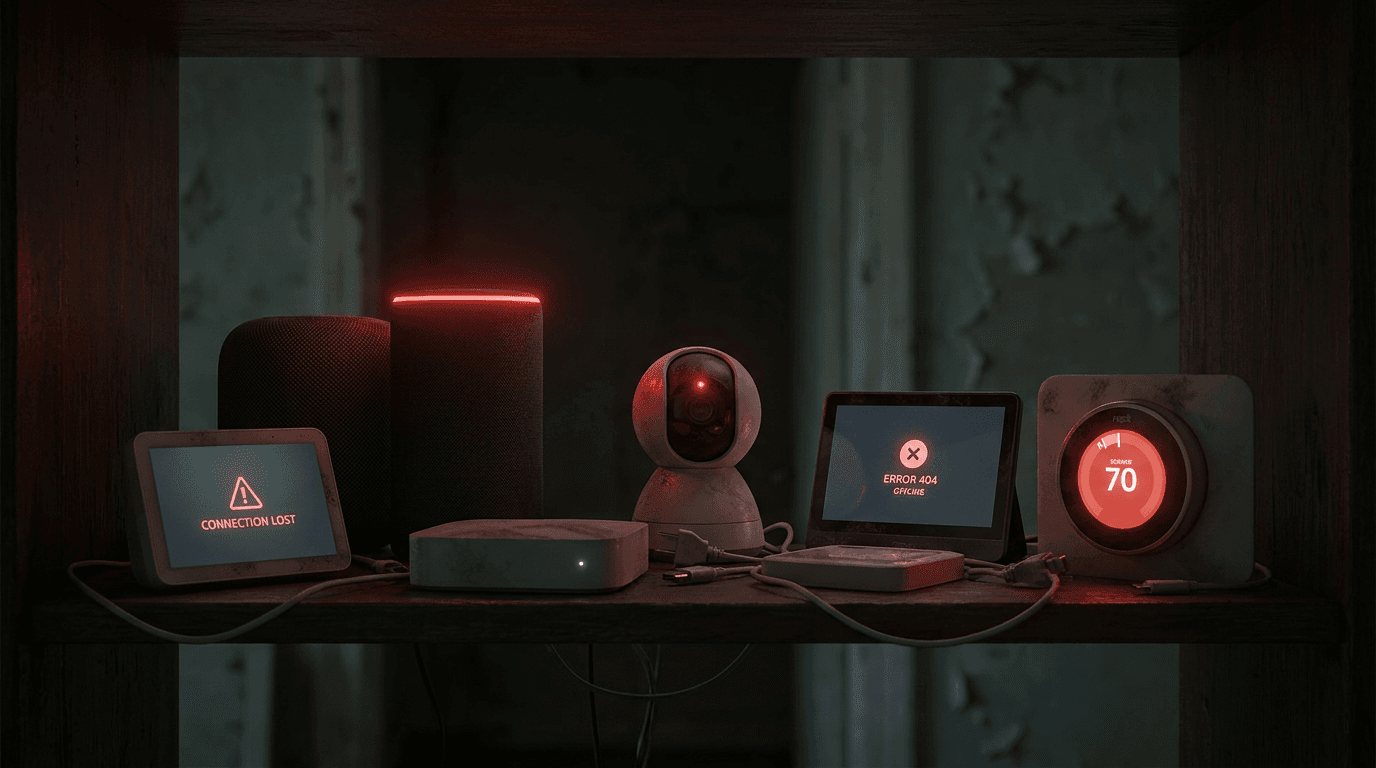
In the past 18 months, at least a dozen major smart home products have been discontinued, lost cloud support, or had features removed through forced firmware updates. Every one of these products was sold with the implicit promise of ongoing functionality. Every one of them broke that promise.
I compiled a list from Reddit discussions across r/smarthome, r/homeautomation, r/GoogleHome, and r/amazonecho. These aren’t hypothetical risks — they’re things that happened to real people who spent real money on products that stopped working.
On this page
The Graveyard: Devices That Stopped Working
| Device | What Happened | Year Killed | User Impact |
|---|---|---|---|
| Meta Portal (all models) | Discontinued, servers shutting down | 2025-2026 | $200-350 paperweight |
| Wink Hub | Subscription required, then abandoned | 2024-2025 | Entire smart home ecosystems broken |
| Insteon (original) | Company folded, servers offline | 2022 (still affecting users) | Whole-home automation dead |
| Google Nest Secure | Discontinued, no replacement | 2024 | Security system stopped getting updates |
| Samsung SmartThings (v2 hub) | End of life, forced migration | 2025 | Complex automations broke during migration |
| First Alert Onelink | Cloud service discontinued | 2025 | Smart smoke detectors became dumb detectors |
Meta Portal: The Freshest Wound
Meta Portal is the most recent and most painful example. Meta sold Portal devices as dedicated video calling screens — they marketed them to families, grandparents, and remote workers. Then Meta decided to pivot away from consumer hardware and announced Portal’s end of life. The servers are shutting down, and every Portal device becomes a useless screen.
“Bought my parents a Portal so we could video chat easily. They loved it. Now I have to explain to my 75-year-old mom why the $300 device I gave her for Christmas doesn’t work anymore and she needs to learn a new one.” — r/smarthome
The Portal situation is particularly frustrating because the hardware is perfectly functional. The screens, cameras, and speakers work fine. The only reason they’re dying is that Meta chose to stop supporting them. This isn’t hardware failure — it’s business-decision failure.
The Pattern: How Smart Home Products Die
After analyzing dozens of these cases, the pattern is consistent:
Phase 1: Launch with excitement. Company releases a cloud-dependent smart home product. Reviews are positive. Early adopters buy in. The product works great because the company is actively developing it.
Phase 2: Neglect. Updates slow down. New features stop arriving. Support response times increase. The company shifts resources to newer products. Users notice but hope it’s temporary.
Phase 3: The announcement. The company announces end of life, sometimes with a migration path to a newer product, sometimes with nothing. Users have weeks to months to find alternatives.
Phase 4: Bricks. Cloud servers shut down. Devices lose core functionality. Products that cost $100-400 become e-waste.
What Reddit Recommends: The Survival Guide
The r/homeautomation community has developed a practical framework for avoiding smart home product death. Here are their battle-tested recommendations:
Rule 1: Local control is non-negotiable
Every smart home device you buy should work without the internet. If the device requires a cloud connection to function, you’re renting functionality, not buying it. When the company decides the rental is over, your device dies.
Products that work locally: Zigbee devices (IKEA TRADFRI, Sonoff), Z-Wave devices (Zooz, Inovelli), Thread/Matter devices. These communicate directly with a local hub and don’t depend on any company’s servers.
Rule 2: Open protocols over proprietary ecosystems
Matter (the new universal smart home standard) is the best thing to happen to smart home reliability. Matter devices work with any compatible hub — Apple Home, Google Home, Amazon Alexa, Home Assistant. If one platform dies, your devices work with the others.
Before Matter, buying a Works-with-Nest device meant you were locked into Google’s ecosystem. If Google killed Nest (which they’ve partially done multiple times), your devices lost functionality. Matter breaks that lock-in.
Rule 3: Home Assistant is the insurance policy
Home Assistant is a free, open-source home automation platform that runs on a Raspberry Pi or any small computer. It supports virtually every smart home protocol and device, and because it runs locally, it can’t be discontinued by a company’s business decision.
“Moved to Home Assistant after Wink died on me. Two years later, not a single device has stopped working because of a cloud shutdown. The setup took a weekend, but the peace of mind is worth it.” — r/homeassistant
Home Assistant has a steeper learning curve than consumer platforms like Alexa or Google Home. But once configured, it’s more reliable, more private, and immune to the corporate decisions that kill cloud-dependent products.
Rule 4: Evaluate the company, not just the product
Before buying a smart home device, ask: how does this company make money? If the answer is “they sell the hardware at cost and rely on cloud subscriptions or data monetization,” that business model is fragile. If the company gets acquired, pivots, or runs out of funding, your device is at risk.
Companies with sustainable smart home products: IKEA (massive retail business, smart home is a feature), Apple (hardware margins fund services), Lutron (professional-grade, 50+ year company). Companies to be cautious about: startups, crowdfunded projects, and tech giants treating smart home as a side project.
The Products That Survived (And Why)
Not everything in the smart home space is doom and gloom. Several products and platforms have proven reliable over years:
Philips Hue — 11 years old and still receiving updates. The Zigbee-based local control means bulbs work even if the Hue Bridge loses internet. Signify (Hue’s parent company) has a sustainable business model.
Lutron Caseta — Professional-grade smart switches that work locally with their own hub. Lutron has been making lighting controls since 1961. They’re not going anywhere.
IKEA TRADFRI/Dirigera — IKEA’s smart home products use Zigbee and work with any compatible hub. At IKEA’s prices ($10-15 per smart bulb), even if IKEA discontinued the line, the devices work with third-party hubs.
Apple HomeKit/Home — Apple’s smart home platform runs locally on HomePod or Apple TV. Apple’s track record of long-term support (they still support 10-year-old devices) and massive cash reserves make HomeKit one of the safest ecosystem choices.
How to Audit Your Current Setup
Try this experiment: unplug your internet router for 30 minutes. Everything in your smart home that stops working is dependent on cloud connectivity and vulnerable to the same fate as Meta Portal and Wink.
For each cloud-dependent device, ask yourself:
- Can this device be controlled locally if I add Home Assistant?
- Does this device support Matter, Zigbee, or Z-Wave?
- Is there a local firmware alternative (like Tasmota for ESP-based devices)?
- If this device died tomorrow, how much would it cost to replace with a local-control alternative?
The Bottom Line
The smart home industry has a trust problem. Companies sell hardware with the understanding that it will continue working, then kill cloud services when the business math doesn’t work out. As consumers, the only protection is choosing products that don’t depend on a company’s ongoing goodwill.
Buy local-control devices. Prefer open protocols (Matter, Zigbee, Z-Wave). Consider Home Assistant as your central hub. And before spending $300 on the latest smart gadget, ask yourself: will this still work if the company that made it disappears tomorrow? If the answer is no, either accept that risk or choose a different product.
Your smart home should be smart enough to survive a corporate restructuring. In 2026, the tools to build that kind of resilient setup finally exist — you just have to choose to use them.