
CheckPet · cat food
Cat food for indoor cats: compare calories, portions, and monthly cost
“Indoor” is not a separate AAFCO life stage. For a healthy adult cat, compare the nutritional-adequacy statement, calories per cup or can, the labeled daily portion, food format, and how long the exact package should last.
On this page
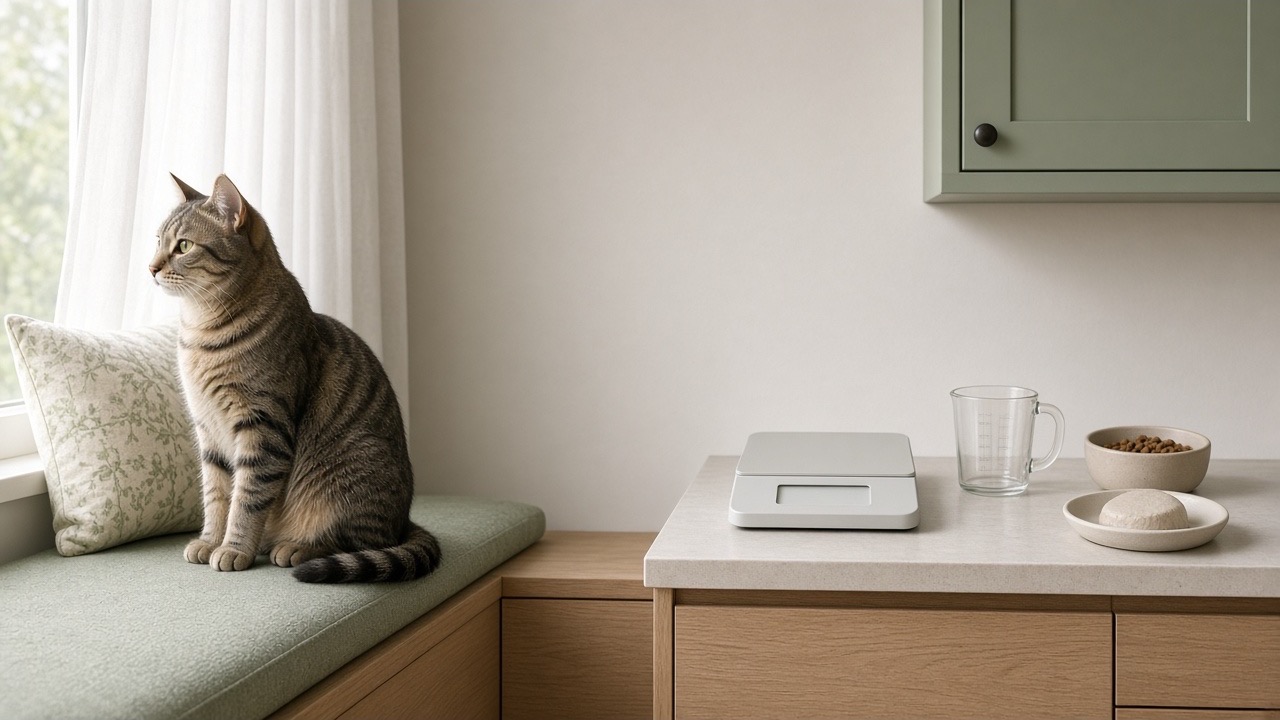
“Indoor” is a lifestyle description, not a fifth life stage
AAFCO lists four recognized life-stage categories for cats and dogs: gestation/lactation, growth, maintenance, and all life stages. It does not list “indoor” as another stage. That matters because the prominent word on the front of a package may describe calories, fiber, hairball positioning, or the intended household, while the small nutritional-adequacy statement tells you whether the food is complete and balanced for adult maintenance.
This does not make every indoor formula a marketing trick. It changes the order of the check. First confirm the exact food is complete and balanced for the cat’s life stage. Next record calories and the labeled daily amount. Only then decide whether its format, fiber level, package size, and handling fit your cat and home.
| Label field | What it answers | What it cannot answer |
|---|---|---|
| Nutritional-adequacy statement | Whether the formula is complete and balanced for adult maintenance, growth, reproduction, or all life stages. | Whether the individual cat needs a therapeutic diet or a different calorie target. |
| Calories | Energy per cup, can, kilogram, or other stated unit. | How accurately a household scoop matches the label cup. |
| Feeding table | A manufacturer starting amount for a weight band. | A permanent prescription; body condition, activity, neuter status, and weight trend still matter. |
| “Indoor,” “weight,” or “hairball” wording | The product’s intended positioning and formula features. | A diagnosis, guaranteed outcome, or substitute for the adequacy statement. |
| Amazon variant | The selected formula, flavor, package weight, and pack count at checkout. | Whether a parent listing will keep the same selection when reopened later. |
Do not make a routine food comparison solve a medical problem
Unexpected weight loss, persistent weight gain despite measured portions, repeated vomiting, diarrhea, increased thirst or urination, trouble chewing, or a sustained appetite change needs veterinary assessment. An “indoor” bag is not a treatment for diabetes, kidney disease, urinary disease, dental pain, or obesity. If a veterinarian has prescribed a therapeutic diet, compare that plan and its monitoring requirements instead of this retail shortlist.
Kittens and pregnant or nursing cats are also outside this article’s adult-maintenance scope. Use the appropriate growth or reproduction label; our kitten food guide explains that separate decision. For age-related texture, appetite, or condition changes, use the senior cat food guide.
Convert the label into days per package
Package price is a poor shortcut because the compared units differ. The verified Hill’s dry listing offers a 15.5 lb bag, while its wet listing is a 24-pack of 5.5 oz cans. Start with a labeled daily amount, not with the largest package or lowest displayed price.
Dry worked example: Hill’s current official dry-food table lists 60 g per day for an 8 lb cat. The verified 15.5 lb bag contains about 7,031 g, so the label-based estimate is about 117 days: 7,031 ÷ 60 = 117.2. That is an arithmetic example, not a promise that an 8 lb cat should remain at 60 g or that every crumb will be usable.
Wet worked example: Hill’s current canned-food table lists 1 1/4 of its 5.5 oz cans per day for an 8 lb cat. A 24-pack therefore lasts about 19 days: 24 ÷ 1.25 = 19.2. Thirty days at the label starting amount uses 37.5 cans, so purchasing requires two 24-packs even though nutrition math does not round a daily portion up to a whole can.
IAMS publishes cups per day for the compared formula but does not provide an unambiguous grams-per-cup figure on the official panel we reviewed. We do not invent one. Weighing the household’s actual labeled cup portion provides a better local estimate than borrowing cup weight from another formula.
Wet, dry, and mixed feeding create different trade-offs
| Format | Useful when | Repeat-purchase check | Main downside |
|---|---|---|---|
| Dry | The cat comfortably eats kibble and the household needs simple measuring and shelf storage. | Convert bag weight to grams, divide by grams per day, then check whether the open bag can stay fresh for that long. | A scoop is easy to overfill, and a large bag can outlast freshness for a low-intake cat. |
| Wet | The cat accepts the texture and the household can manage opened-food refrigeration and serving. | Multiply cans per day by 30, then include any refrigerated portion that is discarded. | More packaging, storage space, and opened-food handling; cost per day can be higher. |
| Mixed | Both formats have a defined role and total calories are recalculated. | Subtract calories from one format before adding the other; do not stack two full label portions. | “A little of both” can become two unmeasured rations. |
Three verified products with different jobs
This is not a universal top-three ranking. The products make three practical comparisons possible: a calorie-labeled dry option, a lower-calorie-per-cup dry option with separate maintenance and weight-loss columns, and a complete canned format. Every label and Amazon identity below was checked on October 28, 2026. Amazon.com showed the United States marketplace but a Singapore delivery destination, so product identity is verified while U.S. stock, price, and delivery availability are not claimed.
| Product | Verified label facts | Best fit | Skip when / largest downside | Buy |
|---|---|---|---|---|
| Hill’s Science Diet Adult Indoor Chicken Recipe Dry · 15.5 lb, pack of 1 | Complete and balanced for adult maintenance by AAFCO feeding tests; 327 kcal per 3.3 oz cup. Official page lists 3.5, 7, and 15.5 lb bags. | Adult cats that eat dry food comfortably and households willing to measure grams and monitor how long an open bag lasts. | Skip for kittens, pregnancy/nursing, prescribed diets, or cats that do not handle kibble. At 60 g/day, the 15.5 lb bag estimates to 117 days—possibly too long for one cat’s freshness plan. | Check 15.5 lb Amazon variant Official label |
| IAMS Proactive Health Adult Indoor Weight & Hairball Care Dry · Chicken & Turkey · 7 lb, pack of 1 | Complete and balanced for maintenance; 302 kcal per cup. Guaranteed analysis lists 30% minimum protein, 11% minimum fat, and 8.3% maximum fiber. | Adult dry-food eaters when the owner wants a smaller verified bag and can choose the maintenance column rather than casually copying the weight-loss column. | Skip for kittens, pregnancy/nursing, prescribed diets, or if a clinician has not approved a weight-loss plan. The official panel lacks a clear grams-per-cup value, limiting package-duration math without a kitchen scale. | Check 7 lb Amazon variant Official label |
| Hill’s Science Diet Adult Indoor Savory Chicken Entrée Wet · Chicken Minced · 5.5 oz, pack of 24 | Complete and balanced for adult maintenance by AAFCO feeding tests; 159 kcal per can. Official page gives 1 1/4 cans/day as the starting amount for an 8 lb cat. | Adult cats that accept minced wet food and households able to refrigerate unused portions and track cans per day. | Skip for kittens, pregnancy/nursing, prescribed diets, or when opened-food handling does not fit. At 1.25 cans/day, a 24-pack does not cover a full month. | Check 24-pack Amazon variant Official label |
Estimate 30-day cost without freezing a temporary price
Record the current price only after confirming the exact formula, flavor, size, and pack count. For dry food, use package price ÷ estimated days per bag × 30. For wet food, use price per case ÷ cans per case × labeled cans per day × 30. For mixed feeding, calculate the new amount of each format after reducing the other; adding a full dry portion to a full wet portion double-counts the intended ration.
The Pet Food Cost & Feeding Calculator handles daily cost, days per package, and 30-day cost without storing a changing retailer price in this article. Use the pet food label checklist first so the inputs come from the same exact formula.
Cost per cup is not interchangeable across formulas because cup weight and calories differ. Cost per day is more useful for household budgeting; cost per 1,000 kcal can help compare energy price, but it still does not determine the appropriate food or daily calorie target for an individual cat.
Best when / skip if
- The cat is an otherwise healthy adult eating a normal over-the-counter maintenance diet.
- You can read the exact adequacy statement, calories, feeding unit, formula, and package size.
- You will measure portions and watch weight trend, leftovers, stool, and comfort.
- A smaller trial package can be finished while fresh before any repeat order.
- The cat is a kitten, pregnant or nursing, or needs a veterinarian-directed diet.
- Weight, thirst, urination, appetite, chewing, vomiting, or stool has changed unexpectedly.
- The recommendation relies on a parent Amazon listing without matching flavor, weight, and pack count.
- “Indoor” is the only reason for choosing the food and calories or adequacy remain unchecked.
Common failures
- Buying the “indoor” claim instead of reading adequacy — the front panel does not replace the adult-maintenance statement.
- Copying a weight-loss column without a plan — lower printed amounts are not a do-it-yourself diagnosis or safe target.
- Using bag price as daily cost — package weight, cup weight, calorie density, and daily amount all change the result.
- Stacking wet and dry portions — mixed feeding needs subtraction, not two complete rations.
- Ordering the largest bag for one cat — a low unit price can create freshness loss and discarded food.
- Trusting a parent listing — Amazon can switch size, flavor, pack count, or formula between visits.
- Treating reviews as medical evidence — another cat’s hairballs, stool, appetite, or weight outcome does not predict yours.
FAQ
Does an indoor cat need food labeled “indoor”?
Not automatically. A healthy adult indoor cat needs a nutritionally appropriate complete diet and a suitable amount. An indoor-positioned formula may fit, but compare its adequacy statement, calories, portion, format, and package size against alternatives instead of treating the word as a requirement.
Is wet food always better for an indoor cat?
No single format wins every household. Wet food changes water intake, texture, storage, and cost; dry food changes measuring, shelf storage, and calorie concentration. The useful choice is the format the cat can eat and the owner can portion, store, and repurchase consistently within a veterinarian-appropriate plan.
How much should an indoor cat eat?
Begin with the current feeding table for the exact product, then adjust with body-condition, weight-trend, activity, and veterinary guidance. Do not transfer cups or cans from another formula because calorie density and cup weight differ.
Can hairball wording predict whether a food will work?
No. It describes product positioning and often a fiber strategy, not an individual outcome. Persistent vomiting or suspected hairballs deserve assessment rather than repeated formula switching.
Related guides
Editorial standards · Affiliate disclosure · Health-related diet changes belong with a veterinarian.