
CheckPet · hydration setup
Best cat water fountains: compare cleaning and filter costs
A fountain is only useful if you will keep its wet parts clean. Compare the weekly teardown, annual filter count and failure recovery before paying for app features or a larger tank.
On this page
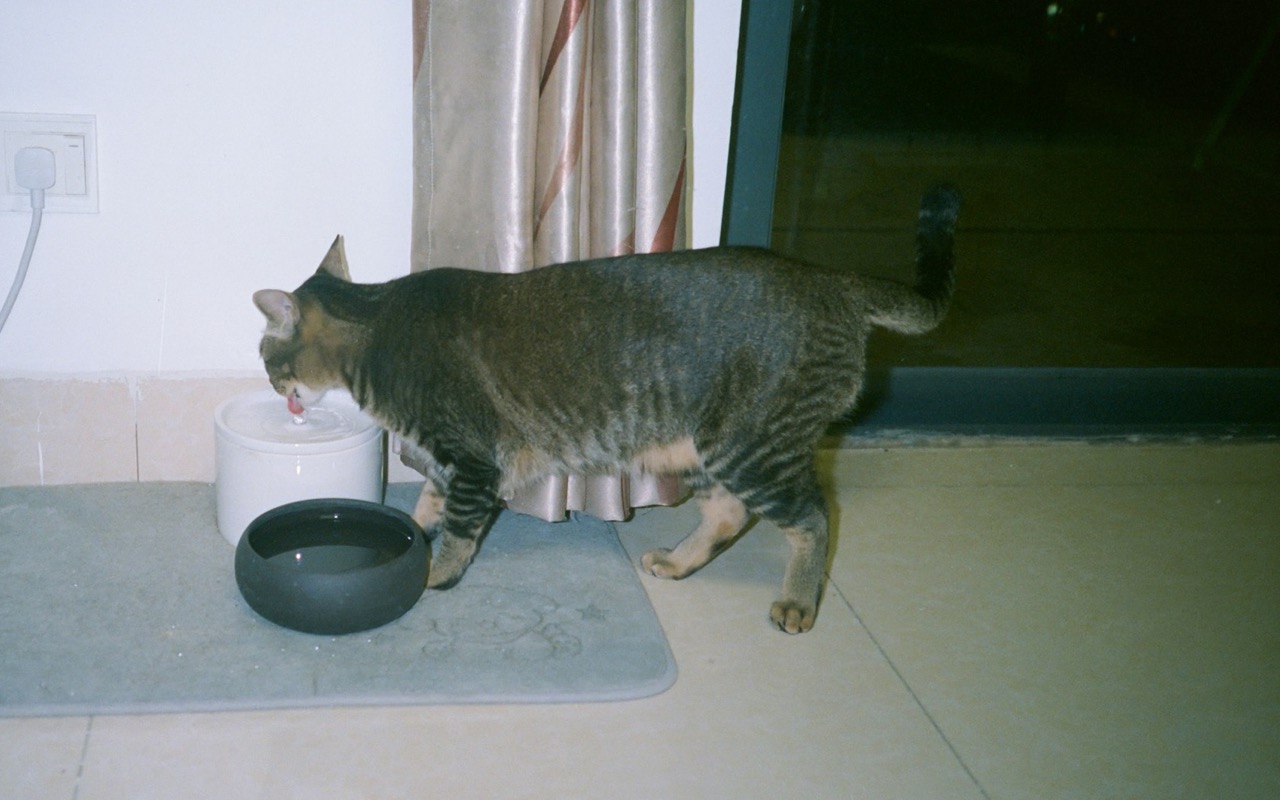
Measure before you buy: run a 7-day cleaning log
Keep the current bowl for one week and record when hair, food dust or slime appears. Also note daily refill volume and where the cat prefers to drink. This gives you a maintenance baseline instead of guessing from a tank-capacity claim.
- Day 1: measure the space, including cable route and room to lift the tank straight up.
- Days 2–3: photograph residue at the waterline and under the bowl; note whether food falls into the water.
- Day 4: time a full wash—bowl, tank and the area around it—not a quick top-up.
- Days 5–6: measure total refill water. More capacity reduces refills but does not make standing water cleaner.
- Day 7: choose a realistic weekly cleaning slot and a separate filter reminder.
When the fountain arrives, place it beside the old bowl rather than removing the familiar water source immediately. Let the cat approach on its own. Keep the old bowl available until you have repeatedly observed normal drinking and the fountain has completed several reliable cycles.
Calculate 12 months of filters before checkout
The useful number is not the price of one replacement pack. It is the annual number of filters under your household’s replacement interval:
Annual filter cost = (365 ÷ replacement interval in days) × price per filter.
Price per filter = pack price ÷ filters in the pack. Round the pack count up because partial packs are not sold.
PETLIBRO says one-cat households should replace the Dockstream 2 filter every two weeks and change it more often with multiple pets. At that schedule, one cat uses about 27 filters in a 365-day year after rounding up. The official store showed eight-filter packs when checked, so the practical purchase is four packs, not “26 filters.” Recalculate with the current non-promotional pack price when ordering.
| Your interval | Filters/year | Five-count packs | Eight-count packs |
|---|---|---|---|
| 14 days | 27 | 6 | 4 |
| 21 days | 18 | 4 | 3 |
| 30 days | 13 | 3 | 2 |
Do not stretch a filter schedule to make the math look better. Local water, food debris, hair and the number of animals affect actual loading. A filter also does not sanitize the tank or remove the need to clean the pump chamber and water channels.
Three fountains, three maintenance trade-offs
These are exact Amazon.com product identities checked on November 27, 2026. The browser was set to delivery in Singapore, so CheckPet does not claim current US price, stock or delivery. Confirm the selected model, seller, return terms and destination before ordering.
| Fountain | Verified identity | Choose it for | Skip or pause when | Amazon |
|---|---|---|---|---|
| PETLIBRO Dockstream 2 | ASIN B0FDKQGRCK; black wired PLWF106/WF106; 3 L; stainless drinking tray; removable tank | A removable reservoir, scheduled/continuous flow and app records for one tracked cat | You need individual records for several cats, dislike recurring filters, or cannot safely work around the fixed filter-tray edge noted by the maker | View on Amazon |
| PETKIT EVERSWEET MAX 2 | ASIN B0FHQC19RV; white dishwasher-safe selection; 3 L/101 oz; 304 stainless tray; removable battery pack | Cordless placement, app modes and a tray/tank assembly designed for disassembly | A headline battery estimate is your only reason to buy; runtime varies by mode and use, and the battery pack is not a dishwasher part | View on Amazon |
| Pioneer Pet Raindrop stainless steel | ASIN B0037NKDSG; manufacturer product 6023; 60 oz; stainless-steel Raindrop design | A smaller, non-app stainless body with replaceable charcoal filters | 60 oz means frequent refills in your household, or you want drinking-history data | View on Amazon |
The Pioneer Amazon page contained both a 60 oz selected identity and an older 96 oz phrase inside a bullet. The linked selection and manufacturer’s product 6023 page agree on 60 oz, so treat 60 oz as the verified capacity and recheck the selection at checkout.
Do a dry-run for four predictable failures
- Unplug it and learn what the cat can still drink
- Remove and reinstall the rotor/pump parts
- Fill below and above the minimum line to recognize warning behavior
- Run one full cleaning cycle with a timer
- A plain backup water bowl
- One clean replacement filter
- The model number and manual link
- A small brush reserved for wet channels and corners
Power or battery stops
Check whether water remains physically accessible with flow off; designs differ. Keep a normal bowl available during travel and power outages. A battery headline should never be the only backup plan.
Flow slows or becomes noisy
Top up to the correct line, then inspect hair and debris around the inlet, rotor and water path. Do not assume a new filter fixes a dirty rotor chamber. Reassemble exactly as the manual shows before judging noise.
Water runs low
Capacity claims are maximum tank volume, not days of safe independence. Daily checks still matter because evaporation, splashing, several animals and a displaced lid can change the usable amount.
The app loses connection
Confirm that the fountain still supplies water without the phone or internet. Reconnecting telemetry is secondary to visible flow, a clean tank and a drinking fallback.
Common failures
- Buying by maximum liters while ignoring whether the tank fits under the faucet or in the dishwasher.
- Cleaning only the visible tray while residue remains around the rotor, filter seat or return channel.
- Assuming a stainless top means every water-contact surface is stainless.
- Counting app visits as proof that one cat consumed a measured amount of water.
- Removing the old bowl before the cat has reliably accepted the new sound and flow.
Best when / Skip if
- Every wet part is reachable with ordinary cleaning tools
- The annual filter cost fits the budget
- The cat has accepted it beside a familiar bowl
- A plain backup bowl remains available
- You cannot lift, open or reassemble it comfortably
- The only appeal is an app, UV or battery-duration claim
- You expect filtration to replace washing
- A sudden drinking change is being treated as a shopping problem
Questions before buying
Are stainless-steel cat fountains easier to clean?
A stainless drinking tray can be easier to inspect and scrub than a scratched plastic surface, but many fountains still use plastic tanks, filter housings and internal channels. Compare every water-contact part, not the top plate alone.
How often should I clean a cat water fountain?
Follow the maker’s instructions and clean sooner when you see hair, food, residue or reduced flow. PETLIBRO specifies at least weekly cleaning for the Dockstream 2 tank and tray. Multi-pet homes commonly need more frequent attention.
How long do cat fountain filters last?
There is no universal interval. For Dockstream 2, PETLIBRO says every two weeks for one pet and more often for multiple pets. Use the exact model’s instructions; do not import one brand’s schedule into another fountain.
Will a fountain make my cat drink more?
Some cats prefer moving water, but preference varies and a fountain cannot guarantee a specific intake. Offer clean water in more than one location and ask a veterinarian about meaningful changes in thirst or urination.
Editorial standards · Affiliate disclosure · Not veterinary advice.