
CheckPet · cat litter
Low-tracking cat litter: compare clay options and your exit setup
Low tracking is a system, not a guarantee printed on a bag. Start with granule size, then measure the route from the litter box to your first rug or bed. A larger box and the right mat can matter as much as the litter.
On this page
What reduces litter tracking?
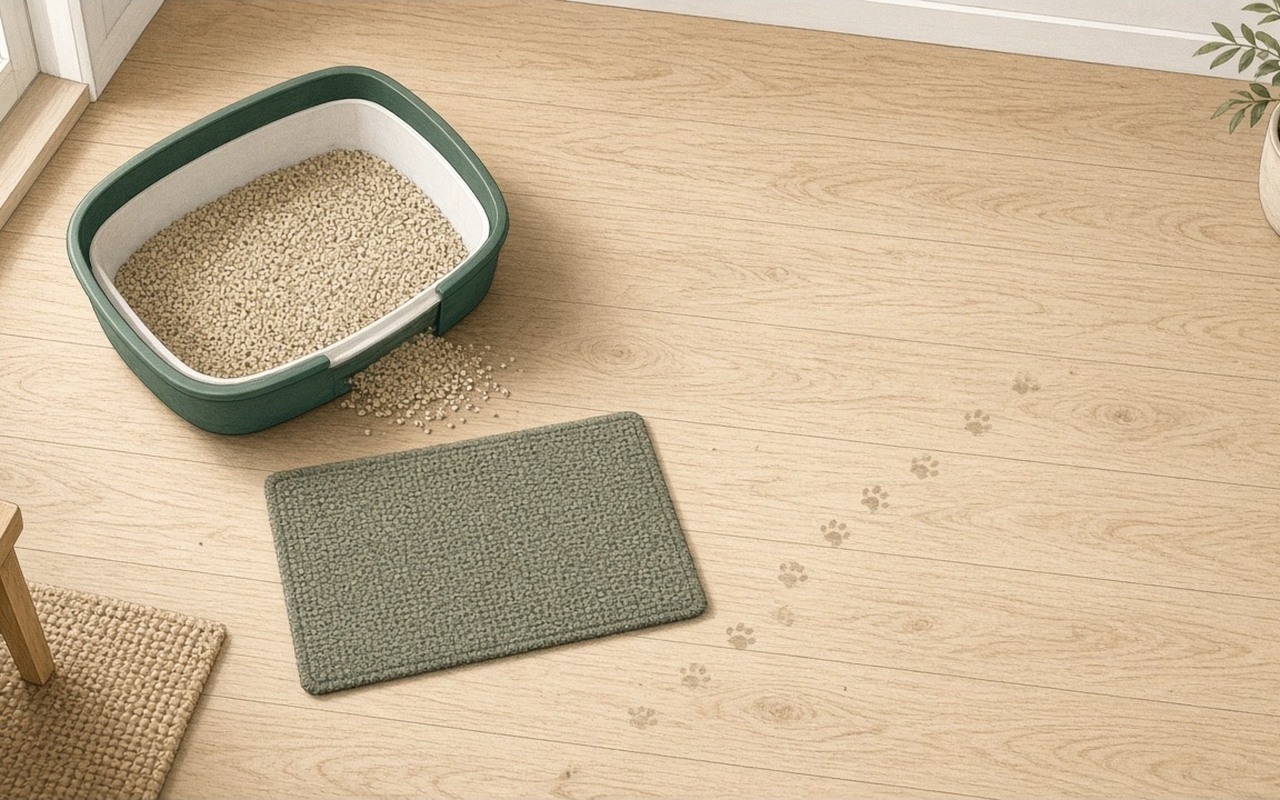
Several manufacturers use larger or heavier granules in their low-tracking designs, but those claims do not establish which product tracks least in your home. Give the cat enough room to turn and use the litter depth specified by the product or box maker. A mat helps only if the cat actually crosses it; do not block access or create a cramped exit to force more steps.
Long-haired cats may carry granules between toe tufts even when a short-haired cat does not. Pellet or larger-grain litter can reduce scatter, but a cat that refuses the texture will create a much bigger problem than a few grains on the floor. Transition gradually and keep the old box available during the test.
Measure before you buy
| Track path | Observe where the cat lands and walks. Place a mat on that route; no universal 3–6 foot minimum is established here. |
|---|---|
| Box floor | The usable floor should let your cat turn without stepping directly into a wall. More turning room reduces frantic digging and side scatter. |
| Litter depth | Follow the exact product instructions or automatic-box fill line. Do not apply one depth to every litter and machine. |
| Bag weight | Verified options here range from 16 to 40 lb. Choose a package you can pour and store safely. |
| Hair and paws | Long toe fur and damp paws carry more litter. Do not assume a label can overcome coat type or grooming needs. |
| Automatic-box fit | Check the box manual for material and granule restrictions before buying; “clumping” alone does not confirm compatibility. |
Low-tracking litter comparison
These Amazon US product identities and selected packages were checked on October 14, 2026. The browser’s delivery destination was Singapore: shipping restrictions in that session do not establish US stock. The table compares format and buying fit, not independently tested dust, tracking or odor performance. No current-price or delivery guarantee is made.
| Option | Best fit | Check before buying | Amazon |
|---|---|---|---|
| Dr. Elsey’s Clean Tracks 40 lb, unscented, medium-grain clumping clay | Best direct match when low tracking is the first filter | Heavy bag; clay still needs a mat and suitable box | View on Amazon |
| Dr. Elsey’s Ultra 40 lb previously checked variant, unscented clumping clay | Another clay option: the manufacturer describes heavy granules combined with medium-grain clay | Confirm size; no CheckPet head-to-head test establishes Clean Tracks as lower tracking | View on Amazon |
| Boxie Pro 16 lb, unscented clumping clay | A lighter package for owners comparing scoopable clay formats | The verified listing emphasizes clumping, odor, and low dust—not a no-tracking guarantee | View on Amazon |
| Purina Tidy Cats Unscented 38 lb selected variant, clumping clay | Unscented activated-charcoal comparison for multi-cat routines | Verify the current package weight and variant before checkout | View on Amazon |
What the manufacturer evidence actually supports
Clean Tracks’ official page identifies natural clay and a medium-grain, unscented clumping formula. Its Directions tab specifies a clean, dry box filled to 3–4 inches, scooping twice daily, topping up as necessary and disposing of used litter in the trash—do not flush. Those are product-specific directions, not a universal fill depth for automatic machines. Check the machine manual before assuming the two requirements agree.
BoxiePro’s official product page describes unscented bentonite clay and offers 16, 28 and 40 lb bags. Its main pitch is odor control and clumping, which does not establish that it tracks less than Clean Tracks. The page’s FAQ answers appear mismatched to their questions; we did not use those answers as compatibility evidence. Purina’s official search did not return the exact Free & Clean formula during this review: that table row is supported by Amazon identity and listing claims, not a newly completed official-label check.
Dr. Elsey’s Ultra product description says it combines heavy granules with medium-grain clay. That supports including Ultra in a clay comparison, not ranking it below Clean Tracks without a controlled comparison.
World’s Best Low Tracking & Dust Control describes larger corn granules and an unscented formula. Its FAQ also says this formula provides fewer days of use than the brand’s other formulas because of the larger granules. This is a useful trade-off to investigate: reduced carryout may come with a different refill cost. Both statements are manufacturer claims, not CheckPet measurements. This corn formula is not one of the Amazon clay options in our table.
A larger-grain formula also needs to work with your scoop: check that clean granules pass through the slots while clumps remain. We have not measured granule dimensions or specified a universal slot width. Dust percentages, tracking performance, and package lifespan are separate claims and cannot substitute for each other.
A repeatable home comparison before a repeat order
Compare cost per usable week, not only cost per pound
A 16 lb bag is 24 lb lighter than a 40 lb bag, or 60% less package weight. That is a handling comparison, not evidence it lasts 60% less time: different routines remove different amounts in clumps and full changes. Count both top-ups and complete replacements during the same observation window.
For example, suppose a bag costs $20 for 40 lb and your log shows 5 lb used per week: the measured consumption would cost $2.50 per week. A hypothetical $14, 16 lb bag at 2 lb per week would cost $1.75 per week despite its higher price per pound. These are invented arithmetic inputs, not current prices or performance for any recommended litter. Calculate your own cost as bag price ÷ bag pounds × pounds used per week; add delivery fees separately. Do not rank value from these examples.
Before repeat delivery, also note the heaviest package you can handle, clean litter discarded because it will not pass through your scoop, and minutes spent cleaning the floor. A lower grain count can still come with more wasted clean litter. Test scoop fit on a clean sample: clean grains should pass while clumps remain; no universal slot width has been measured here.
Use this as a household observation method, not a laboratory test. Mark the same easy-clean area outside the box and clear it at the same time daily. For three baseline days, record visible loose grains, cleanup minutes, and any grains beyond the mat. After a gradual, accepted transition, repeat for three days while keeping the box, mat, depth instructions, and cleaning interval consistent. These three-day windows are our suggested logging method, not a veterinary standard.
Keep kicked-over-rim litter separate from paw-carried litter in your notes. Count days the cat uses the box normally; stop the comparison if avoidance or urinary symptoms appear. A reduction from 60 to 30 counted grains would be a 50% reduction in that marked area, not proof the brand tracks 50% less generally. Record refill amount and cleanup time too: a cleaner floor is not automatically a lower-cost routine.
Best when / skip if
- Your cat already accepts unscented clumping clay
- You can place a mat across the full exit route
- You want firm clumps and can lift the selected bag
- You will compare tracking only after your cat accepts a gradual transition
- Your cat avoids clay or has a strong texture preference
- You need a lightweight package for mobility reasons
- Your automatic box specifies pellets or another substrate
- Sudden box avoidance, straining, or urination changes are present
A setup that keeps more litter near the box
- Keep the transition boring. Mix a small amount of the new litter into the old litter, increasing it gradually. Do not force a sudden switch if your cat hesitates.
- Rotate the exit away from carpet. A wall or screen can create a short turn so the cat crosses more mat before reaching the room.
- Match the landing route. Choose a mat the cat will walk across, without obstructing access. Compare its effect rather than assuming a specified length will solve tracking.
- Vacuum on a fixed schedule. Compare the same 24-hour interval before and after changing litter. Otherwise cleaning frequency distorts the result.
- Keep the box inviting. Scoop at least daily. A cat that jumps quickly out of a dirty box can scatter more litter and may eventually avoid the box.
Common failures
- Buying from the label alone. “Low tracking” is not a standardized promise and cannot account for your cat’s paws, coat, or exit route.
- A tiny mat beside the box. Cats step over it or clear it in one stride.
- Overfilling the pan. Extra depth can turn normal digging into a spray of granules.
- Using a top-entry box without checking mobility. It may contain scatter for some cats but can be unsuitable for kittens, seniors, large cats, or cats with joint limitations.
- Switching texture overnight. A cleaner floor is not worth litter-box avoidance.
Frequently asked questions
Is pellet litter always the lowest-tracking choice?
Pellets are larger and may travel less, but acceptance and box compatibility come first. Some cats dislike the texture, and some automatic boxes require specific clumping litter. Transition gradually rather than replacing every box at once.
Does a covered litter box stop tracking?
A cover can reduce side scatter, but litter still leaves through the doorway on paws. It may also trap odor or feel cramped. Box dimensions, ventilation, and cat preference matter more than the cover alone.
Can I trim the fur between my cat’s toes?
Long paw fur can hold litter, but do not use scissors close to pads unless you know how to do it safely. Ask a groomer or veterinarian for help if trimming is needed.
Related guides
Editorial standards · Affiliate disclosure · Not veterinary advice.