
CheckPet · automatic litter boxes
Best self-cleaning litter boxes
The best automatic litter box is the one your cat can enter safely and your room can actually hold. Compare entrance height, internal space, weight range, litter compatibility, Wi-Fi, and the space needed to remove the waste drawer before spending hundreds of dollars.
On this page
Which automatic litter box format fits?
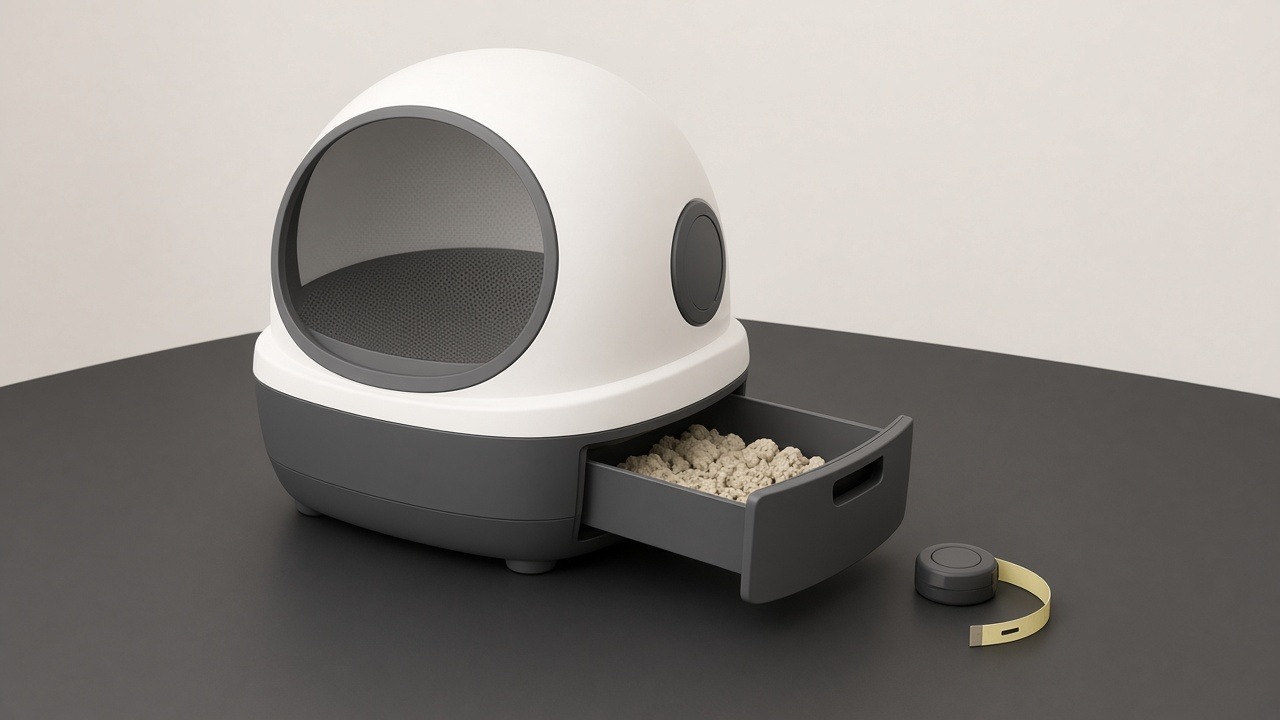
Choose an enclosed rotating model when odor containment and a lower overall profile matter; choose an open-top model when your cat dislikes enclosed spaces or needs more visual and shoulder clearance. Neither format eliminates maintenance. You still need to empty the waste drawer, wipe sensors, deep-clean the drum, monitor litter level, and inspect waste for changes.
Do not buy on “multi-cat” language alone. Similar-weight cats may be difficult for an app to distinguish, and a high-capacity drawer does not replace daily visual checks. Automatic records can reveal patterns, but they are not a diagnosis and should not delay veterinary care.
Measure before you buy
| Machine footprint | Allow at least the listed width and depth, plus clearance to pull the waste drawer and remove the drum. Do not wedge the unit between furniture. |
|---|---|
| Entrance height | Verified listings range from about 4.8 to 7.87 inches. Seniors and cats with mobility limits may need a stable step or the lower entrance. |
| Cat weight | PETKIT lists 3.3–22 lb; Neakasa lists 3.3–33 lb; Meowant lists 3.3–18 lb. Follow the current manual, not a comparison-page summary. |
| Internal opening | Compare shoulder width and turning room, not exterior liters alone. Large cats may prefer an open-top design even when their weight is technically supported. |
| Floor | Weight sensors need a hard, level surface. PETKIT and Meowant explicitly warn against placing a mat underneath the unit. |
| Network | All three verified listings specify 2.4 GHz Wi-Fi. Confirm your router can expose a compatible network before setup. |
| Litter | Check permitted clumping material and granule size in the current manual. Do not assume every clay, tofu, pellet, or crystal litter will sift correctly. |
Self-cleaning litter box comparison
These Amazon pages were checked on October 8, 2026. Specifications below reproduce the selected listing variant and manufacturer claims; CheckPet has not independently lab-tested cycle safety, odor performance, sensor accuracy, or app reliability.
| Model | Best fit | Critical checks | Amazon |
|---|---|---|---|
| PETKIT PuraMax 2 24.21 × 21.96 × 21.96 in; 22 lb machine | Enclosed design, 7.87-in entrance, cats listed at 3.3–22 lb | Not for pets under 6 months per listing; hard flat floor; 2.4 GHz Wi-Fi; verify compatible clumping litter | View on Amazon |
| Neakasa M1 Plus 22 × 20 × 26 in; 22 lb machine | Open-top access and larger-cat range, listed at 3.3–33 lb | Taller body; confirm open space above; kitten/manual mode rules; 2.4 GHz Wi-Fi; drawer clearance | View on Amazon |
| Meowant Automatic Litter Box 20.5 × 20.9 × 21.85 in; 28.8 lb machine | Lower 4.8-in entrance and cats listed at 3.3–18 lb | Internal area listed at 14.9 × 13.7 × 19.7 in; similar-weight cats may be confused; no mat underneath | View on Amazon |
Best when / skip if
- Your cat already uses a box with a similar opening and litter texture
- The cat falls safely inside the current weight and age limits
- You have hard, level flooring and a nearby outlet
- You will inspect the box and waste every day
- You can keep a regular box during a gradual transition
- Your kitten is below the manufacturer’s automatic-cycle threshold
- Your cat is frightened by enclosed spaces, motors, or moving drums
- Your cat is outside the listed weight or interior-size range
- You expect the app to diagnose urinary or digestive problems
- You cannot return a large assembled unit if the cat refuses it
Safety and transition checklist
- Keep the old box. Place the automatic box nearby and leave it powered off until your cat investigates and uses it reliably.
- Match familiar litter. Use a compatible version of the cat’s current litter where the manual permits it. A new box and new texture at the same time create unnecessary refusal risk.
- Start in manual mode. Run cycles only when the cat is away and watching does not cause fear. Follow kitten restrictions in the current manufacturer manual.
- Test every sensor. Confirm a cycle stops when the manufacturer’s test procedure is triggered. Never bypass a safety sensor or defeat the always-open entrance design.
- Inspect daily. Emptying may be less frequent, but check the waste, litter level, liner, drum, entrance, and app alerts every day.
- Keep a fallback box. Power, Wi-Fi, motor, sensor, or liner failures happen. Multi-cat homes should not depend on one machine as the only toilet.
Budget beyond the machine
The checkout price is only the first cost. Compare compatible litter, waste liners, odor-control consumables, replacement parts, warranty length, and return shipping. A proprietary bag or deodorizer can turn a seemingly cheaper machine into the more expensive long-term option.
Before ordering, save the current warranty and returns page, measure the packed return route through your doors, and confirm who pays return freight. Large litter machines are inconvenient and sometimes costly to send back.
Common failures
- Buying by exterior capacity while ignoring the internal opening and turning space.
- Placing a weight-sensing unit on carpet or on top of a mat.
- Turning on automatic cycles before the cat is comfortable with the new box.
- Using incompatible pellets or granules that do not sift through the screen.
- Treating app weight or visit records as medical advice.
- Leaving no conventional box for outages, cleaning days, or a cat that refuses the machine.
Frequently asked questions
Can a self-cleaning litter box replace daily checking?
No. It may reduce scooping, but you still need to inspect waste, confirm the unit cycled, clean sensors, maintain litter level, and notice changes in urination or stool.
Are automatic litter boxes safe for kittens?
Only under the current manufacturer instructions. PETKIT’s verified listing says its automatic mode is not for pets under six months; Neakasa describes a manual kitten mode. Keep automatic cycling disabled until the cat satisfies the specific model’s age and weight rules.
Which format is better for a large cat?
An open-top model may give more shoulder and head clearance, but weight capacity alone is not enough. Compare usable internal dimensions and entry height, then keep the return policy in case the cat will not turn comfortably.
Related guides
Editorial standards · Affiliate disclosure · Not veterinary advice.