
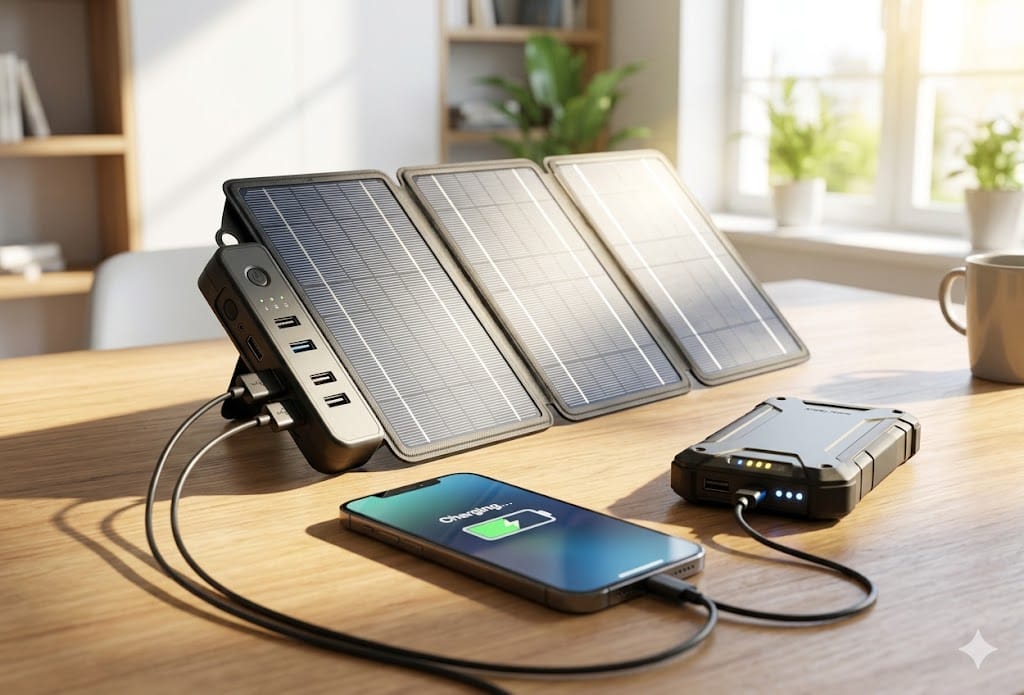
Last summer I did a 10-day backpacking trip through the Sierras with a dead phone by day three. This year, I packed a solar charger and tested five different models across weekend camping trips, beach days, and a week-long road trip. The difference between a good solar charger and a bad one is the difference between staying connected and carrying an expensive paperweight.
Here’s what works, what doesn’t, and the complete outdoor tech kit that kept me powered through every trip this spring.
On this page
- Best Solar Chargers Compared
- How Solar Chargers Actually Work (And Why Most Disappoint)
- 1. Anker 625 Solar Panel (100W) — Best for Car Camping ($75)
- 2. Nekteck 28W — Best Value ($45)
- 3. BioLite SolarPanel 10+ — Best for Backpacking ($80)
- The Complete Outdoor Tech Kit
- Solar Charging Tips That Actually Help
- Bottom Line
Best Solar Chargers Compared
| Charger | Price | Watts | Weight | Best For | Rating |
|---|---|---|---|---|---|
| Anker 625 Solar Panel | $75 | 100W | 5.0 lbs | Car camping, base camp | 9/10 |
| Nekteck 28W | $45 | 28W | 1.3 lbs | Best value | 8.5/10 |
| BioLite SolarPanel 10+ | $80 | 10W | 1.0 lbs | Backpacking (integrated battery) | 8/10 |
| Goal Zero Nomad 20 | $100 | 20W | 1.4 lbs | Reliability + brand support | 8/10 |
| BigBlue 3 USB-A 28W | $50 | 28W | 1.3 lbs | Multiple devices | 7.5/10 |
How Solar Chargers Actually Work (And Why Most Disappoint)
The number one complaint about solar chargers on Reddit is “it doesn’t charge as fast as advertised.” That’s because the wattage rating represents peak output under perfect lab conditions — direct sunlight, perpendicular angle, 77°F, zero cloud cover. Real-world output is typically 50-70% of the rated wattage.
A 28W solar panel realistically delivers 15-20W in good sunlight. That’s enough to charge a phone from 0 to 100% in about 2-3 hours — roughly the same as using a basic wall charger. It’s not fast charging, but it’s enough to keep your devices topped up through a day outdoors.
What matters for real-world performance
Panel efficiency type. Monocrystalline panels (used by Anker, Nekteck) are 20-25% efficient. Polycrystalline panels (used by some budget brands) are 15-18% efficient. CIGS flexible panels are 12-15% efficient but much lighter. For most people, monocrystalline is the right balance of efficiency and price.
Auto-restart after shade. When a cloud passes over your solar panel, charging stops. Good chargers (Anker, Nekteck, Goal Zero) automatically detect when sunlight returns and restart charging. Cheap chargers require you to unplug and replug the device — a deal-breaker if the panel is on your backpack while you’re hiking.
1. Anker 625 Solar Panel (100W) — Best for Car Camping ($75)
If you’re driving to your campsite, the Anker 625 is the clear winner. 100W of output means you can charge a power bank, a phone, and a Bluetooth speaker simultaneously in direct sunlight. The panels fold into a briefcase-sized package and include a kickstand for optimal angle positioning.
I used the Anker 625 at a four-day lakeside campsite and it kept two phones, a power bank, and a camp lantern charged the entire time. On a sunny day, it delivered 60-70W consistently — enough to charge a 10,000mAh power bank from empty in about 2 hours.
Why it’s not for backpacking
Five pounds is too heavy for your pack. It’s also too large to attach to the outside of a backpack while hiking. This is a car-camping and base-camp panel — set it up at your site, point it at the sun, and let it work while you’re doing other things.
2. Nekteck 28W — Best Value ($45)
The Nekteck 28W is the solar charger I recommend to everyone who asks. At $45, it delivers performance that matches panels costing twice as much. Two USB-A ports, monocrystalline cells, auto-restart, and 1.3 lbs makes it versatile enough for both car camping and day hikes.
Attach it to the outside of your backpack with the built-in loops, plug in your phone, and let it charge while you hike. In clear conditions, I consistently got 12-15W — enough for a steady trickle charge that kept my phone above 50% during a full day of GPS navigation and photo-taking.
3. BioLite SolarPanel 10+ — Best for Backpacking ($80)
The BioLite has a unique advantage: a built-in 3,000mAh battery. This means the panel stores energy during the day even when your device isn’t connected. Set it up at camp in the morning, hike without it, and when you return, the stored energy charges your phone in the evening — even after dark.
At 1.0 lbs and 10W, it’s the lightest and lowest-powered option here. The 10W output means charging is slow (3-4 hours for a full phone charge in good sun), but the integrated battery makes it more practical for multi-day trips where you can’t babysit the panel.
The Complete Outdoor Tech Kit
Beyond the solar charger, here’s the rest of my outdoor tech loadout for summer 2026:
Gaia GPS downloads topographic maps for offline use. In areas with no cell signal, your phone becomes a GPS device with detailed trail maps, elevation profiles, and waypoint marking. Download your maps before you leave home — I’ve been caught once without offline maps and it’s not fun.
Safety: Garmin inReach Mini 2 ($300 + $15/month)
If you’re going into backcountry with no cell service, the Garmin inReach Mini 2 is non-negotiable. Satellite SOS, two-way text messaging, and GPS tracking via satellite. It’s saved lives. The $300 price is steep, but it’s the kind of device you buy hoping to never need.
Entertainment: Earbuds + downloaded content
Download podcasts, audiobooks, and music before you leave. The best workout earbuds double as great hiking companions. Water resistance is essential — sweat and surprise rain will destroy non-rated earbuds.
Lighting: BioLite AlpenGlow 250 ($50)
A rechargeable camp lantern that runs for 5+ hours on high and charges via USB-C. Far better than headlamp-in-a-Nalgene hacks. The color modes (warm white, candle flicker, party colors) are surprisingly nice for camp atmosphere.
Photography: Your phone + a mini tripod ($15)
Your phone camera is good enough for outdoor photography in 2026. A $15 flexible mini tripod lets you set up night sky photos, waterfall long exposures, and group shots without asking strangers. The Joby GorillaPod 325 weighs 1.5oz and grips to trees, rocks, and railings.
Solar Charging Tips That Actually Help
Angle matters more than anything. A solar panel pointed directly at the sun produces 2-3x more power than one lying flat. Adjust the angle every hour or two to track the sun’s position.
Charge your power bank, not your phone directly. Solar output fluctuates with clouds and shade. Those fluctuations can confuse phone charging circuits. Charge a power bank from solar (power banks handle variable input better), then charge your phone from the power bank.
Keep panels cool. Solar panel efficiency drops as temperature increases. A panel in direct sun on hot asphalt produces less power than one elevated on a camp chair with airflow underneath. Counterintuitive but true.
Airplane mode while charging. A phone in airplane mode charges 30-40% faster because it’s not wasting power searching for cell signals. If you’re in an area with no signal anyway, airplane mode plus offline GPS maps is the efficient approach.
Bottom Line
For most outdoor trips in summer 2026: get the Nekteck 28W ($45) and a 10,000mAh power bank ($25). Total investment: $70. That combo keeps two phones charged for a 3-4 day camping trip with moderate use. Add the BioLite SolarPanel 10+ ($80) if you’re backpacking and need to minimize weight.
Solar charging isn’t as fast as a wall outlet, and it never will be. But it’s reliable, free after the initial purchase, and removes the anxiety of watching your battery percentage drop when you’re miles from the nearest outlet. Pack it, set it up, and stop thinking about it — exactly how outdoor tech should work.