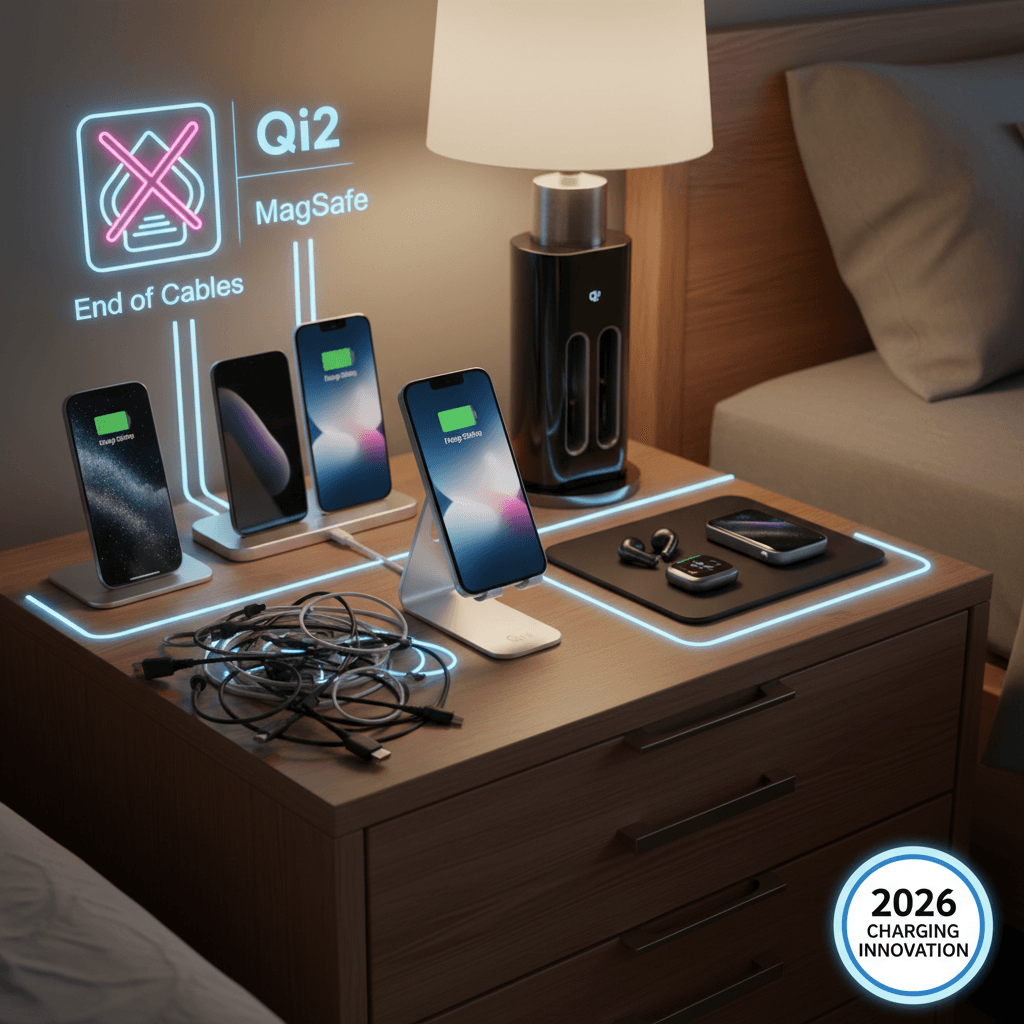
My nightstand used to look like a cable nest — Lightning for the old AirPods, USB-C for the phone, a magnetic puck for the Apple Watch. Three cables, three power adapters, three things to fumble with in the dark before bed. Wireless charging promised to fix this, and it mostly has — if you buy the right charger. The wrong one charges your phone at 5W (which takes about four hours for a full charge) while claiming “fast wireless charging” on the box.
The wireless charging landscape changed meaningfully in 2025-2026 with Qi2, the new universal standard that brings MagSafe-style magnetic alignment to all phones — not just iPhones. Qi2 chargers snap to your phone magnetically, ensure perfect coil alignment every time, and charge at 15W minimum. It’s the first time wireless charging has felt genuinely convenient rather than “convenient but slow.”
I tested six chargers over the past month, measuring actual charging speeds (not the manufacturer’s “up to” claims), heat generation, and real-world usability. If you’re also looking at keeping your devices powered on the go, our best power banks guide covers portable charging.
On this page
- Quick Verdict
- The Reviews
- Anker MagGo Qi2 3-in-1 — Nightstand Problem Solved
- Belkin BoostCharge Pro Qi2 — The Reliable Single Charger
- ESR HaloLock Qi2 Stand — The $30 Winner
- Twelve South HiRise 3 Deluxe — The One That Looks Like Furniture
- Samsung Wireless Charger Duo — Best for Galaxy Users
- Mophie Snap+ Qi2 Pad — The Universal Flat Pad
- Qi2 vs MagSafe vs Qi: The Standards Explained
- What Most People Should Buy
- FAQ
Quick Verdict
| Charger | Price | Type | Max Speed | Devices | Best For |
|---|---|---|---|---|---|
| Anker MagGo Qi2 3-in-1 | ~$80 | Qi2 / MagSafe | 15W phone / 5W earbuds / 5W watch | 3 | Overall best |
| Belkin BoostCharge Pro Qi2 | ~$55 | Qi2 / MagSafe | 15W | 1 | Best single pad |
| ESR HaloLock Qi2 Stand | ~$30 | Qi2 / MagSafe | 15W | 1 | Best value |
| Twelve South HiRise 3 Deluxe | ~$120 | MagSafe | 15W phone / 5W earbuds / watch | 3 | Best design |
| Samsung Wireless Charger Duo | ~$50 | Qi2 | 15W phone / 5W earbuds | 2 | Best for Samsung |
| Mophie Snap+ Qi2 Pad | ~$40 | Qi2 | 15W | 1 | Universal compatibility |
The Reviews
Anker MagGo Qi2 3-in-1 — Nightstand Problem Solved
Price: ~$80 | Type: Qi2 + MagSafe + Apple Watch | Devices: Phone + earbuds + Apple Watch
The Anker MagGo 3-in-1 replaced my three-cable nightstand situation with one device. iPhone snaps magnetically to the angled stand (Qi2 at 15W), AirPods sit on the flat pad at the base (5W), and an Apple Watch puck charges on the side (Apple Watch fast charging at 7.5W on Series 8+). One power cable from the wall, three devices charging. Done.
Actual charging speed for the phone: 0-50% in 38 minutes, 0-100% in 2 hours 15 minutes. That’s slower than a 20W wired charger (0-50% in 25 minutes) but fast enough for overnight charging with plenty of margin. The magnetic alignment is strong — I knocked the stand accidentally and the phone stayed attached.
The base is weighted enough to not tip when you one-hand-pull the phone off the magnetic mount. This sounds trivial but several magnetic chargers are light enough that detaching the phone lifts the entire charger off the table. The Anker stays put.
The good: Three-device charging, strong magnets, stable base, compact footprint, reasonable price. The less good: Apple Watch spot only works with Apple Watch (not Samsung/Pixel watches), fan noise audible in quiet rooms at night, plastic build.
Belkin BoostCharge Pro Qi2 — The Reliable Single Charger
Price: ~$55 | Type: Qi2 + MagSafe | Devices: 1 (phone only)
If you just want one good charger for your phone, the Belkin BoostCharge Pro is the one. It’s a flat pad with strong Qi2 magnets that charges iPhones and Qi2-compatible Android phones at 15W. No extra devices, no unnecessary features, no software. You put your phone on it and it charges. Belkin has been making wireless chargers since the Qi 1.0 days, and the reliability shows — zero charging failures, zero disconnections, zero overheating events in my month of testing.
The alignment magnets are slightly stronger than the Anker, which means even cases with thicker bezels align properly. I tested with an OtterBox Defender (a thick case) and it charged without issues — something that trips up cheaper Qi2 chargers whose magnets aren’t strong enough to maintain alignment through heavy cases.
The good: Rock-solid reliability, strong magnets, works through thick cases, premium build. The less good: Single device only, no watch/earbuds charging, $55 for a basic pad is steep, no included power adapter.
ESR HaloLock Qi2 Stand — The $30 Winner
Price: ~$30 | Type: Qi2 + MagSafe | Devices: 1 (phone only)
The ESR HaloLock delivers 15W Qi2 charging in a stand format for $30. That’s remarkable value. The stand holds your phone at a comfortable viewing angle, so you can see notifications, run StandBy mode (iOS), or watch a video while charging. The magnets are adequate — not as strong as Belkin, but sufficient for standard and thin cases.
Build quality is decent for the price. The stand is lightweight aluminum with a rubberized base that grips desks well. The USB-C cable is detachable (replaceable if it fails), and ESR includes a 20W power adapter — something the $55 Belkin doesn’t include.
“Stop overthinking wireless chargers. Buy the ESR for $30. It charges at 15W, it has magnets, it works. I’ve bought three of them — one for office, one for nightstand, one for kitchen. At this price you can put them everywhere.” — u/pragmatic_charger, r/MagSafe
The good: Incredible value, stand format, includes power adapter, USB-C detachable cable. The less good: Weaker magnets than Belkin, lighter base can tip with heavier phones, no multi-device charging.
Twelve South HiRise 3 Deluxe — The One That Looks Like Furniture
Price: ~$120 | Type: MagSafe + Apple Watch | Devices: 3 (iPhone + AirPods + Apple Watch)
The Twelve South HiRise 3 is what happens when an industrial designer makes a charging station instead of an engineer. The chrome-and-leather base looks like a miniature piece of mid-century furniture. It’s the charging station you buy when your nightstand is walnut and you’d rather not put a plastic gadget on it.
Functionally, it does what the Anker does at 50% more cost: charges iPhone at 15W via MagSafe, AirPods at 5W on the base, and Apple Watch on a flip-up puck. Charging speeds are identical. The difference is build materials (zinc alloy and vegan leather versus Anker’s plastic) and aesthetics.
At $120, this is an aesthetic tax. If your desk or nightstand setup matters to you — and for some people, it genuinely does — the HiRise 3 is the only charger here that looks like it belongs in a designed space rather than on a shelf at Best Buy.
The good: Premium materials, beautiful design, Apple ecosystem integration, stable and heavy. The less good: $120 for the same charging specs as an $80 Anker, Apple-only (no Qi2 for Android), no power adapter included.
Samsung Wireless Charger Duo — Best for Galaxy Users
Price: ~$50 | Type: Qi2 | Devices: 2 (phone + earbuds/watch)
Samsung’s Charger Duo is optimized for Samsung devices. Galaxy S-series phones charge at 15W via Qi2, and Samsung Galaxy Buds or Galaxy Watch charge on the secondary pad at 5W. The auto-detect feature recognizes Samsung devices and applies the optimal charging profile — a nice touch that reduces heat and extends battery longevity.
Cross-brand compatibility works (it’s Qi2), but Samsung-specific features like SmartThings integration, charging notifications, and scheduled charging are Samsung-only. If your ecosystem is Samsung, the integration adds genuine value. If it’s not, the Belkin or ESR are better universal options.
The good: Dual-device charging, Samsung ecosystem integration, sleek design, competitive price. The less good: Best features are Samsung-exclusive, no Apple Watch support, secondary pad is slow (5W).
Mophie Snap+ Qi2 Pad — The Universal Flat Pad
Price: ~$40 | Type: Qi2 | Devices: 1
The Mophie Snap+ is the most universally compatible charger here. Qi2 for phones, and the flat pad design means you can place any Qi-compatible device on it — older phones without magnets, earbuds cases, even Qi-enabled power banks. The snap ring magnets are integrated for Qi2 devices, but the pad also works without magnetic alignment for older devices (at 7.5W instead of 15W).
Build quality is typical Mophie — good plastic with a fabric top surface that prevents scratching. The rubber feet keep it in place. No fans, no noise. It’s a pad. It charges. It works with everything. Sometimes that’s exactly what you need.
The good: Universal compatibility (Qi and Qi2), quiet, slim, works with older devices. The less good: Single device, slower for non-Qi2 devices, no stand option, forgettable design.
Qi2 vs MagSafe vs Qi: The Standards Explained
Qi (first generation): The original wireless charging standard. No magnets, no alignment assistance. You drop your phone on a pad and hope the coils align. Maximum speed varies (5W-15W depending on device). Still works on all Qi2 chargers.
MagSafe: Apple’s proprietary magnetic charging system for iPhone 12+. Ring of magnets ensures perfect alignment. Charges iPhones at 15W. Only certified MagSafe chargers hit 15W; third-party Qi chargers are limited to 7.5W on iPhones.
Qi2: The new universal standard, based on MagSafe’s magnetic alignment but open to all manufacturers. Qi2 chargers work with iPhones at 15W (as MagSafe) and with Qi2-compatible Android phones at 15W+. Samsung Galaxy S25 series and Google Pixel 9 series are among the first Android phones with Qi2 support. This is the standard that matters going forward — buy Qi2 chargers, not MagSafe-only or old Qi chargers.
What Most People Should Buy
The nightstand (multiple Apple devices): Anker MagGo 3-in-1 at $80. Charges phone, earbuds, and watch from one cable.
The desk (single phone): ESR HaloLock at $30. Stand format, 15W, includes adapter. Buy three and put them everywhere.
Samsung ecosystem: Samsung Charger Duo at $50. The SmartThings integration adds real value for Galaxy users.
Universal / mixed devices: Mophie Snap+ at $40 if you need backward compatibility with older Qi devices.
FAQ
Does wireless charging damage phone batteries?
Wireless charging generates more heat than wired charging, and heat accelerates battery degradation. However, modern phones manage this with thermal throttling and optimized charging (slowing charge rate when the battery is above 80%). The practical difference in battery health over 2-3 years of typical use is minimal — maybe 2-5% more degradation than wired. If you want to minimize degradation, charge to 80% instead of 100%, regardless of wired or wireless.
Do I need to remove my phone case for wireless charging?
For Qi2/MagSafe chargers: no, as long as your case is Qi2 or MagSafe compatible (has the magnetic ring). Most modern cases from major brands include this. For thick cases (OtterBox Defender, etc.), ensure the charger has strong enough magnets — the Belkin BoostCharge Pro handles thick cases best.
Is 15W wireless fast enough?
For overnight charging: absolutely. 15W charges a typical phone to 100% in about 2-2.5 hours. For quick top-ups when you need 50% in 20 minutes, wired charging (30-45W) is still faster. Wireless charging is about convenience, not speed. If you need speed, use a cable. If you want to just drop your phone and forget it, wireless is the way.
Can I wirelessly charge through a PopSocket or wallet case?
MagSafe/Qi2 PopSockets that snap on magnetically are designed to work — you attach and remove them before charging. Wallet cases (MagSafe wallet, etc.) should be removed before charging. Non-magnetic PopSockets and thick wallet cases will block or severely slow wireless charging. Check your specific case/accessory for Qi2 compatibility.
Ethan Caldwell’s nightstand now has one cable instead of three and he considers this a major quality-of-life upgrade. More at WU120 Best Picks.