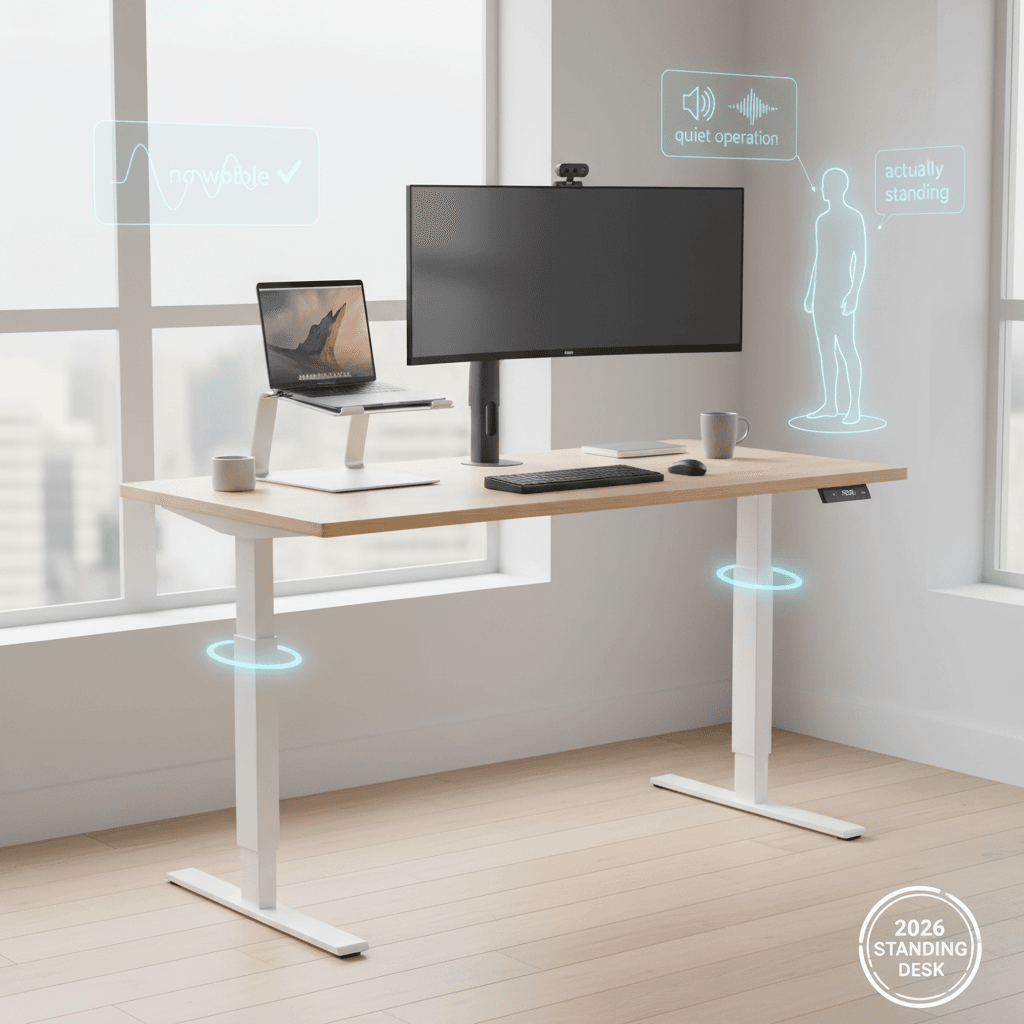
I bought my first standing desk in 2022 with the conviction that standing while working would transform my health, my productivity, and possibly my entire life. Four years later, here’s what actually happened: I stand for about 90 minutes per day (not the 4 hours I intended), the health benefits are modest but real (less lower back pain, slightly more energy after lunch), and the thing I care about most is whether the desk wobbles when I type — because a wobbling monitor at standing height is infuriating in a way that a wobbling monitor at sitting height isn’t.
I tested five electric standing desks between $250 and $500, each for at least two weeks in my home office with a full setup: 27-inch monitor on an arm, laptop, keyboard, mouse, and a coffee mug that I refuse to remove. If you’re not ready for a full desk and want something that sits on top of your existing desk, our standing desk converter guide covers that option, and the small space converter guide handles tight setups.
Quick Verdict
| Desk | Price | Top Size | Height Range | Motor | Wobble (standing) | Best For |
|---|---|---|---|---|---|---|
| Uplift V2 Commercial | ~$480 | 48″x30″ | 22.6″-48.7″ | Dual | Minimal | Overall best |
| FlexiSpot E7 Pro | ~$400 | 48″x24″ | 22.8″-48.4″ | Dual | Low | Best value |
| Fully Jarvis Bamboo | ~$470 | 48″x30″ | 25.5″-51″ | Dual | Low | Tallest users |
| Branch Standing Desk | ~$450 | 48″x30″ | 24.5″-50″ | Dual | Low | Aesthetics |
| IKEA BEKANT | ~$350 | 47″x31.5″ | 22″-48″ | Single | Noticeable | Budget / IKEA fans |
The Reviews
Uplift V2 Commercial — The Stability Standard
Price: ~$480 | Top: 48″x30″ | Motor: Dual | Weight Capacity: 355 lbs | Warranty: 15 years
The Uplift V2 Commercial is the desk I kept after testing all five. The reason is simple: it wobbles less than any other desk here at standing height. Wobble is the spec that matters most and is measured least — most desk reviews talk about speed, weight capacity, and appearance, then mention wobble in passing. But wobble is what you feel every time you type, every time you lean on the desk, every time you accidentally bump the frame with your knee.
At standing height (about 44 inches for me), the Uplift has negligible side-to-side wobble and zero front-to-back wobble. I tested this by placing a cup of water on the desk and typing aggressively — no visible surface movement. The FlexiSpot and Fully showed slight ripples. The IKEA BEKANT had visible water movement. This matters because a wobbling monitor causes eye strain and typing disruption that accumulates over hours.
The “Commercial” version adds a cross-support bar between the legs that the standard V2 lacks. This bar is the primary reason for the improved stability, and it’s worth the $50 premium over the non-Commercial model. Assembly took 45 minutes solo — the instructions are clear, the hardware is labeled, and the frame is heavy but manageable.
The 15-year warranty is the longest here and covers the frame, motor, and electronics. Uplift’s customer service has a strong reputation on r/StandingDesk, with multiple users reporting smooth warranty claims for motor issues.
The good: Best stability at standing height, cross-support bar, 355 lb capacity, 15-year warranty, wide height range. The less good: $480 is top of the budget, heavier frame makes moving harder, desktop options are limited at the base price (upgrades cost extra).
FlexiSpot E7 Pro — 90% of the Uplift at 83% of the Price
Price: ~$400 | Top: 48″x24″ | Motor: Dual | Weight Capacity: 310 lbs | Warranty: 10 years
The FlexiSpot E7 Pro is the desk I recommend to most people because the performance gap between it and the Uplift is smaller than the price gap suggests. Stability at standing height is good — there’s a faint wobble with aggressive typing that the Uplift doesn’t have, but it’s not visible on the monitor and doesn’t affect work. The dual-motor lift is smooth and quiet (under 45dB, comparable to a refrigerator hum).
The 24-inch depth (versus 30 inches on the Uplift and Fully) is the main functional compromise. 24 inches is adequate for a monitor on an arm plus a keyboard and mouse, but it’s tight if you want to push the monitor back for comfortable viewing distance. If you use a 27-inch monitor without an arm, the screen will be closer than ergonomically ideal. For dual monitors, the 30-inch depth options are better. FlexiSpot offers a 30-inch top as an upgrade for about $50 more.
The control panel has 4 programmable height presets, an anti-collision sensor, and a child lock. The anti-collision sensor stopped the desk twice during testing when I left a chair arm in the path — a genuinely useful safety feature that prevented damage to both the desk and the chair.
“Had the E7 Pro for 14 months. Zero issues. The motor is silent, the presets work perfectly, and it hasn’t developed any wobble over time. For $400 I don’t know what else you’d want.” — u/flexispot_fan_not_shill, r/StandingDesk
The good: Excellent value, smooth dual motor, programmable presets, anti-collision, 10-year warranty. The less good: 24-inch depth is tight, stability a step below Uplift, less configurability, desktop material options limited.
Fully Jarvis Bamboo — For the Tall and the Eco-Conscious
Price: ~$470 | Top: 48″x30″ bamboo | Motor: Dual | Weight Capacity: 350 lbs | Warranty: 15 years
The Jarvis has the tallest maximum height here: 51 inches. If you’re over 6’2″, most standing desks don’t go high enough for ergonomically correct standing posture — you end up hunching slightly. The Jarvis solves this. At 6’4″, my ideal standing height is about 47 inches, and the Jarvis reaches it with room to spare. The Uplift’s 48.7-inch max is close; the IKEA BEKANT’s 48-inch max isn’t enough.
The bamboo desktop is the visual standout — warm, natural, and sustainably sourced. It’s harder and more moisture-resistant than standard particleboard desktops, and the grain pattern gives each desk a unique character. The environmental angle isn’t greenwashing; Fully is a B-Corp and the bamboo sourcing is documented and third-party verified.
Stability is good but not Uplift-level. The Jarvis lacks the cross-support bar, and at maximum height extension, there’s noticeable wobble with side pressure. At normal standing height (44-47 inches), wobble is present but manageable — comparable to the FlexiSpot. Below 44 inches (seated height), it’s rock solid.
The good: Tallest height range, beautiful bamboo top, 15-year warranty, B-Corp sustainability. The less good: No cross-support bar, wobble at max height, bamboo top adds to price, limited color options.
Branch Standing Desk — The One That Looks Like Furniture
Price: ~$450 | Top: 48″x30″ | Motor: Dual | Weight Capacity: 275 lbs | Warranty: 12 years
Branch makes office furniture that doesn’t look like office furniture. The Standing Desk has rounded edges, powder-coated steel legs with a slim profile, and desktop finishes (walnut, white oak) that match residential interiors. If your home office is in a living room or bedroom where a utilitarian standing desk would look out of place, Branch is the brand that cares about aesthetics as much as function.
Performance is good across the board. Dual motor, smooth transitions, quiet operation, stable at standing height (wobble comparable to the FlexiSpot — present but unobtrusive). The 275 lb weight capacity is the lowest here, but unless you’re mounting multiple monitors on heavy arms plus a printer, you won’t approach it.
The cable management tray is the best included option — a fabric channel under the desktop that hides power strips and cables cleanly. Other desks sell cable management as a $30-50 add-on. Branch includes it.
The good: Best-looking desk, included cable management, quality finishes, 12-year warranty. The less good: Lowest weight capacity, fewer customization options, smaller brand (less community troubleshooting), slightly wobbly at max height.
IKEA BEKANT — The Budget Pick With Budget Trade-Offs
Price: ~$350 | Top: 47″x31.5″ | Motor: Single | Weight Capacity: 154 lbs | Warranty: 10 years
The BEKANT is the cheapest electric standing desk from a major brand, and it’s adequate — if you understand what “adequate” means in this context. The single motor is slower (about 1.5 inches/second versus 1.7-2.0 for dual-motor desks), louder, and lacks programmable presets. You hold a button up or down to adjust height. Every time. There’s no memory, so finding your preferred standing height is a daily exercise in approximation.
Stability is the BEKANT’s biggest weakness. At standing height, typing causes visible monitor wobble. It’s not catastrophic — the monitor doesn’t shake violently — but it’s a constant, low-level annoyance that the dual-motor desks don’t have. The 154 lb weight capacity limits you to a basic setup: one monitor (not on a heavy arm), a laptop, keyboard, and mouse. A dual-monitor setup with boom arms will exceed the capacity.
The 31.5-inch depth is the deepest here, which is nice for comfortable monitor distance. And you can buy it in-store at IKEA, avoiding shipping costs ($50-100 from other brands) and the uncertainty of delivery timing. If you’re near an IKEA, the BEKANT at $350 out-the-door is a reasonable first standing desk. Just know that every desk above it on this list is meaningfully better.
The good: Cheapest, available in IKEA stores (no shipping), deepest desktop, 10-year warranty. The less good: Single motor, no presets, noticeable wobble, lowest weight capacity, loud operation.
Do Standing Desks Actually Improve Health?
The honest answer is: modestly, and less than you’d expect from the marketing. Standing burns about 50 more calories per hour than sitting — the equivalent of half a banana. You’re not going to lose weight by standing at your desk. The real benefits are orthopedic: reduced lower back pressure, improved posture awareness, and the movement involved in transitioning between sitting and standing.
The research supports alternating between sitting and standing throughout the day — not standing all day, which creates its own problems (leg fatigue, varicose veins, foot pain). The ergonomic consensus is 30-45 minutes standing per 60-90 minutes sitting. I use a timer app that reminds me to switch, and I stand for about 3-4 sessions per day totaling 90-120 minutes.
The best standing desk benefit I’ve experienced isn’t physical — it’s attentional. When I’m stuck on a problem, standing up and continuing to work changes my mental state in a way that staying seated doesn’t. It’s a micro-reset that doesn’t require leaving the desk. Whether this is placebo or physiology, I don’t care — it works for me.
Our ergonomic chairs guide covers the sitting half of the equation, and the ultimate desk setup guide puts it all together.
FAQ
What’s the ideal desk size for a home office?
48″x30″ covers most setups: one monitor on an arm, a laptop to the side, keyboard, mouse, and space for a notebook. If you use dual monitors, consider 60″x30″. If space is tight, 48″x24″ works but feels cramped with anything beyond a basic setup. Measure your available space including clearance for the desk to move up and down without hitting shelves or windowsills.
How loud are standing desk motors?
Dual-motor desks: 40-48dB (quieter than a conversation). Single-motor desks: 50-55dB (noticeable but brief — transitions take 10-15 seconds). None are loud enough to disrupt a video call if you mute during transitions. The Uplift and FlexiSpot are the quietest; the IKEA BEKANT is the loudest.
Can I use my existing desktop with a new frame?
Most brands sell frames separately (no desktop included) for $50-100 less. You can use any solid-core door, butcher block countertop, or existing desktop if it’s at least 3/4 inch thick. IKEA countertops (KARLBY, EKBACKEN) are popular budget desktop options at $80-200. This combination (standalone frame + IKEA countertop) is the most popular setup on r/StandingDesk.
Standing desk or standing desk converter?
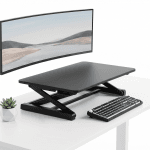
If you’re renting and don’t want to buy/move a full desk: converter. If you own your space and want the best experience: full standing desk. Converters sit on existing desks and raise/lower a platform — they’re portable but wobbly, limited in height range, and take up desk space even when lowered. Full standing desks are the permanent solution. Our converter guide covers the trade-offs in detail.