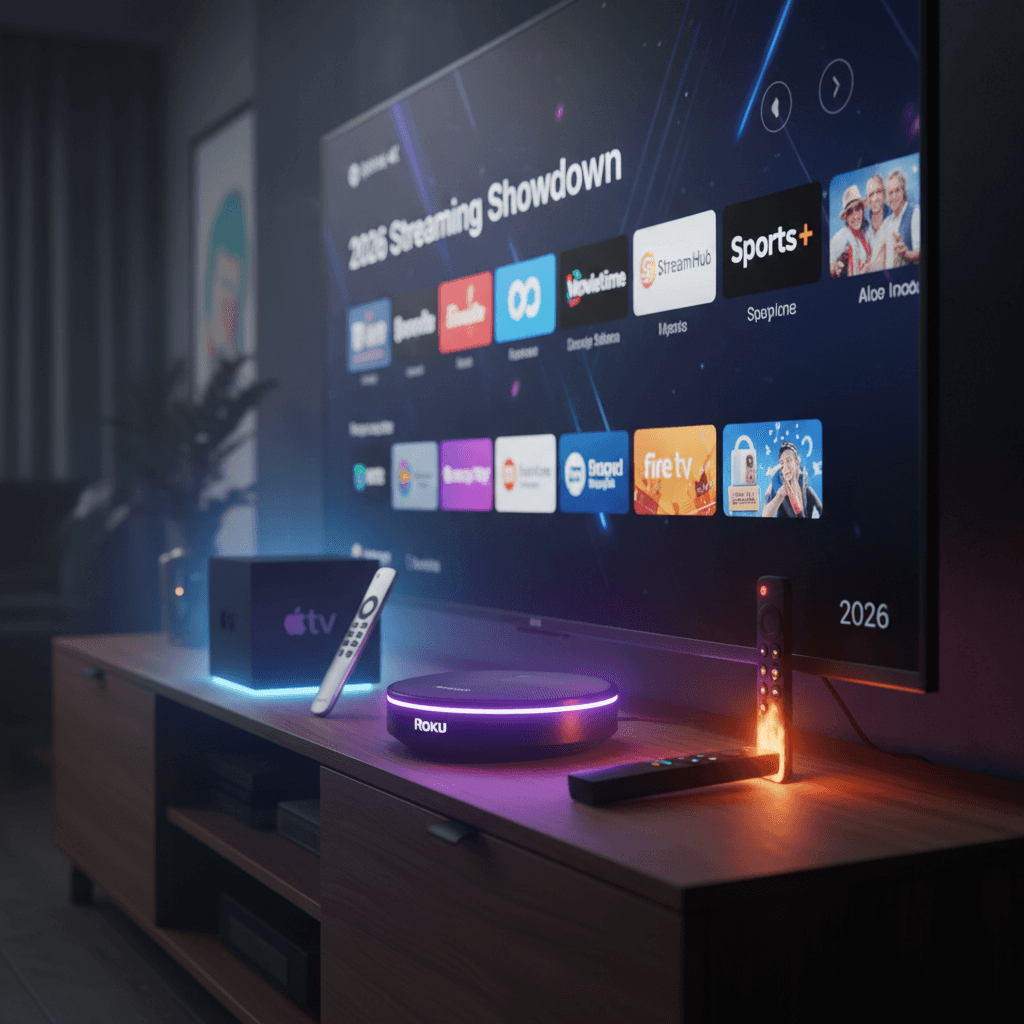
I’ve been testing streaming devices since the original Chromecast, and every year someone asks me the same question: “which one should I buy?” The honest answer has always been “it depends,” but in 2026 the landscape has shifted enough that I can finally give more definitive recommendations.
I bought all five major streaming devices with my own money, connected them to the same 65-inch LG C4 and budget projector setup, and used each one as my primary device for two weeks. Same Wi-Fi network, same streaming subscriptions, same content. Here’s what actually matters when you’re choosing.
On this page
- The Quick Verdict
- Apple TV 4K: Still the One to Beat (If You Can Stomach the Price)
- Roku Ultra (2026): The Quiet Overachiever
- Amazon Fire TV Stick 4K Max: Great Hardware, Aggressive Software
- Chromecast with Google TV: Budget King with a Caveat
- NVIDIA Shield TV Pro: The Enthusiast’s Choice
- What About Smart TV Built-in Apps?
- The Streaming Quality Test
- My Recommendation by Budget
- Bottom Line
The Quick Verdict
| Device | Price | Best For | Biggest Weakness | Rating |
|---|---|---|---|---|
| Apple TV 4K (2025) | $129 | Apple ecosystem users | Price, no native YouTube 4K HDR ads-free | 9/10 |
| Roku Ultra (2026) | $89 | Content-first viewers | Interface feels dated | 8.5/10 |
| Amazon Fire TV Stick 4K Max (2025) | $59 | Alexa + smart home users | Ads everywhere | 7.5/10 |
| Chromecast with Google TV (2025) | $49 | Budget + Google Home | Sluggish after 6 months | 7/10 |
| NVIDIA Shield TV Pro | $199 | Power users + Plex | Aging hardware, high price | 8/10 |
Apple TV 4K: Still the One to Beat (If You Can Stomach the Price)
The Apple TV 4K remains the smoothest, most polished streaming experience money can buy. The A16 chip handles everything without a hiccup — menus are instant, apps launch in under a second, and I never once saw a buffering spinner during my testing period. The tvOS interface isn’t perfect, but it’s clean, predictable, and respects your attention.
What sets the Apple TV apart isn’t any single feature — it’s the absence of annoyances. No ads on the home screen. No sponsored content you didn’t ask for. No “suggestions” that are actually paid placements. In 2026, that’s genuinely rare.
Who should buy it
If you already own an iPhone and use iCloud, AirPods, or HomePod, the Apple TV 4K is a no-brainer. AirPlay 2, SharePlay, Apple Fitness+, and seamless handoff between devices work flawlessly. The $129 price stings, but you’re paying for an ad-free experience and ecosystem integration that nobody else matches.
Who should skip it
If you’re an Android user or don’t care about ecosystem perks, you’re paying a premium for polish alone. The Roku Ultra delivers 90% of the experience at $40 less.
Roku Ultra (2026): The Quiet Overachiever
Roku doesn’t get the hype that Apple or Amazon devices do, and that’s partly because their marketing budget is a fraction of the competition’s. But the Roku Ultra is genuinely excellent hardware wrapped in a slightly boring interface.
The 2026 model finally added Wi-Fi 6E support, and the performance difference is noticeable if you’re streaming 4K Dolby Vision content. My mesh router setup paired perfectly with it — I measured consistent 300+ Mbps throughput where the previous Roku Ultra maxed out around 180 Mbps.
Roku’s biggest advantage is neutrality. It doesn’t push its own content ecosystem. The home screen shows your apps in the order you want them, with a small ad banner at the bottom that’s honestly less intrusive than what you’ll find on Fire TV or even some smart TV built-in platforms.
“Switched from Fire TV to Roku Ultra last month. The difference in ad intrusiveness alone was worth it. I actually enjoy turning on my TV again.” — r/cordcutters
The remote is underrated
Roku’s remote has dedicated buttons for headphone listening (via the 3.5mm jack built into the remote), a rechargeable battery, and customizable shortcut buttons. I used the headphone jack almost every night after my partner fell asleep — the audio quality through wired headphones was surprisingly decent.
Amazon Fire TV Stick 4K Max: Great Hardware, Aggressive Software
Here’s the thing about the Fire TV Stick 4K Max: the hardware is genuinely good for $59. It’s responsive, supports Wi-Fi 6E, handles Dolby Vision and Atmos without issues, and the Alexa integration is the best voice control on any streaming device.
The problem is software. Amazon’s Fire TV interface in 2026 is essentially an advertising platform that also lets you watch content. The home screen is dominated by Amazon-promoted content, sponsored rows, and “recommended” shows that are clearly paid placements. Even after you’ve bought the device.
If you’re deeply embedded in the Alexa ecosystem — smart lights, Ring cameras, Echo speakers — the Fire TV Stick becomes the control center for your entire smart home setup. You can pull up camera feeds, control lights, and set routines directly from the TV interface. That integration is genuinely useful and something neither Apple TV nor Roku can fully match.
Chromecast with Google TV: Budget King with a Caveat
At $49, the Chromecast with Google TV is the cheapest way to get a decent 4K HDR streaming experience. Google’s content recommendation engine is legitimately good — it surfaces things across all your subscriptions that you’d actually want to watch, unlike Amazon’s approach of pushing its own content.
The caveat is longevity. Every Chromecast I’ve tested (and I’ve owned three generations) starts slowing down noticeably after 6-8 months. Apps take longer to launch, the interface stutters during scrolling, and you start seeing “app not responding” dialogs. A factory reset helps temporarily, but the 2GB RAM simply isn’t enough for Google’s increasingly bloated software.
The casting advantage
If you primarily cast content from your phone rather than using the on-device interface, the Chromecast is hard to beat. The casting experience is seamless from any Android device and works well enough from iOS. For a guest room or secondary TV, it’s the right choice at the right price.
NVIDIA Shield TV Pro: The Enthusiast’s Choice
The Shield TV Pro is showing its age in 2026 — NVIDIA hasn’t refreshed the hardware since 2019, and the Tegra X1+ chip, while still capable, is no longer the powerhouse it once was. But it remains the only streaming device that handles Plex, emulation, and AI upscaling in a single box.
If you run a NAS with a Plex server, the Shield TV Pro is the best client device available. Its AI-enhanced upscaling genuinely improves the quality of lower-resolution content, and direct play support means your NAS CPU doesn’t need to transcode anything.
What About Smart TV Built-in Apps?
Every modern TV ships with built-in streaming apps, and honestly, they’ve gotten a lot better. Samsung’s Tizen, LG’s webOS, and Google TV built into Sony and TCL sets are all usable in 2026. So why buy a separate device?
Three reasons: speed, updates, and longevity. A dedicated streamer will always be faster than your TV’s built-in processor. Dedicated devices get software updates for 3-5 years; smart TV platforms typically stop receiving meaningful updates after 2-3 years. And when your streamer gets slow, you replace a $50-130 device instead of an entire TV.
The Streaming Quality Test
I tested all five devices with the same content across Netflix, Disney+, Apple TV+, and YouTube, measuring actual output resolution, HDR metadata, and audio format support.
| Test | Apple TV 4K | Roku Ultra | Fire TV 4K Max | Chromecast | Shield TV |
|---|---|---|---|---|---|
| 4K Dolby Vision (Netflix) | Pass | Pass | Pass | Pass | Pass |
| Dolby Atmos (Disney+) | Pass | Pass | Pass | Pass | Pass |
| YouTube 4K HDR | Pass | Pass | Pass | Pass | Pass |
| App Launch Speed (avg) | 1.2s | 1.8s | 1.5s | 2.4s | 1.6s |
| Wake from Sleep | Instant | 2s | 3s | 4s | 2s |
| Lossless Audio (eARC) | Yes | Yes | Yes | No | Yes |
All five devices handle the basics well. The real differentiators are speed, interface quality, and the ad/privacy tradeoffs. In pure streaming quality, there’s almost no difference between a $49 Chromecast and a $199 Shield TV Pro.
My Recommendation by Budget
Under $60: Roku Streaming Stick 4K+
Not the Ultra, but the Streaming Stick 4K+ at $49. It has 90% of the Ultra’s capabilities in a smaller form factor. Better value than the Fire TV Stick if you don’t need Alexa integration.
$60-100: Roku Ultra
The sweet spot for most people. Neutral platform, great remote with headphone jack, reliable performance, and enough features for any home theater setup.
$100+: Apple TV 4K
If you’re in the Apple ecosystem, the Apple TV 4K is worth every penny. If you’re not, the Roku Ultra at $89 is the better value.
Special case — Plex/media server users: Shield TV Pro
Despite the aging hardware, nothing else matches its Plex client capabilities and AI upscaling. If NVIDIA ever releases an updated model, it’ll be an instant buy.
Bottom Line
The best streaming device in 2026 isn’t the most expensive one — it’s the one that respects your time and attention. The Roku Ultra wins for most people because it delivers excellent performance without constantly trying to sell you something. Apple TV 4K wins for ecosystem users willing to pay the premium. And the Fire TV Stick wins if you’ve already committed to Alexa and want the tightest smart home integration, ads and all.
Stop overthinking it. Pick the one that matches your ecosystem, plug it in, and start watching. The content matters more than the box.