
CheckPet · outdoor play
Best dog fetch toys for your field, water, and throwing style
A fetch toy has to fit two players and one place. Start with the landing area and your dog’s mouth size, then choose a ball, launcher, flexible disc, or floating bumper. A toy that flies farther is not automatically safer—or easier to retrieve.
On this page
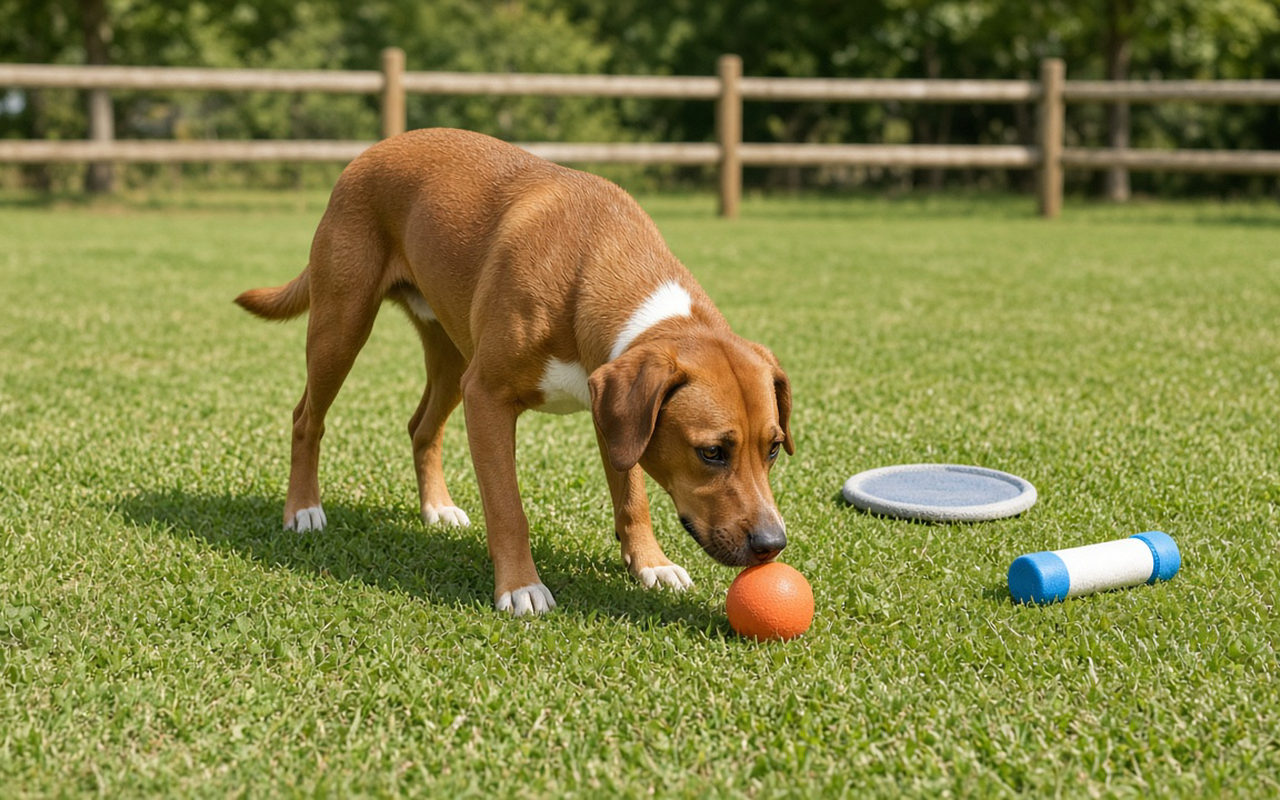
Measure before you buy: map the whole throw
Stand where you actually throw. A long launcher may be useful in a broad, fenced field and awkward in a narrow yard with branches, paving, or nearby roads. A disc needs a clear flight lane and enough room for the dog to slow down. Water fetch adds current, shoreline access, visibility, and the dog’s swimming ability. Those constraints matter more than a generic “best overall” label.
- Clear landing and braking zone
- Toy remains visible in grass or water
- Dog can pick it up without swallowing risk
- Throw distance stays within recall and control
- Roads, drop-offs, glass, ice, or hidden holes
- Blind water entry or difficult shoreline exit
- Dog repeatedly collides, skids, or cannot disengage
- Another dog guards the toy or blocks the return path
Best when / Skip if
Best when: the format solves a specific constraint in a known play area—the right-size ball for a clear yard, a medium launcher for less bending, a flexible disc for controlled open-air throws, or a visible bumper for supervised water retrieval. Skip if: the toy can disappear inside the mouth, the landing zone is blind or unfenced, water entry or exit is uncertain, or the dog turns every return into sustained chewing or guarding.
Pass the mouth-size and return-path gate
| Ball diameter | The medium Ultra Ball is 2.5 inches and the current Amazon US listing identifies it for roughly 20–60 lb dogs. Weight is only a starting point: the ball must be carryable but too large to disappear fully into the mouth. When uncertain, size up. |
|---|---|
| Disc edge | A flexible rubber disc makes a softer catch than a rigid competition-style disc, but it can still be damaged. KONG sells the Flyer in small and large and instructs owners to supervise and size appropriately. |
| Launcher match | The Classic 26M launcher is designed around a medium 2.5-inch ball. A similar-looking small or large ball is not automatically compatible, so match the launcher cup and ball size rather than brand alone. |
| Water pickup | A floating bumper provides a long body and rope handle, which changes how it is thrown and retrieved. Confirm that the dog can see it, turn back safely, and exit the water before adding distance. |
| Chewing boundary | Fetch toys are interactive equipment, not unattended chew toys. Put the toy away after play and inspect the exact point your dog grips on every return. |
Four formats for four different problems
| Format | Best fit | Skip or biggest drawback | Amazon US |
|---|---|---|---|
| Chuckit! Ultra Ball Medium 2.5 in · 2-pack | A visible, buoyant rubber ball for hand throws or a compatible medium launcher | Not for unattended chewing; skip medium if it can fit completely inside the dog’s mouth | Check exact 2-pack |
| Chuckit! Classic 26M 26-inch launcher · medium cup | Less bending and more leverage with 2.5-inch compatible balls in an open field | Extra distance is a liability in a small or unfenced area; check that the selected listing is 26M, not another length or cup size | Check 26M launcher |
| KONG Flyer Red rubber · large | A flexible disc for controlled throws where a softer catch matters more than maximum flight distance | It is still a supervised fetch toy, not a power-chew disc; verify the listing says KONG Flyer, red, large | Check large red Flyer |
| Chuckit! Amphibious Bumper Medium · rope handle | Supervised pool, lake, or shoreline retrieving where floating visibility and a long pickup shape help | Do not use water fetch without a safe entry and exit; assorted colors and sizes make listing verification important | Check medium bumper |
Run a three-throw field check
- Throw short. Use the easiest distance and watch the chase, pickup, turn, return, and release—not just the catch.
- Change only one variable. Add a little distance or change the angle, but do not switch toy, surface, and cue at the same time.
- Inspect the grip zone. Look for punctures, splits, peeled rubber, loose fabric, or frayed rope. Stop if damage creates a loose or swallowable piece.
- End while returns are controlled. Repeated sprinting is not automatically better enrichment. Put the toy away if arousal, guarding, collision risk, or reluctance to release is increasing.
This check catches a common purchasing mistake: solving for throwing distance while ignoring the return. A launcher can reduce bending for the person but may send the dog beyond a safe field boundary. A bright water toy can float yet still be a poor choice where the dog cannot exit easily. The useful toy is the one that keeps the entire loop manageable.
Cleaning and retirement decisions
- Rinse after mud, sand, or water play. Salt, grit, and organic debris can hide damage and make the grip slippery.
- Air-dry rope and fabric fully. Do not store a damp bumper in a sealed bag.
- Do not repair a damaged mouth-contact toy with glue or tape. Replace it when the structure or surface is compromised.
- Keep fetch and chew sessions separate. If your dog settles down to gnaw the returned toy, trade for a reward and store the fetch item.
Common failures
- Buying distance instead of control. A longer throw can cross a safe boundary or make the return harder.
- Matching by brand but not size. A launcher and ball can share a logo while using different cup and diameter sizes.
- Treating floating as a water-safety claim. The shoreline, current, temperature, and dog still determine whether water fetch is appropriate.
- Leaving the toy down after the session. A supervised fetch tool can become an unsafe chew object when play ends.
Frequently asked questions
What is the best fetch toy for a dog that destroys tennis balls?
A rubber fetch ball may last better than a felt-covered ball, but “durable” does not mean chew-proof. Choose a non-swallowable size, supervise each return, and remove the toy instead of letting fetch turn into a chew session. For sustained chewing, use the separate power-chewer decision guide.
Is a ball launcher better than throwing by hand?
It can reduce bending and add leverage, but that benefit is only useful when the field, recall, and ball size support the extra distance. Match the launcher cup to the ball and begin with short throws.
Can every floating dog toy be used at a lake?
No. Floating is a toy property, not a guarantee that the water or shoreline is safe. Check current, water quality, entry, exit, temperature, visibility, and the individual dog’s swimming ability.
Related guides
Editorial standards · Affiliate disclosure · Supervise every fetch session.