
CheckPet · dog enrichment
Best dog puzzle toys by difficulty and feeding job
Start with the action your dog must learn: lift one cover, combine flip-lift-slide steps, knock dry food from a weighted dispenser, or lick and empty a fillable toy. The hardest puzzle is not automatically the most useful one.
On this page
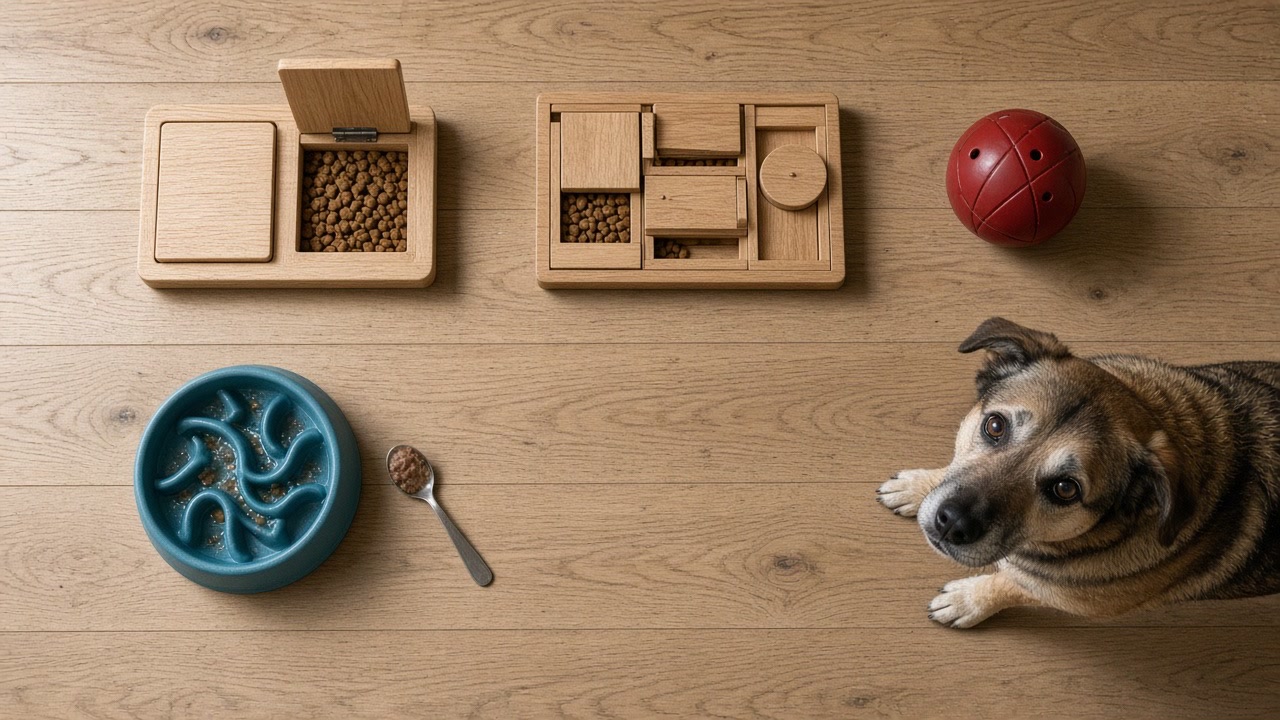
Choose the feeding job before the product
- Dog Smart: lift one cover
- Dog Brick: flip, lift, and slide
- Best for a short, supervised problem-solving session
- KONG Wobbler: push and tip for dry pieces
- Toppl: lick, fill, freeze, or connect two sizes
- Best when the meal format matches the opening and cleanup
A difficulty label is only a starting point. A dog familiar with moving food toys may solve a “Level 2” board quickly, while a puzzle beginner may need one cover raised before attempting a flush piece. The useful comparison is not minutes occupied; it is whether the dog understands the action, can access the food without chewing parts, and returns to the task without escalating frustration.
Check food, floor, supervision, and cleanup
| Food format | Dry kibble or small treats fit board compartments and the Wobbler. Wet food and frozen mixtures fit a fillable Toppl better. Count puzzle food as part of the normal daily allowance. |
|---|---|
| First-session difficulty | Make one success visible. Raise a cover, leave a slider partly open, place only a small amount in the dispenser, or use an easy-to-lick filling. |
| Chewing style | The two Outward Hound boards explicitly require supervision and say not to let dogs chew the game or pieces. KONG labels the Wobbler “not a chew toy.” West Paw calls Toppl suitable for moderate chewers and still requires supervision. |
| Floor and noise | A weighted dispenser can travel and knock against cabinets. Use a clear, washable area where rolling movement will not hit stairs, glass, another pet, or a feeding station. |
| Cleaning | Dog Smart and Dog Brick use warm water and soap. KONG says the Wobbler is top-shelf dishwasher safe. West Paw lists Toppl as top-rack dishwasher safe. |
| Household fit | Separate dogs if food competition or guarding is possible. A puzzle is not a safe unsupervised babysitter simply because it dispenses a meal slowly. |
Four useful puzzle types
| Pick | Best fit | Skip or biggest drawback | Amazon |
|---|---|---|---|
| Outward Hound Dog Smart Level 1 · 9 compartments | A puzzle beginner learning to lift a single removable cover | Nine loose pieces require supervision and storage; skip if the dog grabs and chews covers | Check on Amazon |
| Outward Hound Dog Brick Level 2 · flip, lift, slide | A dog that already understands one-step food puzzles and needs combined actions | Removable bones and several mechanisms add setup and hand-washing; not for unsupervised chewing | Check on Amazon |
| KONG Wobbler Large Weighted dry-food dispenser | Medium or large dogs that will push a moving dispenser rather than dismantle a board | Hard movement can be noisy and mobile; KONG says it is not a chew toy and lists up to 1 cup per filling | Check large Wobbler |
| West Paw Toppl Large Fill, lick, freeze, or connect | Wet or mixed fillings and owners who prioritize top-rack dishwasher cleanup | A single Toppl is primarily a fillable feeder; the chase-style puzzle requires a second compatible size | Check large Toppl |
Run a five-minute first session
- Use part of a normal meal. Do not add a full puzzle portion on top of the normal daily food without accounting for it.
- Make the first action obvious. Raise one Dog Smart cover, expose one Dog Brick compartment, let one Wobbler piece fall easily, or spread a thin Toppl filling near the opening.
- Watch the method. Sniffing, pawing, nudging, licking, and returning to the task show different fit than biting edges, carrying loose parts away, or repeatedly overturning the board.
- Stop before frustration becomes chewing. Remove the puzzle, simplify the next attempt, and inspect every part before reuse.
- Clean and store it. Follow the specific manufacturer method; do not assume every puzzle is dishwasher safe.
Difficulty should increase one action at a time. Moving from an elevated Dog Smart cover to a flush cover is already a progression. Moving from lift-only to the Dog Brick’s combined flip, slide, and lift actions is another. Buying a harder board before the dog understands the first action can create more human prompting, not more independent enrichment.
Common failures
- Shopping by “minutes busy.” Duration depends on food, prior learning, setup, and the individual dog; it is not a stable product specification.
- Ignoring loose parts. Removable covers change the supervision and storage burden.
- Using a moving dispenser on the wrong floor. Noise, travel distance, and nearby stairs can make a good toy a poor room fit.
- Calling every food toy chew-proof. The manufacturers here still give supervision and chew-use limits.
- Forgetting calories. Puzzle food is food, even when the activity looks like play.
Frequently asked questions
What puzzle should a beginner dog start with?
Start with one visible action and a small amount of familiar food. Dog Smart is the clearest lift-cover example here, but even that should begin with a cover raised and direct supervision.
Are dog puzzle toys safe to leave out?
Not by default. Outward Hound says to supervise and store its boards when empty; KONG calls the Wobbler not a chew toy; West Paw also instructs owners to supervise and choose the appropriate shape and size.
Can a puzzle replace a food bowl?
Some food dispensers can hold part or all of a measured meal within the manufacturer’s capacity, but food format, cleanup, the dog’s behavior, and veterinary feeding needs still determine whether that is appropriate.
Related guides
Editorial standards · Affiliate disclosure · Supervise food-puzzle sessions.