
CheckPet · feeding extras
Dog food toppers: compare formats, portions, and storage
If the goal is to moisten kibble, compare a wet food or pet-formulated broth before buying freeze-dried pieces. If you want a dry topper, check calories per gram and raw-food handling instructions first. This guide compares those formats and links one pollock product to inspect; it does not rank the best brands or report a feeding trial.
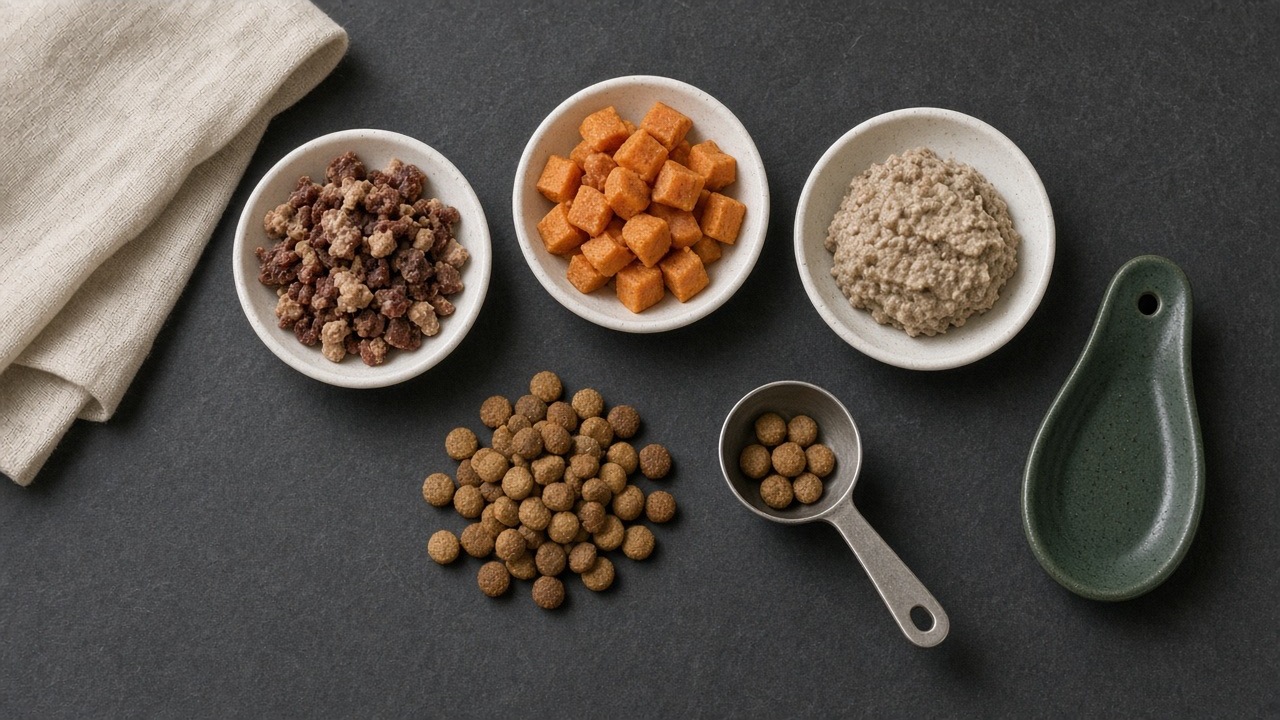
Calculate the serving before the bag size
| Purpose | Choose aroma, moisture, texture, or a training reward. Write down one purpose before comparing products. |
|---|---|
| Daily calorie budget | Ask your veterinarian for the dog’s target. A commonly used ceiling for treats and nutritionally incomplete extras is 10% of daily calories; medical diets can require stricter limits. |
| Serving weight | Use grams on a kitchen scale when possible. Cups and handfuls hide large differences between broth and freeze-dried pieces. |
| Label role | Look for complete and balanced versus supplemental or intermittent feeding. A topper label alone cannot establish adequacy. |
| Opened storage | Read the package for refrigeration, sealing, and use-after-opening instructions. Do not assume dry means shelf-stable indefinitely. |
| Recipe restrictions | Compare the full ingredient list with the existing diet. Fish on the front does not prove a single-protein recipe. |
A worked example: the small serving is the useful number
Before doing the calculation, find the calorie statement and feeding role on the exact package. A serving recommendation without its calorie contribution is not enough to budget an extra. We have not established calories per gram for the linked 5 oz pollock bag, so the numbers below must not be used as its serving instructions.
Suppose a veterinarian sets a 400 kcal daily target. A 10% ceiling leaves 40 kcal for all treats and incomplete extras combined. If training rewards already contribute 25 kcal, only 15 kcal remains for a topper. This is a calculation example, not a feeding prescription and not the calorie content of the Instinct product.
For illustration only, a topper with 5 kcal per gram would use that remaining allowance in 3 grams. Replace 5 with the calorie density from your actual package. Do not calculate a delivery schedule until you also know the opened-storage limit.
Dry pieces, wet food, and broth solve different problems
| Format | Useful for | Purchase trade-off |
|---|---|---|
| Freeze-dried pieces | Distinct texture and measured aroma boost | Check raw handling, calorie concentration, and whether tiny pieces distribute across the meal |
| Wet complete food | Moisture and a softer meal component | Refrigeration and leftovers; adjust the base portion using both labels |
| Pet-formulated broth | Adding liquid to dry food | Check ingredients and opened storage; broth often cannot replace a nutritionally complete meal |
For a dog that only needs a little moisture, a complex raw topper may add unnecessary handling and cost. For a dog that sorts hard and soft pieces, a few dry chunks might simply create another ingredient to pick out. If refusal is the main concern, read our picky-eater food guide before purchasing extras.
Best when / Skip if
- The dog already eats an appropriate complete diet.
- You can measure a fixed serving and count every extra.
- The product’s ingredients and handling instructions fit your home.
- A small first package can be finished within its storage window.
- Appetite loss is sudden, persistent, or accompanied by other symptoms.
- The dog is on a veterinarian-directed elimination or therapeutic diet.
- You cannot safely follow raw-product handling guidance.
- You are buying it to replace the main food without an adequacy statement.
Freeze-dried raw still needs raw-food handling
Freeze-drying is a processing method, not a guarantee that a product is free of pathogens. The FDA identifies risks to pets and people from raw pet food. Follow the manufacturer’s instructions, wash hands and utensils, and keep the package away from human food preparation. Discuss suitability with a veterinarian, particularly if vulnerable people or animals share the home.
Do not rehydrate a whole week’s supply unless the manufacturer specifically provides a safe method and storage interval. Portion at the meal, put the package away, and clean surfaces. A format requiring more care is only useful if you can sustain that routine.
Compare repeat-purchase cost without relying on temporary prices
Divide the current package price by usable servings, then multiply by 30 for an approximate monthly cost. Include wasted leftovers and shipping when relevant. A cheap wet pouch can cost more per used serving than a dry bag if most of the pouch is discarded; a concentrated dry product can also exceed your budget if you pour without measuring.
Check the first small bag before setting a delivery interval. Confirm your actual grams per day, the dog’s acceptance, and storage performance. Automatic delivery should follow observed use rather than the platform’s suggested schedule.
Common failures
- Adding more after every refusal makes the serving impossible to budget.
- Counting only the topper misses chews, training rewards, and table food.
- Calling every wet product a topper obscures whether it is a complete food.
- Choosing a large raw bag without a workable hygiene routine adds avoidable burden.
- Changing several ingredients at once makes digestive reactions hard to interpret.
Questions before checkout
Can I use a topper every day?
Potentially, if its role, serving, calorie contribution, and ingredients fit the dog. Follow label guidance and your veterinarian’s plan. Daily use does not remove the need for a nutritionally complete base.
Are expensive toppers necessary for a healthy dog?
No. A dog eating an appropriate complete food does not automatically need extras. Buy only when the added format solves a practical feeding need.
Is a topper a treatment for digestive problems?
No. Ongoing vomiting, diarrhea, weight change, or appetite loss needs assessment. Our sensitive-stomach food guide explains the boundary between product comparison and veterinary care.