
CheckPet · dog food
Purina Pro Plan small-breed food: compare recipe and feeding fit
This is a same-brand shortlist of five Pro Plan recipes, not a market-wide ranking or a feeding trial. Compare nutritional life-stage suitability, calorie density and full ingredients before choosing. A small dog does not automatically need a different diet if its current complete food fits its needs.
On this page
Measure before you buy
| Dog weight (adult) | Use measured weight and body condition with the exact feeding directions. There is no universal 20 lb cutoff established by this guide. |
|---|---|
| Life stage | AAFCO adult maintenance only for dogs finished growing. Puppies need growth formulas — see our puppy food guide. |
| Calorie density | Compare the actual kcal/kg or kcal/cup statement. The small-breed name alone does not establish energy density. |
| Kibble size | Observe comfortable eating. We have not measured these products’ kibble or established a safe width; swallowing difficulty needs veterinary assessment. |
| Activity level | Discuss an individual allowance when activity, weight or health needs differ from the label’s assumptions. |
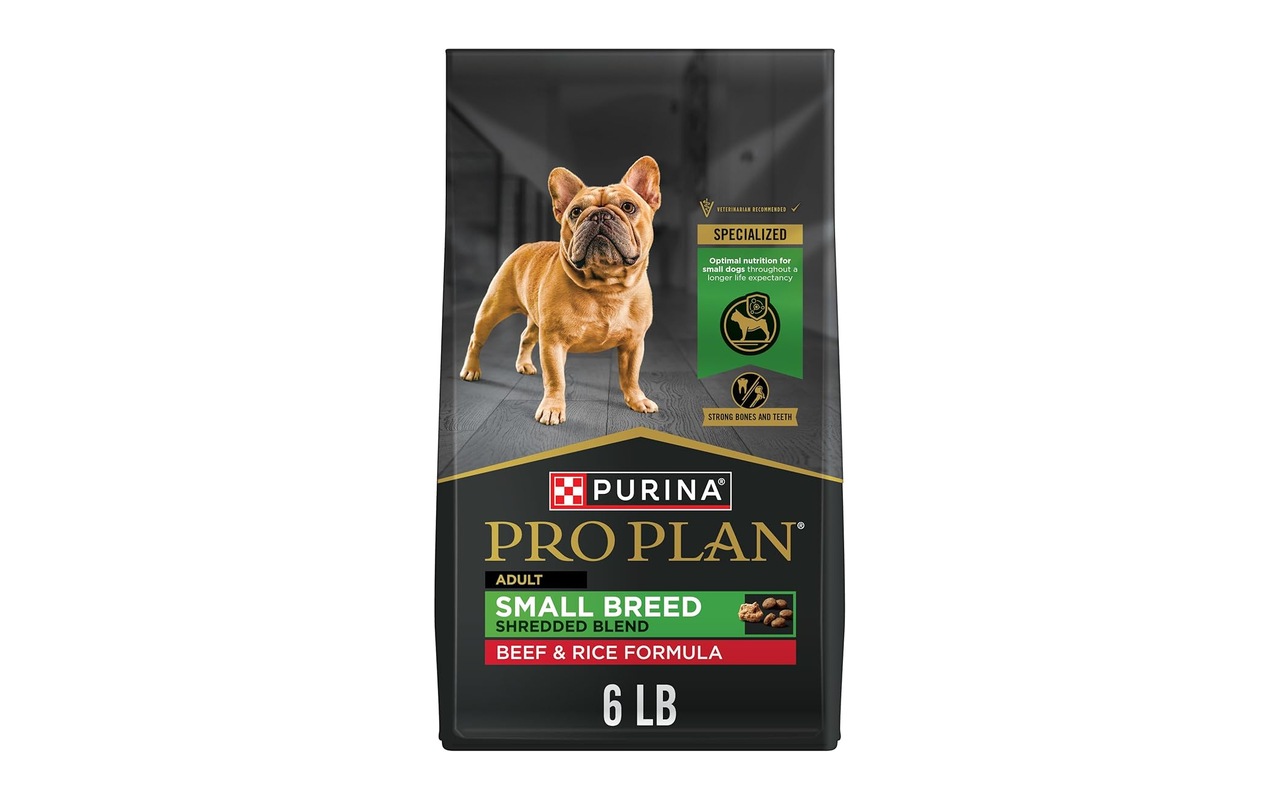
| Listing fit (verify) | The linked beef recipe is ASIN B08VF89C6H. Official formula evidence is below; check that Amazon’s selected variant and the delivered package match it. An official formula page does not independently verify an Amazon listing. |
| Bag size / Subscribe & Save | Same-recipe bag weight changes quantity, not necessarily calorie density. Recheck the label for formula changes and use observed consumption plus storage instructions to set repeat delivery. |
Does the size label settle the choice?
“Small breed” describes product positioning, not an individual calorie prescription. Compare the actual adequacy statement and energy density rather than treating a size label as a nutritional guarantee.
Best when / skip if
- The exact nutritional statement fits the dog’s life stage
- You can confirm that the selected recipe’s texture suits your dog
- Your vet has not prescribed a medical diet
- You can measure a portion against verified calorie information
- Puppy or adolescent still growing — use growth-stage food
- Known ingredient reactions — assess the full recipe with your veterinarian, not only its named protein
- Obesity or weight loss plan — work from kcal targets, not free feeding
- The exact label or individual feeding fit cannot be confirmed
Setup and feeding
- Weigh your dog and note body condition (ribs easy to feel, visible waist).
- Open the bag feeding chart; find kcal/cup and the range for your dog’s weight.
- When the label provides kcal/kg, weigh portions in grams using a kitchen scale. If using kcal/cup, use the specified measuring cup rather than a mug; cup filling can vary.
- Discuss gulping, reflux or swallowing problems with your veterinarian rather than treating meal splitting as a medical solution.
- Monitor weight and body condition with an appropriate veterinary plan. Same-recipe bag-size changes do not necessarily change calorie density.
- Follow the manufacturer’s transition directions or your veterinarian’s plan. A gradual change does not guarantee that digestive upset will be avoided.
Quick comparison
This shortlist covers one brand only. We read all five official formula pages and their linked label PDFs on October 13, 2026. Each PDF states that animal feeding tests using AAFCO procedures substantiate complete and balanced nutrition for maintenance of adult dogs. These are manufacturer adequacy statements, not CheckPet feeding trials or evidence of a best-overall winner.
Official calorie statements: check the version, not just the flavor
| Formula | Official page: kcal/kg · kcal/cup | Linked PDF: kcal/kg · kcal/cup |
|---|---|---|
| Beef & rice shredded blend | 4191 · 453 | 4191 · 453 |
| Chicken & rice shredded blend | 4075 · 397 | 4075 · 397 |
| Lamb & rice shredded blend | 3983 · 402 | 3983 · 402 |
| Sensitive skin & stomach salmon & rice | 3807 · 465 | 3807 · 465 |
| Weight management shredded blend | 3417 · 346 (calculated) | 3612 · 358 (fed) |
Two source conflicts matter. The beef webpage lists chicken by-product meal while its linked PDF says poultry by-product meal. The weight-management page and PDF disagree on calories and approximate grams per cup (101 versus 99). We cannot establish which version matches your bag. Use the delivered label, and ask Purina to clarify if it conflicts; do not average these values.
Recipe names are not ingredient exclusions. The beef, chicken, lamb and weight-management PDFs list poultry by-product meal. The salmon PDF lists beef fat and natural flavor. None of these observations establishes suitability for a diagnosed allergy or replaces a veterinarian-supervised elimination diet.
Equal-calorie worksheet
After obtaining the real label, calculate daily grams as 1,000 × daily food kcal ÷ kcal/kg. A hypothetical 200 kcal allowance at 4,000 kcal/kg equals 50 grams; at 3,200 kcal/kg it equals 62.5 grams. These are illustrative numbers, not linked-product values. Establish the calorie allowance with appropriate veterinary guidance and account for extras. Without real values, this page cannot rank daily feeding cost.
Using the matching official beef and chicken figures, half a cup is approximately 226.5 versus 198.5 kcal: a 28 kcal difference despite the same volume. For an illustrative 200 kcal food allowance, the corresponding weighed portions are about 47.7 g of beef or 49.1 g of chicken. The allowance is not a recommendation for your dog. Cups differ because the recipes have different energy densities and grams per cup.
For repeat-order planning, divide usable bag grams by your measured daily grams. A hypothetical 6 lb bag (about 2722 g) at 50 g/day lasts about 54 days before transition use, spillage or other losses. This is inventory arithmetic, not a shelf-life guarantee. Compare daily cost as bag price × daily grams ÷ bag grams; a lower bag price alone does not establish better value.
Choose by life stage, current weight, calorie needs, and recipe fit—not by package color. Confirm the live label and feeding chart before ordering.
| Pick | Best fit | Check before buying | Amazon |
|---|---|---|---|
| Purina Pro Plan Small Breed Shredded Blend Beef & Rice | Small adult dogs that prefer a shredded-and-kibble texture | Adult maintenance statement and kcal per cup | View on Amazon |
| Purina Pro Plan Small Breed Shredded Blend Chicken & Rice | Chicken-recipe alternative for small adult dogs | Recipe, bag size, and any known ingredient sensitivities | View on Amazon |
| Purina Pro Plan Small Breed Lamb & Rice | Shoppers comparing lamb with beef or chicken recipes | Ingredient list; not an elimination or prescription diet | View on Amazon |
| Purina Pro Plan Small Breed Sensitive Skin & Stomach Salmon & Rice | Small adults whose owner is comparing a salmon-and-rice formula | Ask a vet about persistent skin or digestive symptoms | View on Amazon |
| Purina Pro Plan Small Breed Weight Management Chicken & Rice | Small adults needing a calorie-conscious comparison | Use target weight and veterinarian guidance, not current weight alone | View on Amazon |
Common failures
- Adult food for a puppy — adult maintenance alone does not establish growth suitability.
- Free pouring “one cup” — an unmeasured portion makes the calorie allowance difficult to track.
- Diagnosing from texture alone — difficulty eating or vomiting needs assessment; this guide does not identify its cause.
- Using a universal size cutoff — read the exact nutritional statement and feeding directions instead.
- Switching flavors without transition — beef to chicken swaps can trigger GI upset even within the same brand.
- Subscribe & Save on the wrong bag — compare the same recipe and actual consumption; bag weight alone does not change energy density.
FAQ
What is the best dog food for small dogs?
This page cannot establish a best overall food. It compares five same-brand candidates using official labels, including unresolved page/PDF discrepancies. Compare the exact package and individual needs before making a selection.
How many calories does a small dog need?
A feeding chart is a starting point. Ask your veterinarian for an individual calorie target when weight change, medical needs or body-condition concerns are present; do not diagnose the cause of weight change from appearance alone.
Can large-breed puppies eat small-breed food?
Do not use this adult shortlist to select puppy food. Read the full growth adequacy statement, including suitability for growth of large-size dogs. A small-breed name alone cannot establish or exclude that suitability.
Is shredded blend better than plain kibble?
Shredded blend offers a different texture, but we have no feeding-trial evidence that it improves acceptance for your dog. Persistent appetite changes need assessment, not an assumed ingredient diagnosis.
Is Subscribe & Save safe for dog food?
A repeat delivery is a convenience, not a food-safety guarantee. Check the selected formula, price, delivery interval, packaging condition and label each time. Follow storage instructions and check recalls; pause delivery if the food or feeding plan changes.
Related guides
Editorial standards · Affiliate disclosure · CheckPet guides are not veterinary advice.