Speaker reviews are usually conducted in quiet rooms with calibrated microphones and reference tracks. That’s fine for audiophiles, but nobody buys a $100 Bluetooth speaker to listen to Steely Dan in an acoustically treated living room. You buy it because you’re hosting a BBQ and your phone speaker sounds like a kazoo inside a tin can.
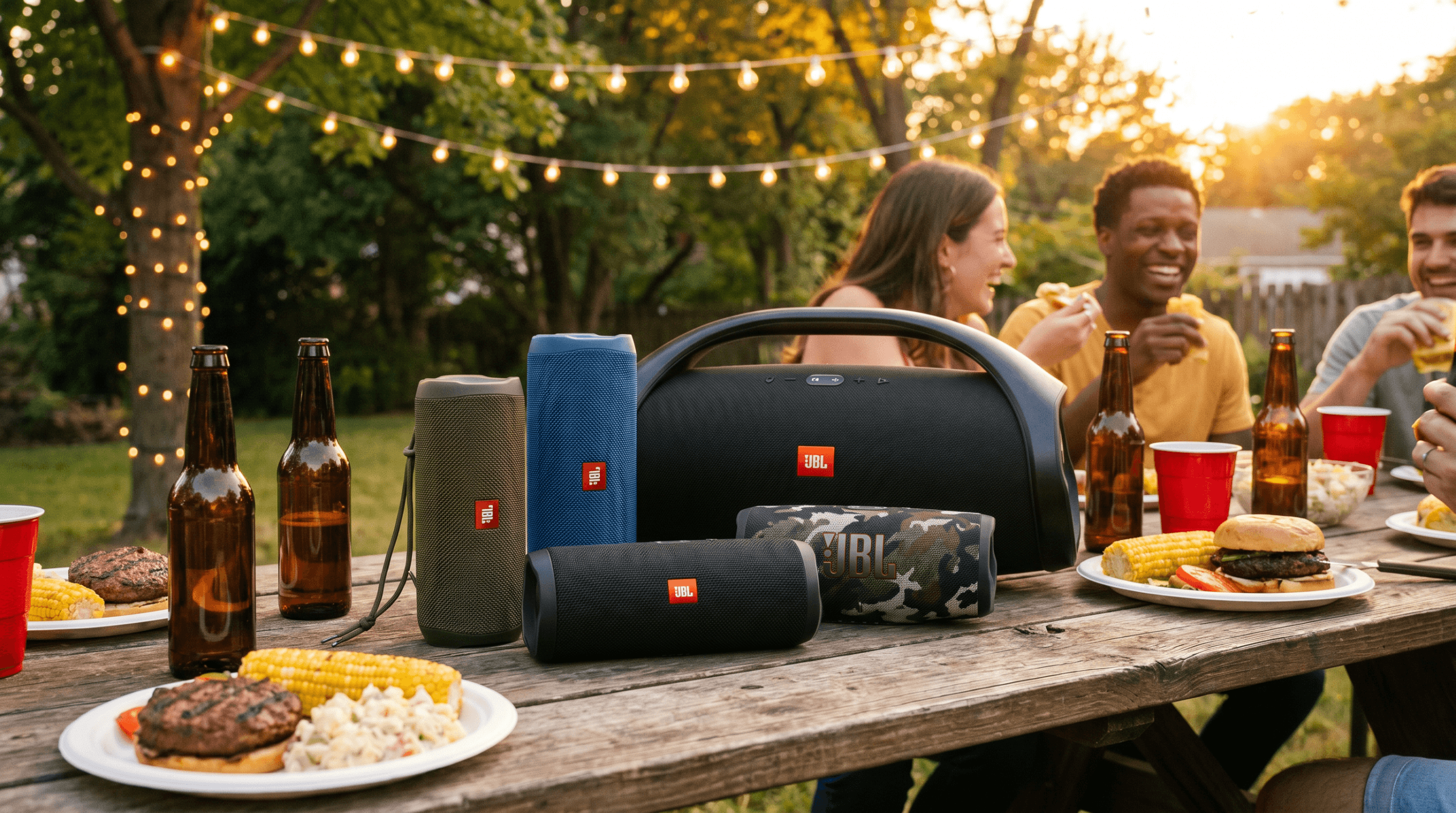
So I tested these speakers at an actual BBQ. My backyard, 15 people, a charcoal grill putting out smoke, kids running around, the neighbor’s dog barking at everything. I played a mix of hip-hop (bass test), rock (midrange test), and acoustic singer-songwriter (vocal clarity test) at volumes ranging from “background music” to “I can hear it over the blender.” Every speaker ran for the full duration — six hours — to test real-world battery life, not the manufacturer’s claimed number that was probably measured at 50% volume in a climate-controlled lab.
If you’re also shopping for personal audio, our noise-canceling headphones guide covers the best options for quieter settings, and the workout earbuds guide handles on-the-go listening.
Quick Verdict
| Speaker | Price | Battery (Claimed / Actual) | Waterproof | Weight | Best For |
|---|---|---|---|---|---|
| JBL Flip 7 | ~$130 | 12h / 9.5h | IP67 | 1.2 lbs | Overall best |
| Sony SRS-XB100 | ~$60 | 16h / 13h | IP67 | 0.6 lbs | Best ultra-portable |
| Tribit StormBox Flow | ~$80 | 30h / 22h | IP67 | 1.3 lbs | Best battery |
| Ultimate Ears WONDERBOOM 3 | ~$80 | 14h / 11h | IP67 | 0.93 lbs | Most durable |
| Anker Soundcore Motion 300 | ~$80 | 13h / 10h | IPX7 | 1.2 lbs | Best EQ customization |
The Reviews
JBL Flip 7 — The Default Recommendation Exists for a Reason
Price: ~$130 | Battery: 12h claimed / 9.5h at 75% volume | Waterproof: IP67
The JBL Flip series has been the best-selling portable speaker line for years, and the Flip 7 continues that streak by being relentlessly good at everything without being the best at anything. The sound signature is crowd-pleasing: boosted bass that sounds full without being muddy, clear vocals, and enough treble sparkle to keep acoustic guitars interesting. At the BBQ, it filled a medium backyard (roughly 30×40 feet) comfortably at 70% volume.
Bass response was the strongest here. Not the deepest — the Tribit has more sub-bass extension — but the punchiest. Kick drums and bass lines have a satisfying thump that makes hip-hop and pop sound fun. At max volume, the bass stays controlled. No rattling, no distortion, no audible strain. Some speakers at this size fall apart at high volumes; the Flip 7 doesn’t.
The cylindrical design radiates sound in 360 degrees, which means placement is forgiving — you don’t have to aim it at your guests like a spotlight. It’s also genuinely waterproof. I intentionally left it on the edge of the cooler where it got splashed multiple times. No issue. JBL claims it can survive submersion in 3 feet of water for 30 minutes, and based on the splashing it endured, I believe it.
At $130, it’s the most expensive speaker here by a significant margin. The premium buys you better sound quality, better build, and the JBL ecosystem (PartyBoost pairing for multiple speakers). Whether that premium is worth it depends on how often you’ll use it.
The good: Best overall sound, punchy bass, 360-degree output, excellent build quality, waterproof. The less good: Most expensive, battery life below claimed spec, no built-in EQ beyond the app’s basic presets.
Sony SRS-XB100 — Fits in Your Pocket, Sounds Like It Shouldn’t
Price: ~$60 | Battery: 16h claimed / 13h at 75% volume | Waterproof: IP67
The XB100 weighs 0.6 pounds and is roughly the size of a baseball. I brought it fully expecting it to be the “yeah but it’s small” qualifier pick — the speaker you recommend with caveats. Instead, it was the most impressive performer relative to its size.
The sound is obviously not going to match the JBL Flip 7. Bass is present but thin — you hear it more than you feel it. But vocals are surprisingly clear, mids are well-balanced, and it handles acoustic music beautifully. At a small gathering (5-8 people), it fills a patio table radius comfortably. It’s not a backyard speaker — it’s a blanket-in-the-park speaker, a kitchen-counter speaker, a bring-it-to-the-hotel-room speaker.
Battery life was the real standout: 13 hours at 75% volume. I started it at noon and it died at 1 AM. The claimed 16 hours is probably achievable at 50% volume, which is still plenty loud for close-range listening.
The built-in strap clips onto a backpack, belt loop, or bag strap. It’s a genuine grab-and-go speaker in a way that the heavier options here aren’t.
The good: Incredibly portable, fantastic battery life, good sound for the size, cheap. The less good: Weak bass, low max volume, no stereo pairing, not loud enough for large outdoor spaces.
Tribit StormBox Flow — The Battery That Won’t Quit
Price: ~$80 | Battery: 30h claimed / 22h at 75% volume | Waterproof: IP67
Twenty-two hours. I ran this speaker for the entire BBQ (6 hours), left it playing at low volume overnight as a test, and it was still going the next morning. The 30-hour claimed battery life is optimistic (measured at unspecified volume), but 22 hours at 75% is still absurd. This is a weekend-camping speaker. A multi-day-trip speaker. A “forgot to charge it last week and it’s fine” speaker.
Sound quality is the surprise. Tribit is not a brand with audiophile credentials, but the StormBox Flow punches above its weight. The XBass mode adds a noticeable low-end boost that works well for outdoor listening, where bass tends to dissipate in open air. It’s not as clean as the JBL Flip 7, but the difference is smaller than the $50 price gap suggests.
The speaker also has USB-C charging with 10-minute quick charge for 3 hours of playback. If you forget to charge it before the party, a quick pit stop is all you need.
“I brought the StormBox Flow on a 4-day camping trip. No charging. It lasted the entire trip with music playing 4-5 hours per day. When we got home it still showed 20% battery. I have no idea what sorcery Tribit put in this thing.” — u/campfire_beats, r/bluetooth_speakers
The good: Extraordinary battery life, solid sound with XBass, USB-C quick charge, excellent value. The less good: XBass mode can sound boomy indoors, build feels slightly cheaper than JBL/UE, app is basic.
Ultimate Ears WONDERBOOM 3 — Drop It, Dunk It, Don’t Worry
Price: ~$80 | Battery: 14h claimed / 11h at 75% volume | Waterproof: IP67
The WONDERBOOM 3 is the speaker you hand to the friend who drops things. It’s dustproof, waterproof, shockproof (tested to drops from 5 feet), and it floats. I know it floats because someone knocked it into the cooler of ice water and it bobbed on the surface still playing music. That’s a party trick that earns its keep.
Sound is pleasant but not remarkable. The WONDERBOOM has always prioritized durability over audio quality, and the 3rd generation continues that tradition. Bass is modest, mids are warm, treble is slightly rolled off. It sounds good at medium volumes but gets harsh at max volume — there’s a noticeable compression that squashes dynamics when you push it past 80%. Keep it at 70% and it’s an enjoyable listen.
The 360-degree sound dispersion is genuine and better than the JBL Flip 7’s claim. The speaker is shaped like a squat cylinder with drivers on both sides, and it sounds nearly identical from any angle. No sweet spot, no “good side” to aim at guests.
UE also supports stereo pairing between two WONDERBOOM 3s. Two of these at $160 total fills a backyard better than any single speaker under $150 can.
The good: Virtually indestructible, floats, true 360-degree sound, great stereo pairing. The less good: Sound quality is middle of the pack, harsh at max volume, no EQ app, design is unchanged (love it or don’t).
Anker Soundcore Motion 300 — The Customizable One
Price: ~$80 | Battery: 13h claimed / 10h at 75% volume | Waterproof: IPX7
The Motion 300 is for people who fiddle with settings. The Soundcore app includes a full parametric EQ, over 20 preset sound profiles, and Anker’s LDAC codec support for high-resolution Bluetooth streaming. If you have a specific sound signature you want and are willing to spend 10 minutes in the app dialing it in, the Motion 300 can sound remarkably good — better than its $80 price suggests.
Out of the box, the default sound profile is a bit flat and boring. The bass is there but restrained, the mids are accurate but lifeless, and the treble is clear but thin. This is a speaker that needs EQ work to shine. After 15 minutes with the parametric EQ — boosted the low-end shelf by 3dB, added a slight bump at 3kHz for vocal presence — it sounded noticeably better than the Tribit at the same price.
The adaptive sound mode automatically adjusts the EQ based on speaker orientation (upright, hanging, flat). It’s gimmicky in theory but actually works — hanging the speaker from a tree branch at the BBQ improved the bass response because the algorithm compensated for the elevated position. I was skeptical until I A/B tested it.
The IPX7 rating (waterproof but not dustproof) is one step below the IP67 rating of the other four speakers. For outdoor use that’s fine; for beach or desert use, the lack of dust protection is a consideration.
The good: Excellent EQ customization, LDAC support, adaptive sound mode works, great value when tuned. The less good: Mediocre out-of-box sound, requires app fiddling, no dust protection, average battery life.
The Real-World Battery Test Results
Every manufacturer inflates battery claims. Here’s what I actually measured, playing a mixed playlist at 75% volume outdoors:
| Speaker | Claimed Battery | Actual (75% vol) | Difference |
|---|---|---|---|
| Tribit StormBox Flow | 30h | 22h | -27% |
| Sony SRS-XB100 | 16h | 13h | -19% |
| UE WONDERBOOM 3 | 14h | 11h | -21% |
| Anker Motion 300 | 13h | 10h | -23% |
| JBL Flip 7 | 12h | 9.5h | -21% |
Average inflation: 22%. Assume any manufacturer’s battery claim is about 20-25% optimistic. The Tribit’s absolute battery life is still the best by a wide margin even after the adjustment.
Who Should Buy What
The all-arounder: JBL Flip 7. Best sound, built to last, works in any scenario. If you buy one speaker and want it to do everything well, this is it.
The budget pick: Sony SRS-XB100. At $60, it’s the cheapest here with genuinely good sound for its size. Perfect for personal use and small gatherings.
The adventure speaker: Tribit StormBox Flow. That battery life is unmatched. Camping, road trips, multi-day outings — charge it once and forget it.
The worry-free pick: UE WONDERBOOM 3. For pool parties, beach trips, and environments where the speaker will get dropped, dunked, and abused. It can take it.
The audiophile-lite: Anker Motion 300. If you’re willing to spend time in the EQ app, it rewards the effort with sound that competes with speakers $30-50 more expensive.
FAQ
Is a $150 Bluetooth speaker worth it over a $50 one?
For outdoor use at higher volumes, yes. The difference between the $60 Sony and the $130 JBL is dramatic in bass response, max volume, and how the speaker handles distortion at loud levels. For quiet indoor listening at a desk, the $60 speaker is fine and the extra money is better spent elsewhere.
Does Bluetooth codec matter for outdoor speakers?
Not much. The difference between SBC, AAC, and LDAC is audible in quiet rooms with good headphones. Outdoors with ambient noise, at the bitrates these speakers reproduce? You won’t hear the difference. Buy based on sound quality and durability, not codec support.
Can I pair two different speakers together?
Generally, no — stereo pairing requires two identical speakers from the same brand. Some brands (JBL with PartyBoost, UE with their pairing feature) allow connecting different models from the same brand for party mode (mono, multiple speakers), but true stereo pairing requires matching units.
How loud is “loud enough” for a backyard?
For a medium backyard (30×40 feet) with 10-15 people, you want a speaker that can comfortably play at 70-80% volume without distortion. The JBL Flip 7 and Tribit StormBox Flow handle this well. The Sony XB100 doesn’t have the output for this scenario — it tops out at “patio table” volume.