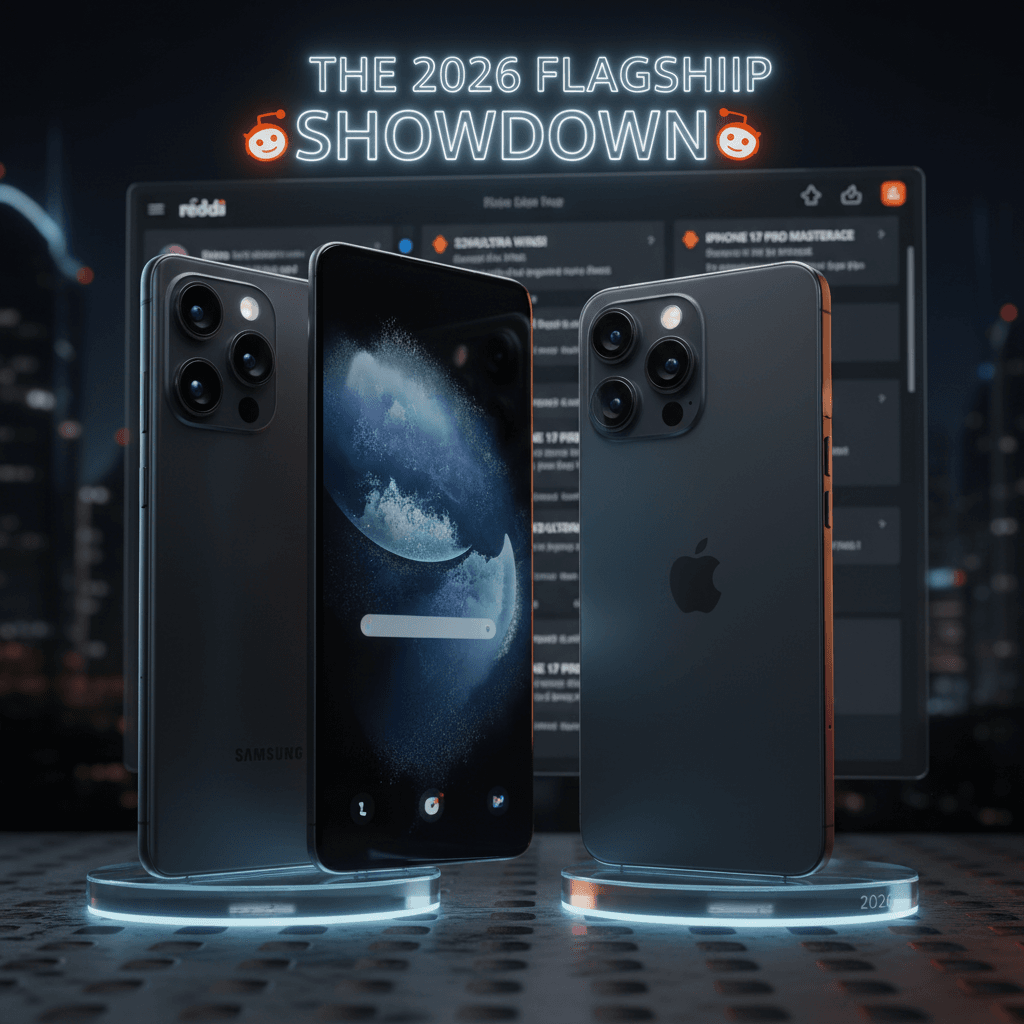
Every year, the same war rages across r/Android, r/iPhone, r/smartphones, and r/PickAnAndroidForMe: Samsung’s Ultra versus Apple’s Pro Max. Every year, both sides declare decisive victory. And every year, the truth remains stubbornly in the middle — both phones are exceptional, neither is perfect, and which one is “better” depends entirely on what you value.
I’ve used both daily for the past two months — the S26 Ultra as my primary phone for a month, then the iPhone 17 Pro Max for a month, then back to back for direct comparisons. This isn’t a spec-sheet regurgitation. This is what it actually feels like to live with each phone as your one and only device. For the previous generation comparison with the Pixel thrown in, see my three-way camera shootout.
Contents
Spec Comparison
| Spec | Galaxy S26 Ultra | iPhone 17 Pro Max |
|---|---|---|
| Price | ~$1,299 | ~$1,199 |
| Display | 6.9″ QHD+ AMOLED, 120Hz LTPO | 6.9″ OLED, 120Hz ProMotion |
| Processor | Snapdragon 8 Elite Gen 2 | Apple A19 Pro |
| RAM | 16GB | 12GB |
| Storage | 256GB / 512GB / 1TB | 256GB / 512GB / 1TB |
| Main camera | 200MP wide + 50MP ultra + 50MP 3x + 50MP 10x | 48MP wide + 48MP ultra + 12MP 5x |
| Battery | 5,500mAh | 4,850mAh |
| Charging | 45W wired, 15W wireless | 27W wired (MagSafe), 25W wireless |
| Weight | 218g | 227g |
| Unique features | S Pen built-in, DeX mode, 10x optical zoom | Action Button, Dynamic Island, ProRes video |
Camera: The Category That Starts Fights
“The S26 Ultra 10x zoom is genuinely cheating. I was at a concert and got shots from the nosebleeds that look like I was front row. The iPhone 5x can’t compete at distance.” — r/GalaxyS26
“iPhones don’t win benchmarks, they win consistency. Every photo from the 17 Pro Max looks great. Samsung photos range from stunning to oversaturated mess depending on the lighting.” — r/iphone
Both camps are right. The S26 Ultra’s 10x optical zoom is a genuine capability advantage — at concerts, sports events, and travel, the ability to zoom 10x without quality loss produces photos the iPhone simply cannot. This is the single biggest hardware differentiator between the two phones.
But the iPhone’s image processing is more consistent. Samsung’s AI-enhanced processing occasionally over-sharpens, oversaturates colors, or aggressively smooths skin in ways that look unnatural. Apple’s processing is more conservative — photos look closer to how your eyes perceived the scene. For the detailed breakdown of how each camera handles real-world shooting, my phone photography guide covers specific scenarios.
Video: iPhone wins decisively. ProRes recording, Cinematic Mode that actually works in 4K, and the best video stabilization in any smartphone. The S26 Ultra shoots excellent 8K video that almost nobody needs, but its stabilization and color science in video don’t match Apple’s. If video matters to your content creator workflow, iPhone is the tool.
Software: Where Preferences Become Religion
Samsung One UI 7 (Android 16): Highly customizable. Split-screen multitasking, floating windows, Good Lock modules for changing everything, and DeX mode that turns the phone into a desktop with monitor + keyboard. Samsung’s Galaxy AI features (circle to search, live translate, note assist) are genuinely useful daily. The downside: pre-installed Samsung apps, occasional duplicate apps (Samsung Browser + Chrome, Samsung Messages + Google Messages), and more complexity than some users want.
iOS 20: Refined, consistent, and opinionated. Everything works smoothly together — AirDrop, Handoff, Universal Clipboard across Mac/iPad/iPhone. The walled garden is frustrating until you’re fully inside it, then it’s seamless. Less customization but fewer decisions to make. The App Store consistently has better-optimized apps because developers target iOS first.
For developers specifically: if you develop iOS apps, you need an iPhone. If you develop Android apps, you need an Android phone (or at minimum, heavy emulator use). Beyond that, both phones integrate with every major dev tool — GitHub, Slack, VS Code Remote, terminal apps. Your laptop is your dev machine; the phone is for communication and reference. See my developer tech stack for more.
Battery and Charging: Samsung’s One Clear Win
The S26 Ultra’s 5,500mAh battery outlasts the iPhone 17 Pro Max by roughly 1.5-2 hours of screen-on time in my testing. Both comfortably last a full day, but the Samsung gives more buffer — ending the day at 25-30% vs the iPhone’s 10-15%. For power users who don’t want to think about charging, Samsung’s larger battery and 45W wired charging (full charge in ~55 minutes) beats Apple’s 27W (full charge in ~90 minutes).
Apple counters with MagSafe’s 25W wireless, which is faster than Samsung’s 15W wireless. And the MagSafe accessory ecosystem — car mounts, wallet attachments, battery packs that snap on — is a genuine lifestyle convenience Samsung can’t match with its flat-back Qi charging.
Reddit’s Final Verdict (And Mine)
After reading thousands of comments from owners of both phones, the community consensus is clear: there is no consensus. Both phones are at 95% of what a smartphone can be in 2026. The remaining 5% is entirely personal preference. Here’s my honest breakdown:
- Buy the S26 Ultra if: You value zoom photography, customization, multitasking, S Pen note-taking, or longer battery life. You don’t mind occasional software quirks for greater flexibility.
- Buy the iPhone 17 Pro Max if: You value video quality, software consistency, the Apple ecosystem (Mac/iPad/Watch/AirPods), or resale value. You prefer simplicity over customization.
- The wrong reason to buy either: Brand loyalty without examining what you actually use daily.
FAQ
Which holds its resale value better?
iPhone, significantly. A 2-year-old iPhone Pro Max retains 55-65% of its value. A 2-year-old Samsung Ultra retains 35-45%. If you upgrade every 2-3 years, the iPhone’s resale partially offsets its lower purchase-to-value ratio.
Which is better for gaming?
Both run every mobile game flawlessly. The A19 Pro and Snapdragon 8 Elite Gen 2 are both overkill for current mobile games. Samsung’s larger battery and cooling system give it an edge in sustained gaming sessions (less thermal throttling after 30+ minutes). But the App Store has more premium gaming titles and earlier releases.
Is the S Pen actually useful?
For most people, no — it’s a nice-to-have that stays in its slot. For people who take handwritten notes, sign PDFs, do quick sketches, or use their phone as a remote presentation clicker, it’s genuinely indispensable. About 20% of S26 Ultra owners on Reddit report using the S Pen daily; the rest use it once a month or never.
Should I switch from iPhone to Samsung (or vice versa)?
Switching ecosystems has real costs: repurchasing apps, losing iMessage (→ RCS), reconfiguring smart home devices, potentially replacing Watch and earbuds. Unless you have a strong specific reason (need zoom camera, need iOS for development, need DeX mode), staying in your current ecosystem is usually the pragmatic choice. The grass is equally green on both sides.