
CheckPet · dog walking gear
Best no-pull dog harnesses: measure fit before choosing the clip
A front clip can change where leash pressure is applied, but it cannot correct a rotating, rubbing, or escapable harness. Measure the widest chest and check how the harness passes over the head or neck first. Then choose front, back, or dual attachment for the walk you need to manage.
On this page
Two measurements, not one
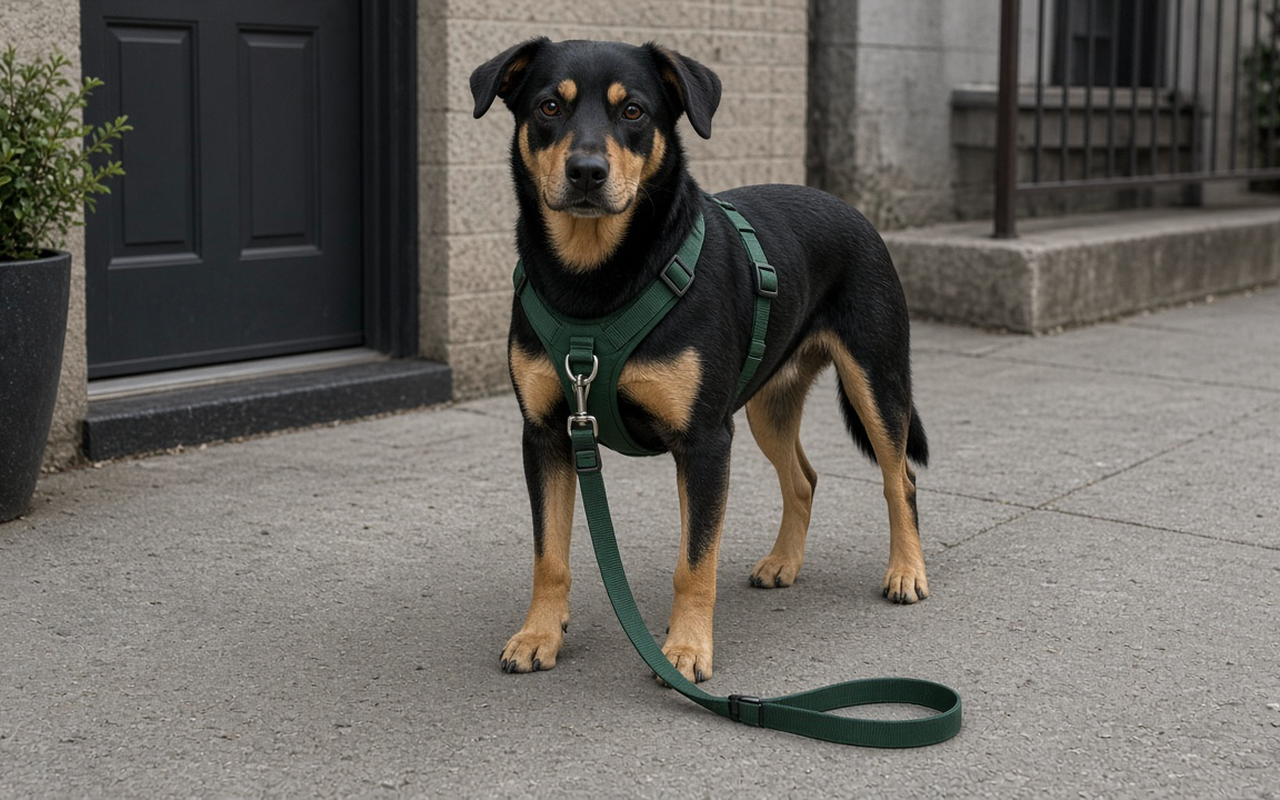
Chest girth is the starting number: wrap a soft tape around the widest part of the rib cage just behind the front legs. The second check depends on the design. For an overhead harness, confirm that the neck opening clears the head and ears without forcing them through; for a neck-buckle design, confirm the closed neck section cannot slip over the head. Measure while the dog is standing, keep the tape level, and do not add an arbitrary number of inches to “allow room.” Use the current chart for the exact model.
| Chest girth | Measure the widest rib-cage point behind the front legs. Repeat once after the dog changes position. A coat or thick seasonal fur can change the usable fit. |
|---|---|
| Head and neck passage | Check the opening the dog must enter and the closed opening the dog must not escape. This matters even when two dogs share the same chest measurement. |
| Between sizes | Follow the exact manufacturer instruction. 2 Hounds tells buyers to choose the smallest size that still fits; do not transfer that rule to every brand. |
| Strap location | The rear chest strap should sit behind, not inside, the front-leg crease. Recheck after a few indoor turns because a centered standing fit can rotate in motion. |
Choose the control geometry
- Useful when the goal is to redirect forward pull
- Needs a centered chest piece and enough strap stability
- Skip when the leash repeatedly crosses or tangles under a front leg
- Back clip keeps the leash above the shoulders for ordinary walking
- Dual connection can distribute handling between front and back
- It adds leash hardware and does not replace training
No attachment point guarantees loose-leash walking. A front ring may help redirect motion, while a back ring is simpler for a dog already walking without sustained pulling. A dual-ended leash adds options but also requires the handler to manage two contact points without tightening both continuously. Choose the least complicated setup that stays fitted and lets the dog move normally.
Best when / Skip if
Best when: the exact size chart fits, the entry method is manageable, the chest section remains centered, and the chosen clip solves a defined walking problem. Skip if: the dog can reverse out, the strap sits in the armpit, the shoulder stride shortens, hardware presses on a sensitive area, or the selected Amazon variation does not match the verified model, width, size, and color.
Three designs, three different boundaries
PetSafe Easy Walk Comfort: padded front control
Best fit: owners who want a padded harness with front and back leash attachments, a top handle, and reflective material on the current Black/Blue color. Skip if: overhead entry is stressful, the chest panel rotates, or Blue Medium is not within the current chart. PetSafe’s live page describes full-body padding and a front martingale loop, but its adjustment-point count is inconsistent across the same page; CheckPet does not use that count as a buying claim.
2 Hounds Freedom: dual connection and strap-width choice
Best fit: a dog whose measured chest fits the selected size and whose handler specifically wants front-and-back connection. The official Rose Pink page lists Medium at 24–28 inches and separates 5/8-inch Medium for dogs under about 40 lb from 1-inch Medium for roughly 40–60 lb. Skip if: girth alone is being used to ignore body weight and strap width, or the rear strap cannot remain behind the front legs.
Ruffwear Front Range: padded everyday comparison
Best fit: an everyday padded design with a back aluminum V-ring, reinforced front attachment, ID pocket, and reflective trim. Skip if: the official chest-girth chart does not fit or if the front attachment is being treated as a pulling cure. Ruffwear is included for design comparison from its current official page. CheckPet has not linked an Amazon variant because Amazon interrupted the final product-page verification with a human checkpoint.
| Model | Entry and control | Largest buying risk | Amazon U.S. |
|---|---|---|---|
| PetSafe Easy Walk Comfort Blue · Medium | Overhead padded body; front martingale loop, back clip, and top handle | Confusing it with the classic Easy Walk or selecting Medium without the current chart | Check exact variant |
| 2 Hounds Freedom Rose · 1-inch Medium | Front and back connection; current listing includes matching leash | Missing the 5/8-inch versus 1-inch Medium distinction | Check exact variant |
| Ruffwear Front Range Official-page comparison only | Overhead padded body; reinforced front clip and back V-ring | Assuming the front clip guarantees no pulling or buying an unverified marketplace variation | No merchant link until exact page can be rechecked |
Run a 10-minute indoor fitting protocol
- Fit with no leash pressure. Fasten the harness, follow the model’s clearance directions, and center the chest section.
- Walk a straight line for 2 minutes. Watch shoulder extension and whether either rear strap moves into the front-leg crease.
- Turn both directions for 2 minutes. Stop if the chest piece rotates and does not return to center.
- Add light leash guidance for 3 minutes. Try only the attachment point you intend to use. Do not simulate a hard pull.
- Check reverse movement for 1 minute. With slack available and indoors, observe whether elbows or shoulders begin to slip through. Do not deliberately drag the dog backward.
- Remove and inspect for 2 minutes. Look for compressed fur, warm or pink skin, armpit contact, hardware pressure, or a changed gait. Any one is a reason to refit or return.
This protocol is a return-window check, not a behavior or safety test. A dog with pain, skin disease, respiratory concerns, fear around handling, or a history of escaping equipment needs individualized professional guidance. Use a secure secondary connection when escape would create immediate risk.
Common failures
- Buying from breed or weight alone. Rib-cage shape, head passage, and the exact brand chart still decide fit.
- Solving rotation by tightening every strap. That can move pressure into the armpit without stabilizing the chest piece.
- Calling every front clip “no-pull.” Attachment geometry may redirect force; it does not teach leash behavior or guarantee comfort.
- Ignoring variation selectors. Color, size, strap width, leash inclusion, and model family can change inside one marketplace listing.
- Keeping a harness after gait changes. A product can feel secure to the handler while restricting the dog’s normal stride.
Cleaning and rechecking fit
Follow the exact care label rather than assuming every padded harness is machine washable. 2 Hounds permits a gentle cycle inside a pillowcase or hand washing and says to air dry. After washing, check webbing, stitching, buckles, rings, and padding before refitting. Re-measure growing dogs and dogs whose weight, coat, or body condition changes; do not rely on the previous strap marks.
Frequently asked questions
Is a front-clip harness guaranteed to stop pulling?
No. It changes the point where leash force reaches the harness and may help redirect forward motion. Fit, dog behavior, handling, and training still determine the result.
How tight should a dog harness be?
Use the clearance and fitting directions for the exact model. A common finger rule is not a substitute for checking rotation, armpit distance, shoulder movement, and escape risk while the dog moves.
Should I choose the smaller size when my dog is between sizes?
Only when the manufacturer says so. 2 Hounds instructs buyers to choose the smallest size that still fits, but another brand may use a different overlap rule. Never transfer one chart’s instruction to another model.
Related guides
Editorial standards · Affiliate disclosure · Educational guidance, not veterinary or training advice.