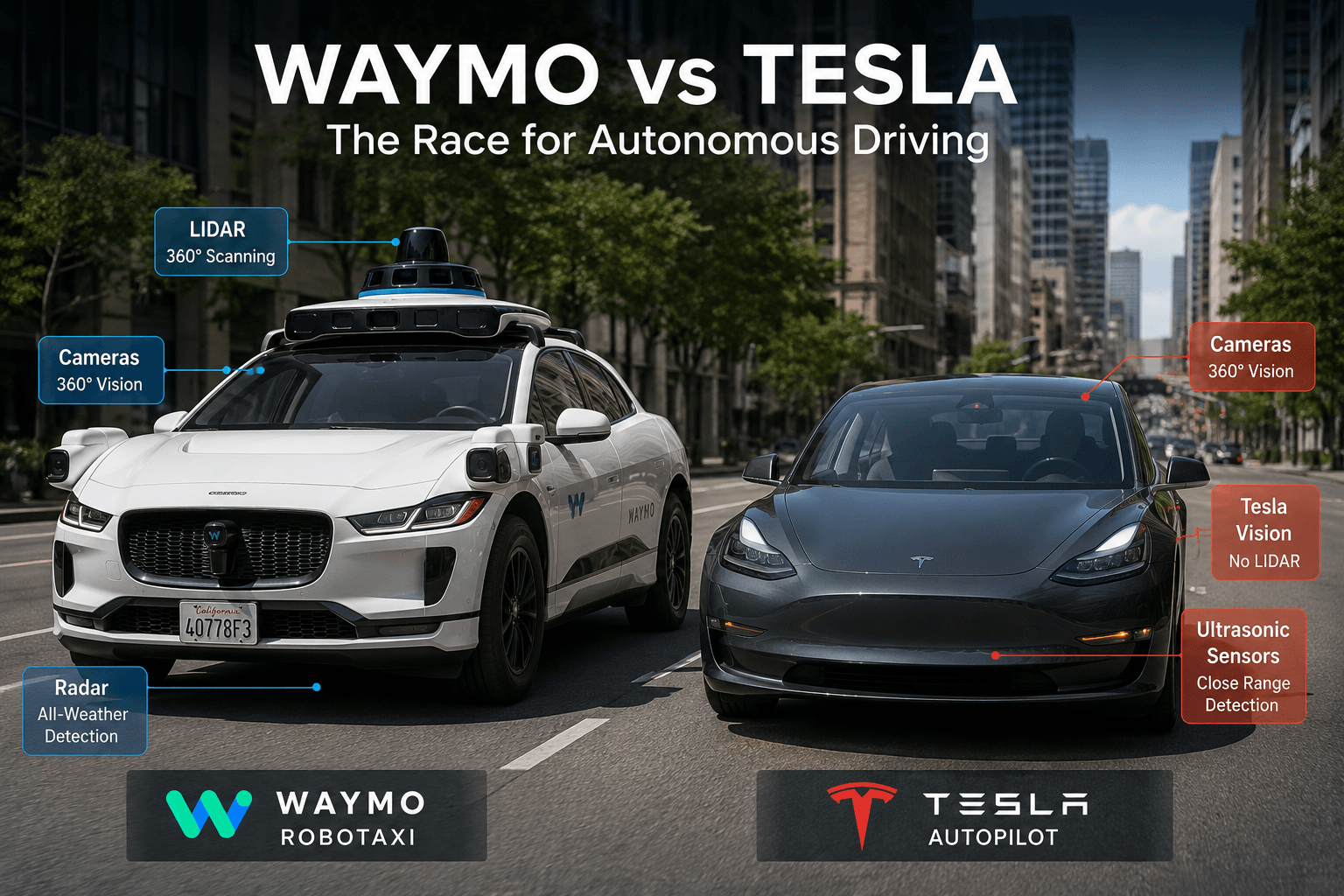
Self-driving cars are no longer a future promise — they’re on the road right now, carrying real passengers, in real traffic. But the two leading approaches couldn’t be more different. Waymo operates fully driverless robotaxis in multiple cities. Tesla sells “Full Self-Driving” as a software subscription for cars with a human driver who’s legally responsible for everything.
I’ve ridden in Waymo robotaxis over 30 times in San Francisco and Phoenix. I’ve driven a Tesla Model 3 with FSD v13 for six months. Here’s the honest comparison that the fanboys on both sides don’t want to hear.
On this page
The Fundamental Difference
| Factor | Waymo | Tesla FSD |
|---|---|---|
| Level of Autonomy | Level 4 (fully driverless) | Level 2+ (driver must supervise) |
| Where It Works | Specific cities (SF, Phoenix, LA, Austin) | Anywhere roads exist |
| Hardware | Lidar + cameras + radar ($100K+ per car) | Cameras only ($40K-90K car) |
| Who’s Liable | Waymo (the company) | You (the driver) |
| Cost to Use | Per-ride (like Uber) | $99/month subscription or $8,000 purchase |
| Availability | 24/7 in service areas | 24/7 anywhere |
This difference matters more than any technical comparison. When you ride in a Waymo, Waymo is legally and financially responsible for the driving. When you use Tesla FSD, you are legally and financially responsible — Tesla’s terms of service explicitly state the driver must maintain control at all times.
Waymo: What Riding in a Robotaxi Actually Feels Like
The first time a car with no driver pulls up and you get in, it’s surreal. The steering wheel turns by itself, the car checks its mirrors (not that it needs to — it has 360-degree sensor coverage), and it pulls into traffic with a smoothness that most human drivers can’t match.
After 30+ rides, the novelty wears off and you start evaluating Waymo like any car service. The driving is consistently cautious — it follows speed limits precisely, leaves generous following distances, and stops for pedestrians with more patience than any human driver. This cautiousness is occasionally annoying (it’ll wait longer than necessary at some intersections) but never dangerous.
What Waymo does well
Night driving. Waymo’s lidar sensors work identically in daylight and darkness. My late-night rides in San Francisco — through poorly lit streets with jaywalking pedestrians — were flawless. This is where the sensor advantage over camera-only systems is most obvious.
Construction zones. Waymo handles construction zones, lane closures, and temporary traffic patterns surprisingly well. It slows down, reads temporary signs, and navigates around cones with precision. In my experience, it handles construction better than most human rideshare drivers who aren’t familiar with the area.
Consistency. Every Waymo ride feels the same. No aggressive drivers, no drivers texting at red lights, no drivers who don’t know the route. The consistency is what converts skeptics — after three rides, you stop thinking about the autonomy and just ride.
What Waymo does poorly
Edge cases. Unusual situations — a delivery truck blocking both lanes, a traffic cop waving cars through a broken stoplight, a funeral procession — can cause Waymo to stop and wait for remote human assistance. This has happened to me twice in 30+ rides. Both times, a remote operator took over within 2-3 minutes, but those minutes felt long when traffic was building behind us.
Availability. Waymo only works in mapped service areas. If your destination is two blocks outside the zone, you’re walking. The service areas are expanding, but in 2026 it’s still limited to parts of San Francisco, Phoenix, Los Angeles, and Austin. If you don’t live in those cities, Waymo is irrelevant to your daily life.
Tesla FSD: What Using “Full Self-Driving” Actually Feels Like
Tesla FSD v13 is a dramatic improvement over earlier versions. The car handles highway driving, city streets, traffic lights, stop signs, and most turns without intervention. On a good day, you can drive 30+ minutes without touching the wheel (though you’re legally required to remain attentive and ready to take over).
The experience is genuinely impressive — until it isn’t. FSD’s failures are unpredictable and sometimes abrupt. It might handle a complex intersection perfectly 19 times, then do something bizarre on the 20th — a sudden unnecessary brake, a lane change that cuts off another driver, or a turn that starts too late and feels unsafe.
What Tesla FSD does well
Highway driving. FSD on highways is excellent. Lane keeping, speed adjustment, passing slower vehicles, taking exits — all handled smoothly. Highway driving is the most solved problem in autonomous driving, and Tesla does it as well as anyone.
Coverage. FSD works on any road, in any city, in any country where Tesla operates. You’re not limited to a service area. This is genuinely valuable for people who live outside major cities or travel frequently.
Continuous improvement. Tesla pushes FSD updates over the air, and the system genuinely improves with each version. FSD v13 is dramatically better than v11 was two years ago. The camera-only approach means every Tesla on the road contributes training data, creating a feedback loop that improves the system for everyone.
What Tesla FSD does poorly
Left turns across traffic. This is FSD’s persistent weakness. Unprotected left turns — where you need to judge gaps in oncoming traffic — are inconsistent. Sometimes FSD waits too long and misses safe gaps. Sometimes it goes when the gap is marginal. I intervene on left turns more than any other maneuver.
Pedestrian-heavy areas. In busy urban areas with jaywalkers, cyclists, and scooters, FSD becomes nervous — frequent unnecessary braking, hesitant starts, and occasionally stopping when there’s no actual obstacle. The camera-only system struggles with depth estimation in cluttered environments, especially at dawn/dusk.
The name itself. “Full Self-Driving” implies the car drives itself fully. It doesn’t. You must watch the road, keep your hands near the wheel, and be ready to intervene instantly. The gap between the marketing name and the actual capability creates dangerous complacency. Tesla’s own data shows intervention rates that confirm this isn’t fully autonomous driving.
Safety: The Numbers
Waymo publishes detailed safety reports. In millions of driverless miles, Waymo’s crash rate is significantly lower than human drivers, with zero at-fault fatalities. Their data is independently verified and publicly available.
Tesla’s safety data is harder to evaluate. Tesla claims FSD vehicles are involved in fewer accidents per mile than the average human driver, but these numbers include highway miles (which are inherently safer) and don’t separate FSD-active miles from manual driving miles. Independent researchers have questioned Tesla’s methodology, and several high-profile FSD-related crashes have made headlines.
The honest assessment: Waymo is demonstrably safer than human driving in its service areas. Tesla FSD is probably safer than the average human driver on highways, but the data for city driving is less conclusive.
Which One Wins?
For passengers who want to be driven: Waymo wins. It’s genuinely driverless, consistently safe, and the experience is better than most human rideshare drivers. The limitation is availability — you need to be in a served city.
For car owners who want driving assistance: Tesla FSD wins by default — it’s the only option that works on a car you own, on any road. But “driving assistance” is the correct framing. It’s not self-driving; it’s very advanced cruise control that occasionally handles city streets well.
For the future of transportation: Both approaches will likely coexist. Waymo’s robotaxi model works best in dense urban areas where car ownership is already declining. Tesla’s owner-assisted model works best in suburbs and rural areas where robotaxi service isn’t economically viable.
“Rode Waymo for the first time last week. It ruined Uber for me. Going back to a human driver who’s texting at red lights and taking wrong turns felt like going from a Tesla back to a horse-drawn carriage.” — r/SelfDrivingCars
What This Means for You Right Now
If you live in San Francisco, Phoenix, LA, or Austin — try Waymo. Download the app, take a ride, and form your own opinion. It costs roughly the same as Uber.
If you’re considering buying a Tesla partly for FSD — understand what you’re buying. It’s impressive driving assistance that makes highway commutes less fatiguing. It is not a robotaxi that lets you nap while it drives. Budget $99/month for the subscription rather than the $8,000 purchase in case you decide it’s not worth it.
If you’re waiting for fully self-driving cars to be everywhere — it’s coming, but not as fast as anyone promised. Waymo is expanding to new cities at roughly 2-3 per year. Tesla is improving FSD with each update but hasn’t achieved true Level 4 autonomy. Realistically, widespread self-driving availability is a 2028-2030 reality, not a 2026 one.
In the meantime, the best driving assistant is the one between your ears. Stay attentive, stay responsible, and treat any driving automation as assistance, not replacement.